




Agentic AI in banking is moving past the pilot stage, shifting AI from a system that flags issues for a human to review into one that investigates, decides, and closes the loop on its own. For banks, that shift touches fraud and AML operations, credit decisioning, and customer servicing at once – and it only pays off when the agents are engineered into core systems by a partner who understands both the AI and the regulatory reality banks operate under.
This piece explores how agentic AI in banking is transforming fraud detection, AML investigations, KYC onboarding, and customer servicing. It also examines what it takes to deploy agentic AI in banking responsibly and how GEM Corporation helps financial institutions move these capabilities from pilot to production.
1. Agentic AI in Banking Has Moved Past the Pilot Question
For the last two years, the question inside most banks was whether generative AI belonged in regulated, customer-facing operations at all. That question has largely been settled. According to Cambridge’s 2026 Global AI in Financial Services Report, agentic AI is already in active use at 52% of surveyed financial institutions, with 23% at the more advanced scaling or transforming stage. By 2026, agentic AI is expected to expand beyond early scaled deployments towards broader adoption across the banking industry, by Accenture (2026).
The economics behind that shift are hard to ignore. McKinsey also stated in its Global Banking Annual Review 2026 that widespread adoption of agentic AI could reduce banks’ net operating costs by 15–20%, even after accounting for higher technology investment. Yet moving from pilots to enterprise value remains difficult. Although nearly 80% of organizations now use generative AI in at least one business function, many still report little measurable impact on their bottom line. In banking, the challenge is rarely the AI model itself – it is integrating agents into governed workflows, enterprise data, and mission-critical systems where every decision must be auditable and compliant.
For banking and financial services specifically, that gap matters more than in most industries. A bank’s AI agent is not summarizing a document; it is often initiating a transaction hold, closing a fraud case, or advancing a loan file – actions with direct regulatory and customer consequences. That is precisely the environment where an experienced AI engineering partner earns its keep.
2. Where Agentic AI in Banking Is Already Changing Outcomes
Compressing AML Investigations From Days to Minutes
AML investigations are among the most mature use cases for agentic AI in banking. Agentic AI in banking enables compliance teams to automate evidence collection, prioritize high-risk alerts, and reduce manual investigation effort while maintaining regulatory oversight. Traditional transaction monitoring systems generate extremely high volumes of false positives – typically 90–95% of alerts require no further action – forcing investigators to spend much of their time gathering information rather than analyzing genuine risk. Meanwhile, the United Nations Office on Drugs and Crime (UNODC) estimates that roughly US$2 trillion in illicit proceeds are laundered globally each year, underscoring both the scale of financial crime and the operational burden placed on compliance teams.
Relevant case study: National Australia Bank – AI-Powered Customer Intelligence for Faster Onboarding (Australia)
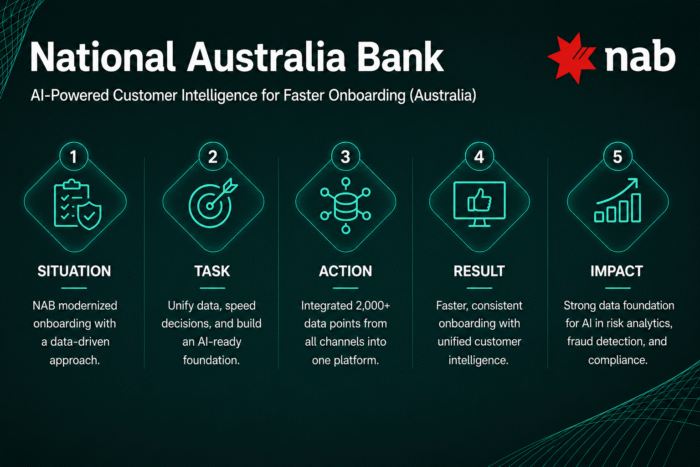
Situation: National Australia Bank (NAB) sought to modernize its customer onboarding experience while improving enterprise-wide decision-making through a more unified and data-driven approach.
Task: The bank aimed to consolidate customer data across multiple channels, accelerate onboarding and decision-making, and establish a scalable foundation for AI-powered risk analytics and compliance.
Action: According to Fujitsu, NAB implemented its Customer Brain platform, integrating more than 2,000 customer data points from digital banking, branch networks, and contact centers into a unified intelligence platform. This enabled AI-driven customer insights, real-time decision-making, and a more seamless onboarding experience.
Result: The initiative delivered a more consistent customer experience, faster and more informed onboarding decisions through unified customer intelligence, and a robust data foundation for expanding AI into areas such as risk analytics, fraud detection, and regulatory compliance.
Turning KYC and Underwriting Into a Straight-Through Process
Another high-value application of agentic AI in banking is KYC onboarding and credit decisioning. Instead of moving documents manually between disconnected systems, agentic AI in banking orchestrates identity verification, AML screening, internal policy checks, and underwriting workflows end-to-end. McKinsey identifies financial crime compliance as one of the highest-potential use cases for agentic AI because traditional KYC/AML investment has continued to rise without a corresponding improvement in detection. Citing Interpol, the firm notes that the financial industry still detects only about 2% of global financial crime flows, despite KYC/AML spending increasing by up to 10% annually in some advanced markets between 2015 and 2022.
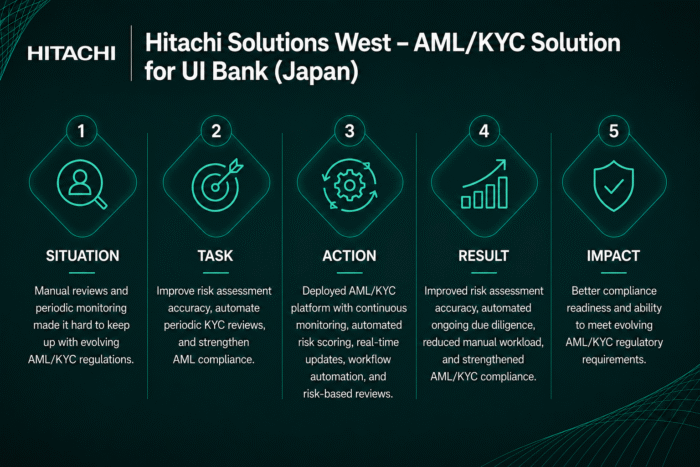
Relevant case study: UI Bank – Modernizing KYC Through Continuous Risk Monitoring (Japan)
Situation: Hitachi Solutions West implemented an AML/KYC solution for several Japanese financial institutions, including UI Bank. The bank’s ongoing customer due diligence process relied heavily on manual reviews and periodic monitoring, making it increasingly difficult to keep pace with evolving regulatory requirements.
Task: UI Bank aimed to improve the accuracy of customer risk assessments, automate periodic KYC reviews, and strengthen compliance with Japan’s increasingly stringent AML regulations.
Action: Hitachi Solutions West deployed an AML/KYC platform featuring continuous customer monitoring, automated risk scoring, real-time customer information updates, workflow automation across the KYC lifecycle, and risk-based review scheduling instead of fixed periodic reviews.
Result: The solution improved the accuracy of customer risk assessments, significantly automated ongoing customer due diligence, reduced manual workloads for compliance teams, and enhanced the bank’s ability to meet evolving AML and KYC regulatory requirements.
3. Why the Engineering, Not the Model, Determines Whether Agentic AI Works
Nearly every large bank now has access to comparable frontier AI models. What separates institutions that scale agentic AI from those stuck in permanent pilot is the engineering layer around the model: how it connects to core banking platforms, how it is monitored, and how cleanly it fits into the workflows compliance, risk, and servicing teams already use.
This is where GEM Corporation positions itself deliberately as the engineering partner for agentic AI in banking, rather than a model vendor. Banks do not need another standalone AI tool; they need an engineering team that can:
- Embed agentic workflows directly into core banking, CRM, and case-management systems, rather than shipping a separate interface staff have to learn.
- Apply document AI and computer vision to KYC documents, ID verification, and statement processing, turning unstructured intake into structured, auditable data agents can act on.
- Use natural language processing and conversational AI to route customer inquiries, disputes, and servicing requests to the right resolution path, whether that is full automation or a human handoff.
- Orchestrate agent workflows through hyperautomation and low-code/no-code tooling, so compliance and risk teams can adjust rules and thresholds without waiting on a lengthy engineering backlog.
- Build the automation layer on ServiceNow-style workflow platforms for banks that run case management and IT service operations through that ecosystem.
In GEM’s own delivery work, this engineering-first approach has translated into 50% lower operating costs, 40% faster implementation timelines, and 2.5× productivity gains for enterprise clients moving from manual or semi-automated processes to agentic workflows – the same kinds of improvements banks are now pursuing in fraud detection, AML compliance, and customer onboarding. These figures represent the average outcomes achieved across GEM’s banking transformation projects.
To explore real-world implementations and business results, see: Every GEM AI-Powered Banking Case Study
4. Governance Is the Precondition, Not an Afterthought
Because agentic AI in banking acts rather than merely recommends, the governance bar is higher than it was for earlier generations of AI tools. Regulatory expectations are rising just as quickly as the technology itself. Most obligations for high-risk AI systems under the EU AI Act begin to apply on 2 August 2026, while the Colorado AI Act took effect on 30 June 2026, introducing governance and transparency requirements for high-risk AI systems. In the financial sector, FINRA’s 2026 Annual Regulatory Oversight Report similarly emphasizes that firms should be able to explain where AI is used, validate and test model outputs, and maintain appropriate monitoring and supervisory controls
A defensible agentic AI program in banking rests on three engineering commitments that have to be designed in from the start, not added after a pilot succeeds:
- Auditability: every agent decision and the data behind it must be traceable, not just the final output.
- Real-time monitoring: visibility into whether an agent is operating inside its intended scope, with the ability to intervene the moment it isn’t.
- Risk-proportional oversight: heavier human checkpoints on credit and AML decisions than on lower-stakes servicing tasks, rather than one governance model applied uniformly.
This is also why GEM treats agentic AI delivery for banking clients as an engineering discipline rather than a proof-of-concept exercise: the architecture that makes an agent auditable and explainable has to be built at the same time as the workflow that makes it useful, not retrofitted once a regulator asks for evidence.
Discover clear guidance on: Building a Responsible AI Governance Framework for Enterprises
5. Getting From Pilot to Production: Where Banking Leaders Should Start
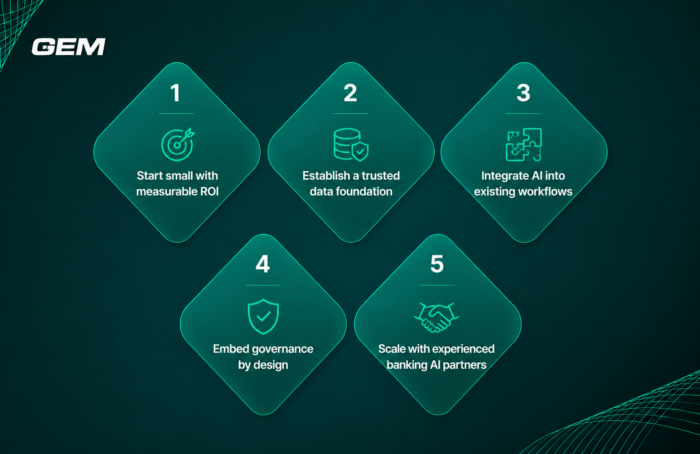
Institutions that move agentic AI in banking past the pilot stage tend to follow the same sequence, regardless of which use case they start with:
- Pick one measurable, well-bounded workflow – AML alert triage or KYC onboarding are common starting points because the ROI is easy to quantify.
- Get the underlying data clean and consistently structured before scaling the agent to a second workflow.
- Embed the agent inside the system compliance, risk, or servicing teams already use daily – a new login is where adoption quietly fails.
- Build auditability and monitoring into the architecture from day one, so scaling to higher-stakes workflows like credit decisioning doesn’t require rework.
- Bring in an engineering partner who has done this inside regulated financial workflows before, rather than treating the agent as a generic AI project.
The question for banking and financial services leaders in 2026 is no longer whether agentic AI works – the adoption data already answers that. The real question is whether the engineering, data, and governance foundations exist to scale it safely, and who is building them.
GEM Corporation – Your Trusted Agentic Engineering Partner

GEM Corporation is a Vietnam-based AI engineering partner with a proven track record delivering scalable, outcome-focused agentic AI and automation implementations across diverse industries, including banking and financial services. Since 2014, we’ve supported enterprises in Japan, APAC, and Europe with high-performance technology solutions built for long-term value.
Our AI engineering practice is purpose-built for agentic AI in banking, helping financial institutions deploy secure, governed, and scalable AI agents across AML, KYC, lending, fraud detection, and customer servicing. With over 400 IT professionals, including certified AI, automation, and ServiceNow specialists, we help financial institutions move from manual, siloed compliance and servicing workflows to structured, auditable agentic operations. Whether the goal is to accelerate AML investigations, streamline KYC onboarding, or improve customer servicing, we bring the technical depth and delivery discipline to support it end-to-end.
GEM’s capabilities for banking and financial services span end-to-end agentic AI delivery, including workflow design, platform integration, and governance-driven rollout. We build document AI and computer vision pipelines for KYC and identity verification, NLP and conversational AI for customer servicing, and hyperautomation and low-code orchestration so compliance and risk teams can adapt agent logic without waiting on an engineering backlog.
As an ISO/IEC 27001:2022, ISO 9001:2015, and CMMI Level 3 certified organisation, and an ISTQB Gold Partner, we approach agentic AI in banking projects with enterprise-grade process control and a commitment to measurable outcomes – 50% lower operating costs, 40% faster implementation timelines, and 2.5× productivity gains for enterprise clients moving from manual or semi-automated processes to agentic workflows.
Our clients value us not just for the technical build, but for the way we drive clarity, adoption, and long-term platform sustainability.
Where is agentic AI already delivering measurable results in financial services?
The clearest results so far are in AML and fraud investigation, where agentic AI compresses case review from days to minutes and cuts false positives, and in KYC/onboarding, where agents pre-screen and prepare files before a human underwriter is involved.
Why does agentic AI in banking need to be engineered, not just deployed off the shelf?
Because banking agents act on regulated processes with real financial and compliance consequences, they need to be embedded into core banking, KYC, and case-management systems, monitored in real time, and built with auditability from the start - work that requires dedicated AI engineering, not a generic chatbot integration.
What role does GEM Corporation play in agentic AI adoption for banks?
GEM Corporation acts as the AI engineering partner that builds and integrates agentic workflows into a bank's existing systems - combining document AI, computer vision, NLP, hyperautomation, and low-code orchestration so agents fit into how compliance, risk, and servicing teams already work.
How should a bank choose its first agentic AI use case?
Start with a single, well-bounded, measurable workflow - AML alert triage and KYC onboarding are the most common starting points - build on clean data, embed the agent into existing systems, and prove auditable results before expanding to higher-stakes workflows like credit decisioning.