
Why Application Managed Services by GEM Outperforms Reactive Application Support
Most applications get support only after something breaks. Managed services means the application is watched, maintained, and improved continuously – so issues are caught before users notice, and support has clear, measurable accountability.
Reactive application support
Issues are found when users report them, not before
Support is reactive, ticket-driven, with no proactive monitoring
Knowledge of the application lives with a few individuals, creating key-person risk
Enhancements queue up indefinitely with no clear prioritization
Service levels are informal, with no measurable accountability

Application Managed Services by GEM
Proactive monitoring detects issues before users notice them
A defined SLA governs response and resolution times for every severity level
Documented knowledge and cross-trained teams reduce key-person risk
Enhancements are planned and prioritized as part of ongoing service, not an afterthought
Service levels are measured and reported transparently, with clear accountability
Enterprise Use Cases for AI-Accelerated Modernization
GEM’s application modernization services deliver measurable outcomes that help businesses transform legacy systems into agile, high-performing applications.
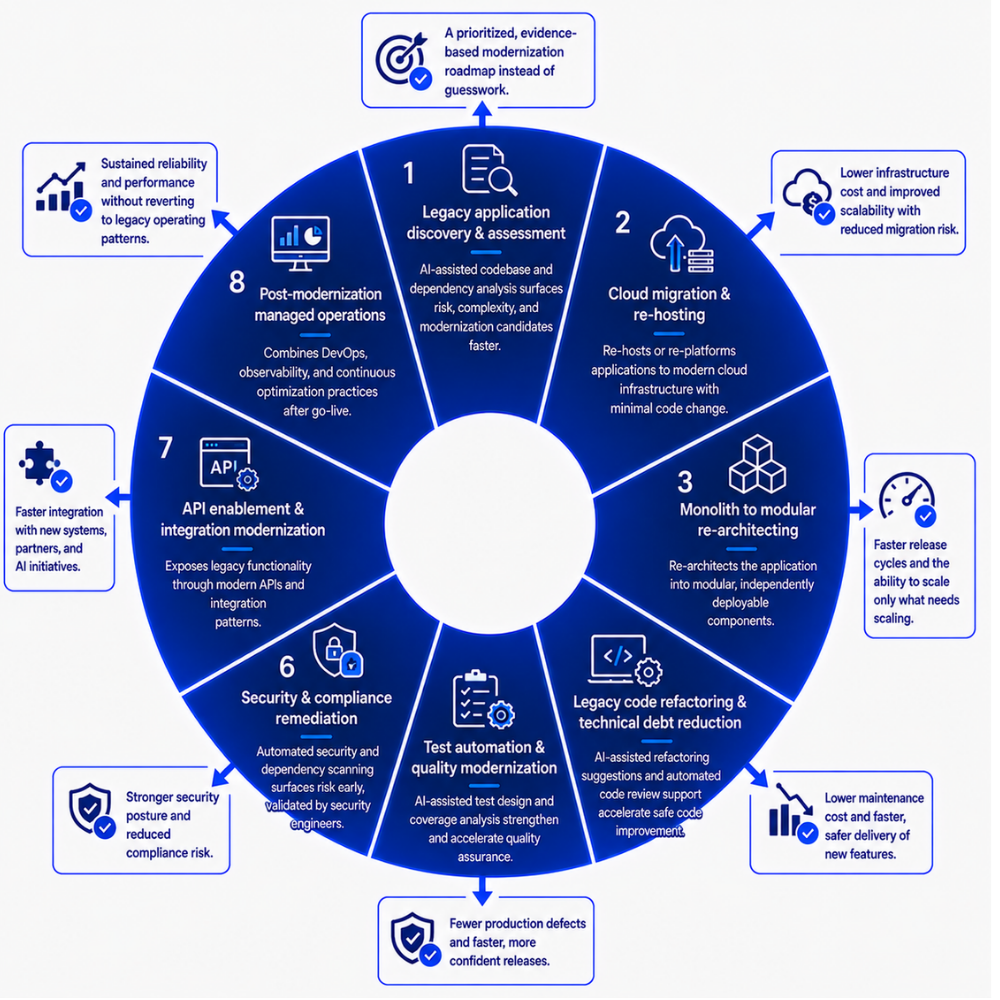
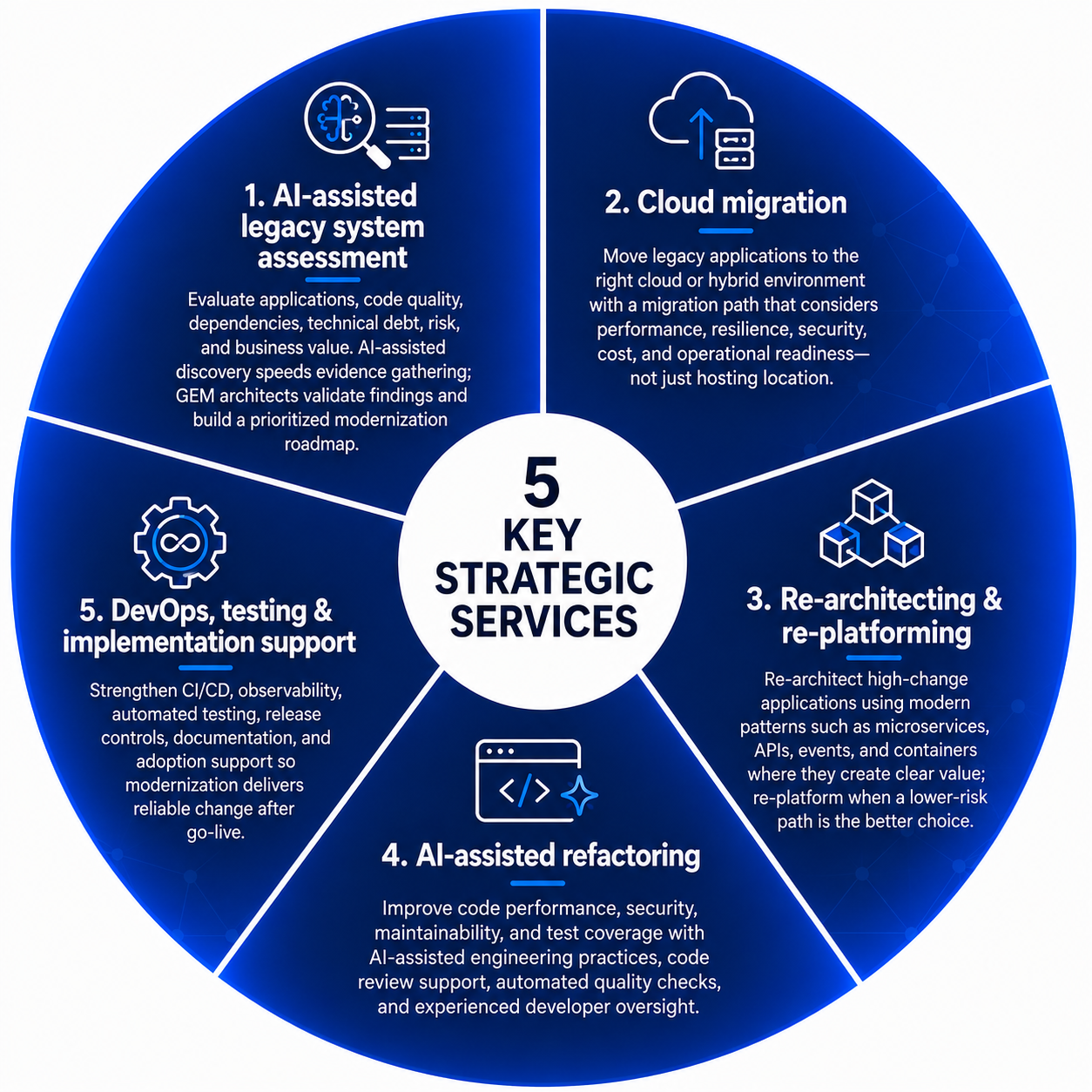
What We Modernize
GEM evaluates every application against seven modernization paths and recommends the least-disruptive option that meets your required outcome.
How GEM Delivers
Step 1: Transition & Assess
Assess the application, document architecture and dependencies, and define SLA tiers and support scope.
Step 2: Stabilize & Operate
Establish monitoring, incident response, and ticketing; operate the application against agreed SLAs.
Step 3: Optimize & Improve
Analyze recurring issues and performance trends, and deliver prioritized enhancements over time.
Expected Business Outcomes
Every AI-Accelerated Modernization engagement begins with an Assess & Prioritize phase. GEM baselines the current estate, defines measurable modernization KPIs, and builds the business case before implementation begins.

Reduced downtime and faster incident resolution
Proactive monitoring and defined response processes catch and resolve issues faster.

Predictable, accountable service levels
Clear SLAs mean support quality is measured, not assumed.

Lower total cost of application support
A managed model is typically more cost-efficient than ad hoc, reactive support.
Reduced security and compliance risk
Managed patching and vulnerability remediation keep applications current.

Reduced key-person dependency
Documented knowledge and cross-trained teams mean support doesn’t depend on one person.

Continuous improvement, not just maintenance
Enhancements are planned and delivered as part of ongoing service.
Why Choose GEM?


FAQs About Our Application Managed Services
1. What is included in application managed services?
Application managed services typically include proactive monitoring, incident response, security patching, performance optimization, helpdesk support, and ongoing minor enhancements – all governed by defined SLAs.
2. How is this different from application development or modernization?
Application development and modernization are project-based – building or transforming an application over a defined period. Application managed services is the ongoing operation and support that follows, keeping the application running reliably and improving it over time.
3. What SLA levels does GEM offer, and how are they defined?
SLA tiers are defined by issue severity – for example, critical outages get the fastest response and resolution commitments, while minor issues follow a longer but still defined timeline. Specific SLAs are agreed based on your application’s business criticality.
4. How do you handle security patching and vulnerability management?
Patching follows a managed cadence aligned to risk severity, with practices informed by standards such as ISO/IEC 27001, so known vulnerabilities are addressed on a predictable schedule rather than left indefinitely.
5. What happens during the transition to a managed services model?
GEM assesses the application, documents its architecture and dependencies, and agrees on SLA tiers and support scope before ongoing support formally begins, to avoid gaps in coverage.
6. Can managed services cover a portfolio of multiple applications?
Yes. GEM can support a portfolio of applications under a unified managed services model, providing consistent service quality across different technologies and business units.
7. How is ROI measured for a managed services engagement?
GEM defines KPIs during Transition & Assess, such as uptime, mean time to resolution, and ticket backlog, and measures results against a pre-agreed service baseline.
8. How is service performance reported?
Service metrics – such as uptime, response times, and ticket resolution – are reported on an agreed cadence, giving full visibility into support quality over time.
9. How does the engagement scale as the application portfolio grows?
Additional applications can be brought under the same managed services model incrementally, reusing established monitoring, SLA structures, and support processes.
Related Articles
Discover Other Application Development Services
Tell us what’s holding your business back
Get a free transformation assessment: the right technology opportunities, expected business impact, and a practical roadmap. We reply within 1 business day.