





AI in hospitality has moved from experiment to budget line. A 2026 survey of more than 400 hotel technology decision-makers found that 71% see AI having a significant or transformative impact, and 85% plan to put at least 5% of their IT budget into AI tools this year. Agentic AI, meaning software that takes actions instead of only answering questions, is following the same path. A recent Phocuswright’s research shows that more than 60% of travel businesses are experimenting with it or scaling it. Yet only 6% are scaling it across multiple functions.
That gap is the real story of AI in hospitality. The money and the intent are there. What is missing is the groundwork: connected systems, reliable guest data, people who keep the tools running, and clear rules for what AI may do on its own. This guide starts with where AI in hospitality stands today and where it already pays off. It then looks at the four reasons most projects stall, what the operators that get past them do differently, and a five-step roadmap to move from pilot to production.
What Is the State of AI in Hospitality in 2026?
To see why that gap matters, start with how far the industry has actually come. Most hotel companies have started with AI in hospitality workflows. Few have scaled them. The figures below show how much of the activity is still early-stage.
| Metric | Finding | Source |
| Hotel tech buyers who see AI as significant or transformative | 71% | Canary Technologies, 2026 |
| Expect to spend at least 5% of IT budget on AI tools this year | 85% | |
| Plan to expand their use of AI in 2026 | 82% | |
| Travel businesses experimenting with or scaling agentic AI | More than 60% | Phocuswright, 2026 |
| Travel businesses actively scaling agentic AI | 6% (plus 22% beginning to scale) |
Read together, the numbers describe an industry that has decided AI matters but has not yet built what it needs to run AI at scale. That does not mean the early work has been wasted. In specific, narrow tasks, AI is already earning its place.
Where AI in Hospitality Already Pays Off
The early gains are practical. In the Canary survey, hoteliers using AI most often report saved staff time, higher guest satisfaction, automated workflows and more revenue. The working use cases for AI in hospitality fall into four areas:
- Guest messaging. AI answers repetitive questions by chat and text, handles pre-arrival requests, and passes anything unusual to staff.
- Pricing and revenue. Models forecast demand and adjust rates faster than a revenue team can by hand.
- Staff scheduling. Tools match rosters to expected occupancy, which cuts overtime and idle hours.
- Operations and maintenance. Housekeeping sequencing, early warnings on HVAC and equipment, and smart building controls reduce downtime and energy waste.
These wins share one trait: each works inside one system, on one set of data. That is why they were easy to start. It is also why they are hard to extend. The moment an AI has to act across systems, or across more than one hotel, it runs into problems the pilot never had to face.
Related reading: 4 Powerful Reasons Agentic AI Is Becoming the Next Enterprise Growth Engine in 2026

4 Common Reasons AI in Hospitality Stalls Between Pilot and Production
Those problems are easiest to see by comparing the two settings. A pilot runs at one hotel, on a clean data extract, with a team that wants it to work. Production runs across the portfolio, on live bookings, duplicate guest profiles and a dozen systems that were never built to talk to each other. Four problems show up again and again in AI in hospitality projects, and the first sits in the systems themselves.
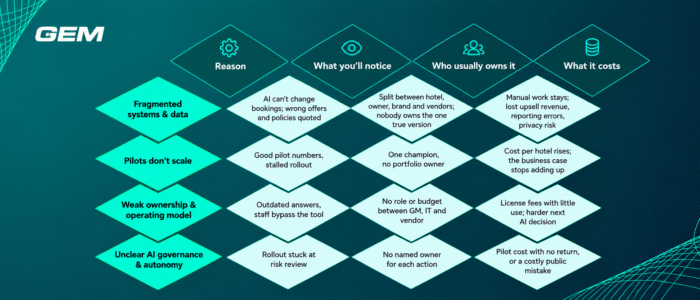
1. Fragmented systems & data
What you’ll see. Each hotel runs its own set of tools: the PMS (Property Management System), a channel manager for the OTAs (Online Travel Agency), a booking engine, revenue management, a CRM (Customer Relationship Management) platform, restaurant and spa POS (Point of Sale), and payments. Research published in 2026 by RMS and RoomPriceGenie found some operators run 10 or more systems at once. In a management company, the mix often changes from hotel to hotel, depending on what each owner bought or each brand requires.
The number of systems is not the real problem. The same research found hotels with only one to three systems still see wrong rates, missing data and failed updates between systems. The weak link is the connection, not the tool.
Where it gets stuck. The AI can see a booking but can’t change it. A guest asks to stay one more night. The AI checks availability, but it cannot update the bill in the PMS. So it either passes the request to the front desk, which saves no time, or confirms a night the PMS doesn’t know about.
Who owns it. It is difficult to see, because often, nobody owns the connection end-to-end. 25% of respondents said they have no dedicated resource overseeing system connectivity.
What it costs you. Your staff already pay for this. In the RMS and RoomPriceGenie research, 42% of hospitality professionals/operators spend one to three hours a week fixing system and data problems, and one in five spend four hours or more. Put AI on top of broken connections and every exception still lands on a person. When integrations remain fragmented, the efficiency gained from an AI pilot can be difficult to reproduce consistently across a larger portfolio.
2. Pilots don’t scale
What you’ll see. The same guest can appear multiple times across your systems. An OTA booking arrives with a masked email address, so you can’t match it to the guest’s history. Room preferences sit in one system while other guest information lives somewhere else. For example, your cancellation policy might say one thing on your website and another on an OTA listing.
Hotel teams know this. In the RMS and RoomPriceGenie research, nearly 70% of operators rated their own data accuracy at two or three out of five, and almost 20% gave the lowest score. In a June 2026 interview on Hospitality Net, a Shiji executive said any hotel claiming not to have duplicate profiles is being unrealistic.
Where it gets stuck. A person at the front desk can spot a bad record and work around it. An AI system depends on the data it can access. If the underlying record is wrong, the AI can act on the wrong information just as efficiently as it acts on the right one.
Who owns it. Guest data crosses teams – from front desk and marketing to revenue and distribution. But who owns the data layer connecting them? In the RMS and RoomPriceGenie research, one in four operators said they have no dedicated resource responsible for system connectivity
What it costs you. For example, an AI could offer a “welcome back” upgrade to a first-time guest because duplicate profiles make the guest appear to have stayed before. Or it could quote the wrong cancellation terms, creating a guest dispute that staff then have to resolve manually. If a guest opts out of marketing on one profile but remains active on duplicate profiles, the hotel may inadvertently continue sending communications, creating a potential privacy compliance risk.
Clean data does not stay clean on its own, and neither does the AI that reads it. Both need someone to look after them, which leads to the third problem.
3. Weak ownership & operating model
What you’ll see. In the RMS and RoomPriceGenie research, nearly 70% of operators said running a hotel now takes both service skills and technical skills, yet 25% have nobody responsible for keeping their systems connected. The report calls the missing person a “hospitality engineer”. The Canary survey, as reported by Hotel Dive, also lists limited training time and lack of technical expertise among the top barriers to AI adoption.
Where it gets stuck. The problem often starts after launch. During a pilot, the vendor team and an engaged manager may keep the tool on track. Once that support fades, who updates the AI when pool hours or pet policies change?
Who owns it. The GM owns the guest experience. IT – whether an internal team, corporate function or external provider – manages the technology. The vendor owns the product. But the job of connecting the three often has no dedicated owner. In the RMS and RoomPriceGenie research, one in four properties have no dedicated resource overseeing system connectivity.
What it costs you. Without ongoing ownership, even a useful AI tool can start returning outdated answers. More requests get passed back to staff, and adoption can weaken. The result is familiar: the hotel keeps paying for the tool while more of the work returns to people. The bigger issue is what happens next: when one AI project loses momentum, it can make the next investment harder to justify.
Even a well-connected, well-maintained AI can still stall at the last gate. That gate is permission: deciding how far the AI may go on its own.
4. Unclear AI governance & autonomy
What you’ll see. In a pilot, the AI answers questions. In production, you want it to act: issue a refund, change a rate, cancel a group booking, or adjust loyalty points. Your staff already do these things within clear limits. A front office manager knows what they can approve and when to call someone. The challenge is defining the same boundaries for AI.
Where it gets stuck. Before an AI agent can act autonomously, the organisation has to answer a few simple questions: Can it issue a refund, and up to how much? What requires human approval? Who is accountable when it gets something wrong? If those boundaries are unclear, deployment becomes harder to approve. A management company faces another question: when an AI makes a costly mistake, who bears the operational and financial consequences?
Who owns it. The vendor provides the technology, but the company deploying it still has to govern what the AI tells and does on its behalf. In February 2024, the British Columbia Civil Resolution Tribunal ruled against Air Canada after its website chatbot incorrectly told a passenger he could claim a bereavement discount after travel. Air Canada argued that the chatbot was responsible for its own answers.
The tribunal rejected that argument and held that Air Canada remained responsible for information provided through its website, including the chatbot. The damages were modest – about C$650 for the fare difference, plus interest and fees. The bigger lesson is accountability: when an AI speaks to a customer on your company’s behalf, the consequences do not automatically belong to the AI or its vendor.
What it costs you. Without clear boundaries, deployment can stall because nobody is comfortable giving the AI authority to act. Or the organisation can give it too much autonomy before the controls are ready – and discover the gap through a real customer incident.
The four problems are closely linked. Fragmented systems and data make a pilot harder to repeat. When a pilot cannot be repeated reliably, it becomes harder to justify the ownership and investment needed to scale it. And without clear ownership, nobody is accountable for defining the rules.
What Operators That Scale AI in Hospitality Do Differently
The good news is, none of these four problems is unusual in AI in hospitality, and none is permanent. The operators that get past the pilot do not use a better model. They fix the same four problems, one workflow at a time. In practice, that looks like four habits, each matching one of the reasons above.
- They connect before they automate. Before an AI can change a booking, it needs live access to the PMS, not a nightly export. Phocuswright’s 2026 trends report names clean data governance as one of two immediate priorities for hotels, airlines and travel management companies before they scale autonomous systems. For guest messaging, this means the AI can post a late checkout or an extra night directly to the folio, and staff only see the exceptions.
- They give each piece of data one owner. One team owns the guest profile rules: how duplicates are merged and which record wins. One team owns rates and policies, and every channel reads from that source. For pricing and revenue, this is what lets the AI’s rate suggestions match what the guest actually sees on every channel.
- They treat the AI as a job, not a purchase. Someone is named to review escalated conversations every week, update the AI’s answers when a policy changes, and track a small set of numbers. The gains come from that ongoing tuning. Conduit, a guest messaging vendor, reports that one 35-property manager raised its automation rate from 80% at launch to 96% through continuous optimization. That is a vendor-reported figure, but the pattern is the point: the improvement happened after launch, not at it.
- They write the rules before the risk review. They list what the AI may do alone (answer questions, look up bookings), what it may do up to a set limit (small refunds, late checkouts), and what always goes to a person (group cancellations, rate overrides). Phocuswright’s second priority, custom AI evaluations, is how they test those rules before go-live. When a case needs judgment, the AI hands over with the full conversation and booking details, so the guest never repeats themselves.
A Five-Step Roadmap to Scale AI in Hospitality
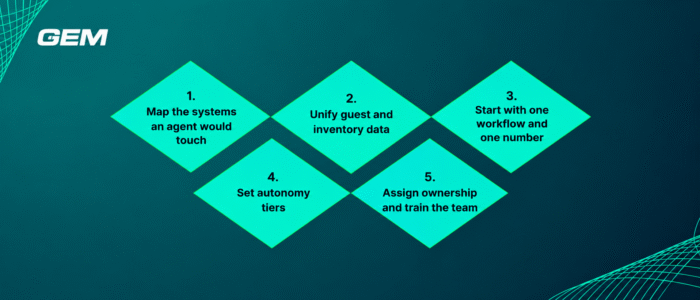
In AI in hospitality, the order of the work matters more than the choice of AI tool. Each step below fixes one of the four problems, and each can be approved on its own, so one weak result does not sink the whole program.
- Map what the AI would touch. List the PMS, booking engine, channel manager, CRM, payments and loyalty systems at each hotel, who owns each one, and how they connect today. Mark every point where a person re-keys data. (Fixes reason 1.)
- Clean up guest and rate data first. Merge duplicate profiles, agree on one source for rates, availability and policies, and name an owner for each. (Fixes reason 2.)
- Start with one workflow and one number. Pick a workflow with a clear owner, such as post-booking requests or group inquiries, and record a starting figure such as cost per request or time to resolve.
- Write the rules for what the AI may do. Decide what it does alone, what it does up to a limit, and what always goes to a person. Build the handover to staff before launch, and keep a log of every action. (Fixes reason 4.)
- Name the owners and train the team. Give each AI workflow a business owner and a technical owner. Train front desk and revenue teams to work with it and to override it. Review the numbers monthly and extend to the next hotel only when the first one holds. (Fixes reason 3.)
This also keeps the budget conversation simple: one workflow, one number, one decision at a time.
Steps 3 to 5 depend mostly on your own teams: the people who know the guest journey and the rules of each hotel. Steps 1 and 2 are different. Mapping and connecting systems across hotels with different owners, brands and vendors is technical work that many management companies do not have in-house, and it is where an implementation partner usually adds the most.
Also Explore: How AI Consulting Services Help Enterprises Avoid 3 Expensive AI Pilot Mistakes
GEM Corporation: Your AI-Native Implementation Partner for Travel and Hospitality
GEM is an AI-native technology partner that builds and connects the systems behind travel and hospitality operations. Our travel and tourism work covers inventory management across flights, hotels, and tours, booking engines, pricing and distribution, agent management, CRM, and integrations with GDS and payment gateways. That connected layer is what AI in hospitality needs before it can act.
GEM works through the roadmap above in three phases:
- Assess: Map systems, data quality and integration gaps across your hotels, and rank AI use cases by value and readiness (roadmap steps 1 and 2).
- Prove one workflow: Build one AI agent or workflow on the connected data, with limits and staff handover defined up front, and measure it against the starting number (steps 3 and 4).
- Extend: Roll out to more workflows and hotels, and remove manual handoffs as they are replaced. Where an old platform blocks progress, GEM modernizes it step by step rather than through a full rebuild (step 5).
Across GEM’s enterprise AI and modernization engagements, clients typically report 20-45% lower costs, 40-70% faster implementation, and two to five times higher productivity in the workflows affected. Delivery is ISO 9001 and ISO 27001 certified and CMMI Level 3, with partner experience in ServiceNow and Databricks, which gives risk and compliance teams the audit trail they expect.
Discover How GEM Is Transforming Tourism & Hospitality with AI: Optimising Workplace Service Delivery for 24,000+ Employees with 40% Faster Onboarding
Conclusion
For AI in hospitality, the question is no longer whether to use it in your hotels. It is whether your systems, data, people and rules let AI keep working after the pilot ends. Scaling AI in hospitality does not mean automating everything. A useful default is to pick one workflow, fix the data and connections under it, write down what the AI may do alone, and name the person who keeps it running. Expand only when that workflow holds its number for a full quarter.
Talk to GEM about an AI readiness assessment for your travel or hospitality business.