
Why Web & Mobile Delivery by GEM Outperforms Fragmented App Delivery
Customers and employees do not experience your business in silos. They move between web, mobile, service channels, data, and back-office systems. GEM helps enterprises design a consistent product experience across those touchpoints – with the architecture, integrations, security, and delivery discipline needed to scale.
Whether you are launching a new digital product, replacing a legacy portal, or extending an existing platform to mobile, we start with the business journey and build the right web, mobile, API, and data foundation around it.

Fragmented app delivery
Separate web and mobile projects
Feature-focused releases
Mobile UI without backend readiness
Build once, then hand over
AI bolted on later


Web & mobile delivery by GEM
One product roadmap across web, mobile, APIs, and shared design system
User journeys tied to adoption, conversion, productivity, and service outcomes
Secure integration with CRM, ERP, payments, identity, and internal systems
Continuous delivery, observability, maintenance, and modernization path
AI-ready data, UX, governance, and integration patterns designed in early
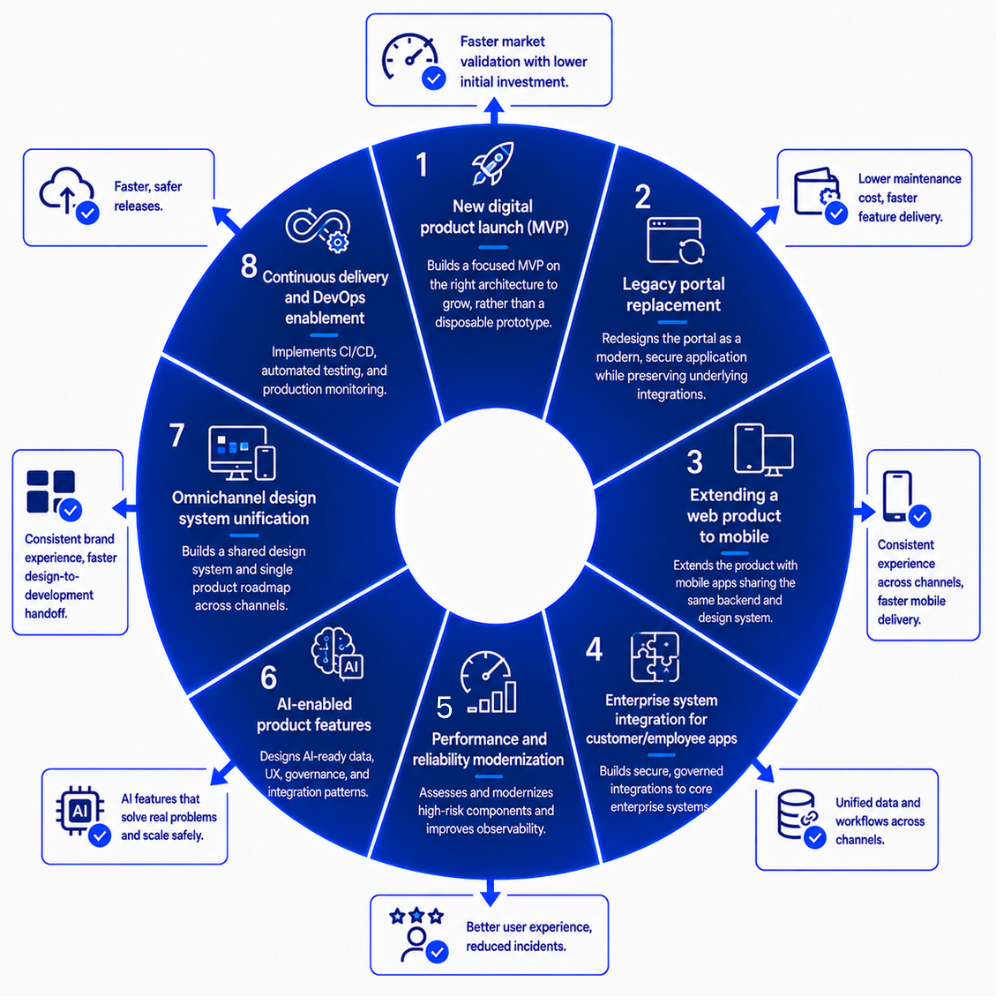
Enterprise Use Cases for Web & Mobile App Development
Explore enterprise web and mobile app use cases that streamline operations, enhance customer experiences, and enable smarter, more connected digital workflows.
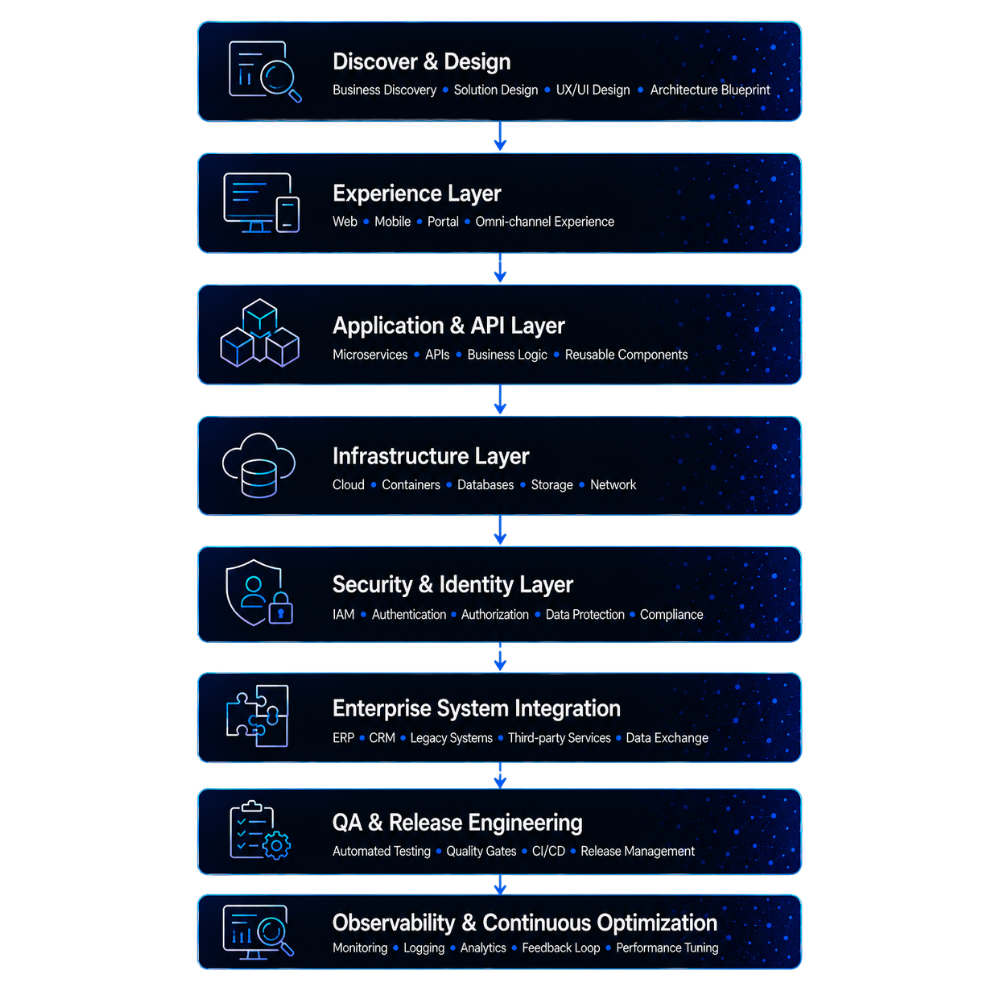
Key Components Of GEM’s Web & Mobile App Development Architecture
With our Web & Mobile App Development services, we help businesses build scalable digital products and modernize application experiences, delivering seamless user experiences and measurable business impact.
How We Deliver
Step 1: Discover & Design
Map the user journey, business priorities, and technical constraints; design the experience, architecture, and integration approach.
Step 2: Build & Integrate
Build the web and mobile application in parallel with the shared backend, APIs, and enterprise system integrations.
Step 3: Test & Launch
Run functional, performance, and security testing across devices and browsers; prepare and execute the release.
Step 4: Operate & Evolve
Monitor performance and usage in production, maintain the application, and plan the next iteration or modernization phase.
Expected Business Outcomes
Every Web & Mobile App Development engagement begins with a Discover & Design phase. GEM maps the user journey and business priorities, and builds a business case before implementation.

Faster time to market
Launch a focused MVP and validate value before investing further.

Higher user adoption and conversion
Design journeys around real user and business outcomes, not just features.

Lower maintenance cost
Build on a shared architecture and design system across web and mobile.
Better reliability and performance
Reduce incidents through testing, observability, and modernization of high-risk components.

Consistent cross-channel experience
Deliver one product experience across web, mobile, and service channels.

AI-ready, scalable foundation
Add AI-enabled features safely as the product and organization grow.
Why Choose GEM?
FAQs About Our Web & Mobile Development Services
1. What do web and mobile development services include?
GEM helps enterprises plan, design, build, integrate, test, launch, and support web and mobile applications. Engagements can include product discovery, UX/UI, front-end and mobile engineering, back-end and APIs, cloud, QA, security, and ongoing optimization.
2. Should we build native or cross-platform mobile apps?
The right choice depends on your user experience, device requirements, performance needs, release plan, and total cost of ownership. GEM evaluates these factors during discovery, weighing native development against cross-platform frameworks such as React Native or Flutter, and recommends an approach that fits the product rather than defaulting to one technology.
3. Can GEM modernize an existing web or mobile application?
Yes. GEM can assess the current application, identify high-risk components, improve UX and performance, expose reusable APIs, and deliver a phased modernization plan that minimizes disruption.
4. Can our application integrate with enterprise systems?
Yes. Web and mobile applications can connect to CRM, ERP, identity, payment, service management, data platforms, and other line-of-business systems through governed APIs and integrations.
5. How do you maintain quality across devices and releases?
GEM combines test strategy, automated functional and E2E checks, browser/device coverage, performance and security testing, code review, CI/CD, and production monitoring according to the application risk.
6. Can AI features be added to a web or mobile product?
Yes, where they solve a real user or operational problem. GEM can design AI-ready journeys, connect approved data sources, add human controls, and measure output quality before scaling.
7. How is ROI measured for a web or mobile app initiative?
GEM defines success metrics during discovery, such as adoption, conversion, cost per transaction, and support ticket reduction, and measures results against a pre-agreed business case.
8. How do you monitor application performance and reliability in production?
Observability and monitoring are established as part of delivery, with performance, errors, and usage tracked continuously after launch.
9. How does the solution scale as the user base or feature scope grows?
The architecture and shared design system are designed to extend to new features, platforms, or user volumes incrementally, without rebuilding the product from scratch.
Related Articles
Discover Other Application Development Services
Tell us what’s holding your business back
Get a free transformation assessment: the right technology opportunities, expected business impact, and a practical roadmap. We reply within 1 business day.