




ServiceNow CSM (Customer Service Management) has become one of the most strategic enterprise platforms for organizations looking to modernize customer service with AI, unified account data, and CMDB-driven automation. Customer service has quietly become a board-level conversation. As B2B relationships grow more complex – multiple products, multiple entitlements, multiple regions – the systems built to support them are struggling to keep pace. Gartner forecasts the CRM Customer Service & Support software market to continue growing at a 13.9% CAGR through 2027-2028, fueled by cloud adoption and GenAI-enabled capabilities. That growth isn’t just software spend. It reflects a broader shift: customer service is being re-architected around unified data, governed accounts, and AI.
For enterprises managing hundreds of B2B accounts, each with its own contacts, products, and support entitlements, ServiceNow Customer Service Management (CSM) has become the platform of choice. This guide breaks down what CSM actually does, what separates a functional deployment from a genuinely transformative one, and how enterprise leaders are approaching implementation in 2026.
The Shift Driving Customer Service Investment in 2026
For years, enterprises bought customer service tooling account by account, region by region, ticketing system by ticketing system. That approach breaks down the moment a business scales past a handful of key accounts. Contacts live in one system, sold products in another, infrastructure data in a third – and every case starts with an agent piecing the story back together before they can even begin solving the actual problem.
AI is accelerating the shift away from that model. Salesforce stated that 66% of customer service organizations have already deployed AI agents, up from 39% the previous year. Agent copilots – surfacing next-best-action, draft replies, and relevant knowledge – are close behind, and adoption is growing fastest inside the workspace itself. Fully autonomous, agentic case resolution is still the newest capability, adopted by roughly a third of organizations today, but expected to more than double in reach by 2028.
The result is a market moving in two directions at once: consolidating fragmented service tools into a single governed platform, and layering AI on top of that platform to close cases faster, with less manual effort.
Why Many ServiceNow CSM Initiatives Fail to Deliver ROI
Despite growing investment in AI-powered customer service, many ServiceNow CSM initiatives fail to achieve the expected business outcomes. The issue is rarely the platform itself. Instead, organizations often introduce AI before establishing the operational foundations that AI depends on.
The most common challenges include:
- Fragmented customer data: Customer profiles, products, contracts, and support history remain spread across CRM, ERP, monitoring tools, and spreadsheets, preventing agents from gaining a complete view of the customer.
- Inconsistent entitlement models: Different business units and regions often define SLAs, priorities, and ownership differently, making automation difficult to standardize.
- Poor CMDB quality: Duplicate or outdated configuration items reduce the accuracy of AI recommendations and make automated routing unreliable.
- Unstructured support processes: If every team handles incidents differently, AI simply automates inconsistent practices rather than improving them.
Organizations that focus on governance first typically realize business value much faster than those that deploy AI capabilities before standardizing their data and operating model.
What a Modern ServiceNow CSM Platform Actually Does
Strip away the acronyms, and CSM does one job: it gives every account a single, living profile – its people, its products, and its history – and puts that profile in front of an agent the moment a case opens.
The Non-Negotiables
- Unified account and entitlement records: Every customer becomes a single Account, with a primary owner, an account team, an SLA tier, and every sold product and entitlement linked and enforceable.
- CMDB-linked case context: Cases connect straight to the infrastructure or service behind them, so agents can trace a single click from what was sold to what’s actually running – no tab-switching, no guessing.
- Automated case intake and routing: Whether a request comes through the portal, an inbound email, or a security alert, the platform knows what to create and where to route it, without a human triaging every ticket by hand.
- Entitlement-driven SLA enforcement: Response and resolution times are honored automatically, based on what was actually sold, not what a spreadsheet says should happen.
What Separates Leading Implementations
- AI case summarization and copilot: Automated summaries and handoff notes cut ramp-up time on reassigned or escalated cases; next-best-action suggestions keep resolution consistent even for new agents.
- Predictive, proactive service: Alerts from monitoring and CMDB data let a case open, or an issue resolve before the customer ever notices impact.
- Agentic, autonomous resolution: For low- and medium-complexity cases, AI can investigate, resolve, and close within policy guardrails, freeing human agents for complex, high-touch work.
- Portfolio-wide analytics: SLA compliance, agent load, and account health become visible on demand, per account, per agent, or across the entire book of business.
How ServiceNow CSM Fits into the Enterprise Architecture
For many organizations, customer service data is distributed across multiple enterprise systems. A modern ServiceNow CSM implementation acts as the orchestration layer that connects these systems into a unified service experience.
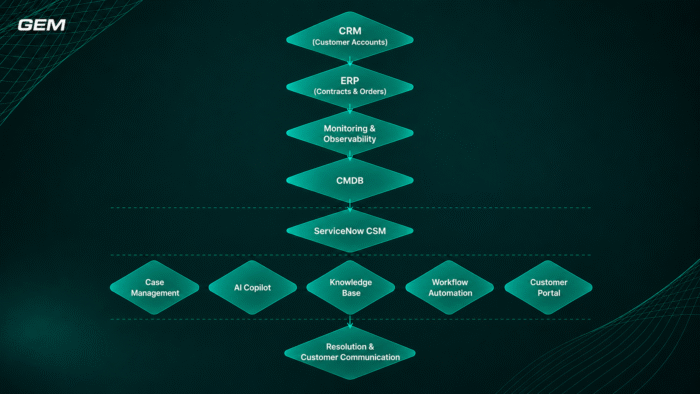
Instead of replacing existing enterprise systems, ServiceNow CSM orchestrates information across them, ensuring agents always work with trusted and contextual customer data.
The Three Case Types Every ServiceNow CSM Deployment Should Support
Not every request is the same, and treating them identically is how SLAs quietly get missed. Enterprise-grade CSM deployments typically recognize three distinct case types, each with its own path from “something’s wrong” to “it’s resolved.”
| Criteria | Managed Service Desk Case | Basic Case | Security Case |
| Handles | Service disruption | Service request | Security incident |
| Triggered by | Customer or agent | Customer (self-service portal) | System (automated alert) |
| Linked record | Incident | Request / Catalog Task | Security Incident Response |
| Customer approval | Required before closure | Optional, configurable | Not applicable |
| SLA basis | Priority + entitlement | Catalog item SLA | Alert severity |
| Escalation path | Service manager | Fulfillment team | SOC / CISO |
For most enterprises, service requests make up the largest share of monthly case volume, followed by incidents, with security cases a smaller but higher-stakes minority. The split matters less than the discipline behind it: each type needs its own SLA logic, its own escalation path, and its own definition of “done.”
The Business Case: What AI-Enabled ServiceNow CSM Delivers
For a CIO or COO evaluating the investment, the numbers that matter aren’t feature counts, they’re time and consistency.
Organizations implementing AI in customer service consistently report shorter resolution times, higher first-contact resolution, and improved customer satisfaction. Freshworks found that businesses using AI Copilot reduced resolution time by 38.7%, while automation users achieved a 42.4% improvement in CSAT. Intercom also reports that its AI agent resolves an average of 51% of support conversations autonomously, with some customers reaching 86% resolution rates.
None of these gains come from AI alone. They depend on the unglamorous work underneath it: a governed CMDB, a clean account model, and case types mapped to how support actually happens. AI accelerates a well-structured platform; it doesn’t fix a fragmented one.
KPIs That Matter After a ServiceNow CSM Deployment
Successful organizations evaluate ServiceNow CSM using operational outcomes rather than feature adoption.
Common KPIs include:
| KPI | Why It Matters |
|---|---|
| Mean Time to Resolution (MTTR) | Measures operational efficiency |
| First Contact Resolution (FCR) | Indicates service quality |
| SLA Compliance | Reflects contractual performance |
| Customer Satisfaction (CSAT) | Measures customer experience |
| AI Resolution Rate | Tracks autonomous case handling |
| Agent Productivity | Measures workload optimization |
| Knowledge Reuse Rate | Indicates maturity of knowledge management |
Rather than pursuing AI adoption as a standalone objective, leading enterprises focus on measurable improvements in customer outcomes, operational efficiency, and service consistency.
How to Roll Out ServiceNow CSM Across a Multi-Account Enterprise
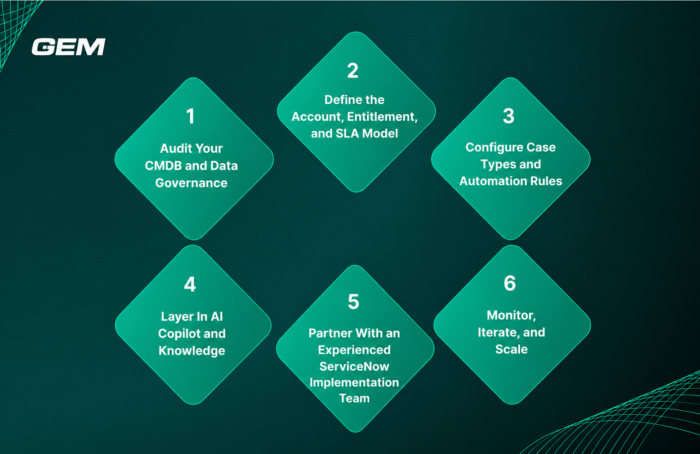
Standing up CSM well is less about the platform and more about the sequencing. Enterprises that get the most value tend to follow a similar path:
Step 1: Audit Your CMDB and Data Governance
Before configuring anything, assess how clean, and how trusted, your existing asset and configuration data really is. Duplicate records and unclear ownership boundaries will undermine every automation built on top of them.
Step 2: Define the Account, Entitlement, and SLA Model
Decide what an Account captures, who owns it, and what each support tier actually promises. This is the foundation every case, SLA, and escalation path will be built on.
Step 3: Configure Case Types and Automation Rules
Map your real support scenarios – service disruptions, service requests, security incidents – to distinct case types, each with its own routing, approval, and escalation logic.
Step 4: Layer In AI Copilot and Knowledge
Once the structural foundation is governed, introduce case summarization, next-best-action suggestions, and knowledge surfacing. AI adopted too early, on top of ungoverned data, tends to automate the wrong answer faster.
Step 5: Partner With an Experienced ServiceNow Implementation Team
CMDB governance, entitlement modeling, and AI configuration are specialist work. An experienced implementation partner reduces rework and gets you to value faster than a purely internal build.
Step 6: Monitor, Iterate, and Scale
Track SLA compliance, resolution time, and AI-resolution rates from day one. Use that data to expand automation into new case types and accounts on a defined roadmap, rather than all at once.
Enterprise ServiceNow CSM Roadmap
While every organization follows its own transformation journey, successful enterprise deployments generally progress through six stages.
| Phase | Primary Objective |
|---|---|
| Assessment | Evaluate CMDB maturity, customer data quality, and support processes |
| Foundation | Standardize accounts, entitlements, and SLA models |
| Implementation | Configure case types, workflows, and integrations |
| Optimization | Improve automation, reporting, and operational governance |
| AI Enablement | Deploy AI Copilot, summarization, and autonomous workflows |
| Continuous Improvement | Expand AI capabilities using operational metrics and governance reviews |
Organizations that gradually mature these capabilities typically achieve more sustainable business outcomes than those attempting enterprise-wide transformation in a single phase.
ServiceNow CSM vs Traditional Customer Support Platforms
| Traditional Support Platform | ServiceNow CSM |
|---|---|
| Ticket-centric | Account-centric |
| Separate customer and infrastructure data | Unified customer and CMDB context |
| Manual routing | Automated workflow routing |
| Limited AI capabilities | AI Copilot and autonomous case resolution |
| Reactive service | Predictive and proactive service |
| Disconnected reporting | Enterprise-wide operational analytics |
The difference extends beyond technology. ServiceNow CSM enables organizations to manage customer relationships, operational services, and infrastructure dependencies within a single governance framework.
Getting the Most Out of Your ServiceNow CSM Investment
- Align case types to real account complexity: A three-tier case model only pays off if it maps to how your accounts actually generate requests. Don’t force a security-case workflow onto what’s really a service ticket, or vice versa.
- Treat the CMDB as a living asset, not a one-time project: The gains above hinge entirely on CMDB data staying accurate. Without ongoing reconciliation and governance, “one click to context” quietly degrades back into tab-switching.
- Make AI adoption a governance decision, not a feature toggle: Decide deliberately which case types are eligible for autonomous resolution, and under what guardrails, rather than enabling every AI capability by default.
- Design for multi-region compliance from day one: For enterprises operating across the US, Australia, New Zealand, and Singapore, data residency, support-hour entitlements, and escalation ownership often differ by region. Build that into your account and SLA model up front, rather than retrofitting it later.
The Future of ServiceNow CSM
Enterprise customer service is evolving beyond traditional ticket management toward autonomous service operations.
Several trends are expected to shape ServiceNow CSM over the next few years:
- Agentic AI capable of resolving increasingly complex customer requests autonomously
- Predictive service powered by observability platforms and CMDB intelligence
- Unified digital operations connecting IT, Customer Service, Security, and HR workflows
- Continuous workflow optimization driven by AI-generated insights
- Enterprise-wide governance frameworks balancing automation with compliance and human oversight
Rather than replacing service professionals, these capabilities enable support teams to focus on higher-value customer interactions while routine work becomes increasingly automated.
Build Your ServiceNow CSM Workspace with GEM Corporation
GEM Corporation is a global IT services and consulting company serving enterprise clients across Japan, Korea, ANZ, Europe, and the US, with a ServiceNow practice spanning CSM, ITSM, and Security Operations. Our team has helped multinational organizations move from fragmented, tool-by-tool support models to governed, AI-enabled CSM Workspaces, including CMDB integration projects that cut incident MTTR by up to 50%
Discover our client’s success story: ServiceNow SecOps – Reducing MTTR by up to 50% in CrowdStrike Security Operations at Scale
We focus on the layer beneath the AI: clean account and entitlement models, reconciled CMDB data, and case-type design that matches how support actually happens inside a multi-account enterprise, so that when AI is layered on top, it’s automating the right answer, not just a faster wrong one.
Takeaways
CSM is no longer a ticketing system with a new coat of paint. It’s becoming the governed layer connecting account relationships, infrastructure data, and AI-driven resolution. Enterprises that treat the account and CMDB foundation as seriously as the AI layer on top of it are the ones seeing the resolution-time and SLA gains the market is reporting. The platform matters less than the discipline underneath it. A successful ServiceNow CSM implementation depends on governance, CMDB quality, and AI readiness rather than technology alone.
To start scoping your ServiceNow CSM implementation, contact GEM Corporation today.