
Enterprise AI Governance Services
GEM’s Enterprise AI Governance experts equip your teams to adopt AI responsibly with practical training, framework-based governance, and implementation support across your AI initiatives.
Transform your operations and reach new heights with GEM’s assistance in robotic process automation (RPA)
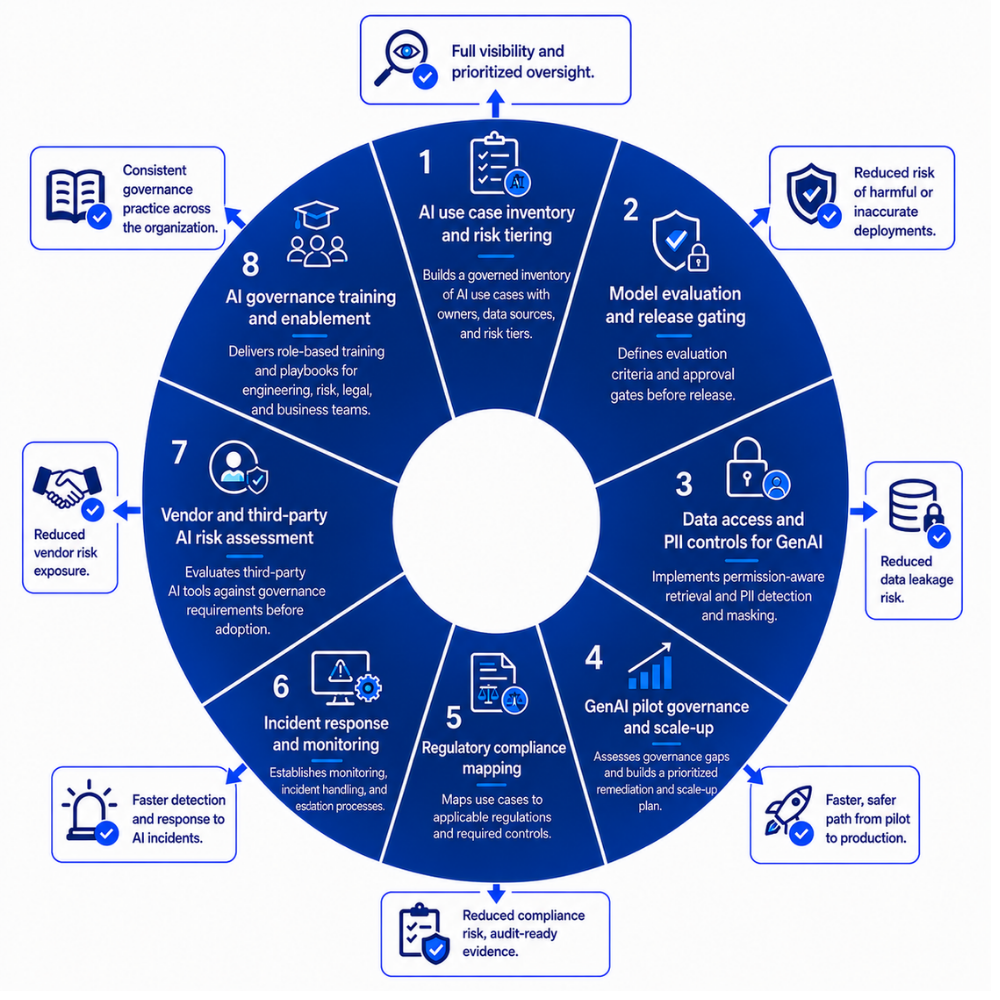
GEM helps organizations turn responsible AI principles into an operating model that engineering, data, risk, security, legal, and business teams can actually use. We combine governance design with implementation across data platforms, AI applications, workflows, and monitoring tools.
Already using AI or GenAI but unsure whether your controls, accountability, and monitoring are ready to scale? We can help assess the gaps and put the right enterprise AI governance practices in place.

A one-time policy or checklist
Unknown or fragmented AI use cases
Controls handled manually at the end
Compliance seen as a blocker
Limited audit evidence


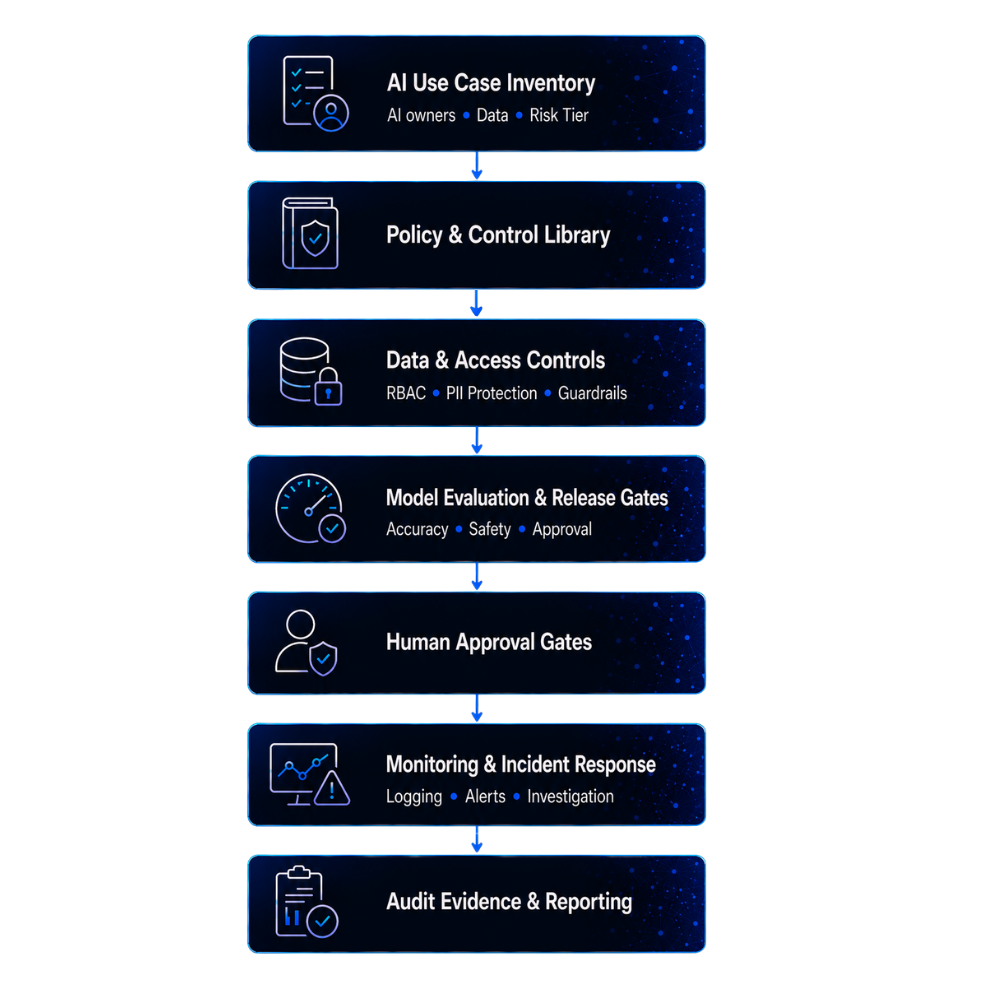
A living operating model connected to AI delivery, approval, and monitoring workflows
An AI inventory with owners, data, risk tiers, and lifecycle status
Controls designed into data access, model evaluation, release, and production operations
Risk-based guardrails that let low-risk use cases move fast while high-impact systems get stronger review
Documented decisions, traceability, monitoring, and evidence that teams can retrieve when needed
We assess your AI landscape, business priorities, data environment, current controls, regulatory context, and highest-risk gaps.
We define a risk-based governance framework, operating model, control library, decision rights, and a roadmap that fits your maturity and industry.
We turn the framework into working processes and technical controls across data, models, applications, integrations, and release workflows.
We help establish monitoring, review cadence, incident handling, metrics, training, and continuous control improvement as AI use expands.
Every Enterprise AI Governance engagement begins with an AI governance and risk assessment. GEM evaluates AI use cases, identifies governance and compliance gaps, defines enterprise policies and controls, and builds a governance framework before implementation.

Move confidently from pilot to production with the right controls in place.

Map AI use cases to applicable regulations and required controls.

Know what AI and GenAI is running across the organization, and who owns it.

Catch and respond to issues earlier through continuous monitoring.

Retrieve documented decisions and traceability when regulators or auditors ask.

Give engineering, risk, security, legal, and business teams a shared operating model.
They help organizations operationalize enterprise AI governance through practical training, framework-based implementation, risk assessments, technical controls, and ongoing monitoring for AI and GenAI initiatives.
No. Every organization using AI benefits from clear ownership, data controls, evaluation, monitoring, and human oversight. Regulated or high-impact use cases typically require more rigorous controls.
Data governance manages the quality, access, lineage, and accountability of data. AI governance adds controls for AI use cases, models, prompts, outputs, decisions, human oversight, and lifecycle risk. They should work together.
Yes. GEM can assess current pilots, identify gaps in data, permissions, evaluation, monitoring, documentation, and ownership, then create a prioritized remediation and scale-up plan.
The right controls vary by use case, but often include permission-aware retrieval, PII detection and masking before prompts are sent to the model, prompt-injection defenses, input/output guardrails aligned to guidance such as the OWASP Top 10 for LLM Applications, evaluation, logging, monitoring, cost controls, incident handling, and approval gates for consequential actions.
Begin with an AI governance assessment that maps your priority use cases, current controls, risk exposure, and target operating model. Then implement the highest-value gaps in phases.
GEM designs governance programs aligned to widely recognized references such as the NIST AI Risk Management Framework and the ISO/IEC 42001 AI management system standard, adapted to your industry, risk profile, and existing governance structures.
GEM defines success metrics during the assessment phase, such as reduced incident rate, faster pilot-to-production time, and audit readiness, and measures results against a pre-agreed roadmap.
Monitoring, review cadence, and incident handling are established during the Operate & Improve phase, with metrics tracked continuously as AI use expands.
Tell us what’s holding your business back
Get a free transformation assessment: the right technology opportunities, expected business impact, and a practical roadmap. We reply within 1 business day.