



This guide compares the leading enterprise low-code, no-code platforms in 2026, including OutSystems, Mendix, ServiceNow, Microsoft Power Platform, Databricks, Appian, and Salesforce. We evaluate each low-code platform based on enterprise readiness, governance capabilities, AI innovation, implementation complexity, and best-fit use cases.
Low-Code, No-Code Is No Longer a Trend
Three years ago, CIOs debated whether low-code, no-code platforms were “real” enterprise technology. That debate is over.
According to Gartner, the low-code, no-code platforms market is projected to hit $44.5 billion in 2026, with 75% of new enterprise applications built on these platforms. Forrester puts enterprise developer adoption at 87%. IDC forecasts a 37.6% CAGR for the broader LCNC and intelligent developer technologies segment through 2028.
For digital transformation leaders across Japan, Korea, Singapore, and Southeast Asia, the implication is direct: if your organisation is running enterprise programs in 2026 without a low-code, no-code platform capability, you are already behind on delivery speed, cost structure, and talent efficiency.
But selecting the right platform is only half the equation. The harder problem, the one that derails more programs than any product decision, is building a delivery team that can actually execute on whichever platform you choose.
Why Enterprises Are Adopting Low-Code, No-Code Platforms in 2026
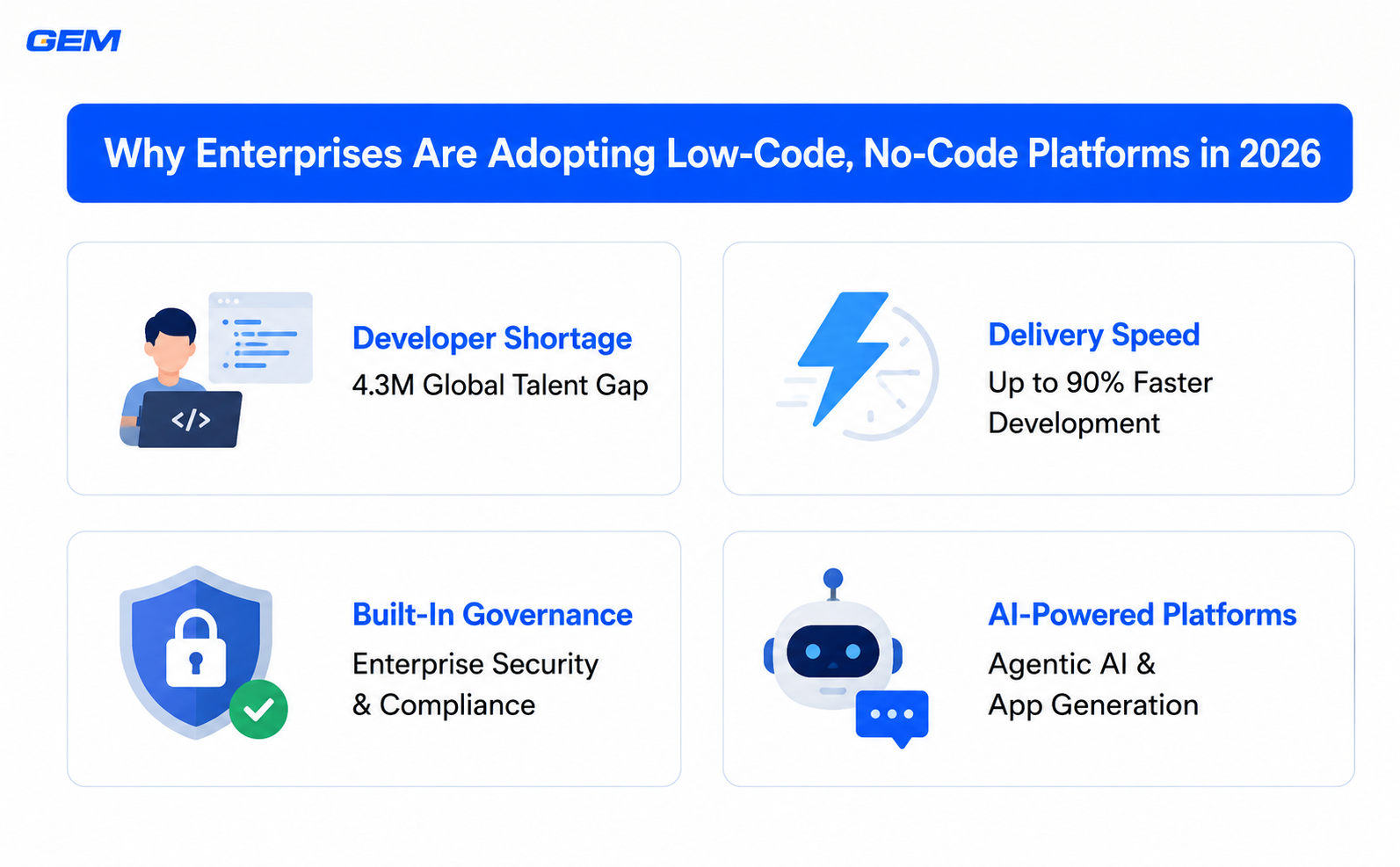
Four structural forces are driving the shift:
1. Developer Shortage Is Structural
McKinsey estimates a global tech talent gap of 4.3 million developers, concentrated most severely in Japan, Germany, and Southeast Asia’s non-metro markets, creating significant delivery constraints for enterprise software initiatives.
Rather than relying solely on traditional hiring, many organisations are turning to low-code, no-code platforms to expand delivery capacity. By enabling business and IT teams to build applications faster with fewer specialised resources, these platforms help reduce dependency on scarce development talent while maintaining project momentum.
2. Delivery Speed Is a Competitive Input
Business priorities now change faster than traditional development cycles can accommodate. Whether launching new customer experiences, automating operations, or responding to regulatory requirements, organisations need the ability to deliver and adapt solutions in weeks rather than months.
Organisations using low-code no-code platforms report up to 90% reduction in development time. The average project completes in 3.2 weeks versus 14.8 weeks for traditional development (Forrester TEI studies). As a result, enterprises can move from idea to deployment faster, allowing technology teams to respond more effectively to evolving business needs.
3. Governance Is Now Built In
One of the earliest concerns about low-code, no-code development was whether speed would come at the expense of security, governance, and compliance. Today, that assumption no longer reflects the reality of enterprise platforms.
Leading low-code, no-code platforms now provide enterprise-grade governance capabilities Enterprise-grade platforms now support SOC 2, GDPR, HIPAA, audit trails, role-based access controls, and full CI/CD pipeline integration. Low-code has moved well beyond departmental experimentation and is increasingly being used to support business-critical enterprise workloads.
4. AI Has Changed What These Platforms Can Do
The latest generation of low-code, no-code platforms is increasingly powered by AI. Capabilities such as natural language application generation, AI-assisted workflow design, automated data mapping, and intelligent recommendations are changing how applications are built and managed.
As these capabilities mature, the conversation is shifting from whether organisations should adopt low-code, no-code platforms to how they can select the right platform, governance model, and delivery approach to maximise business value.
Top 8 Low-Code, No-Code Platforms for Enterprise in 2026
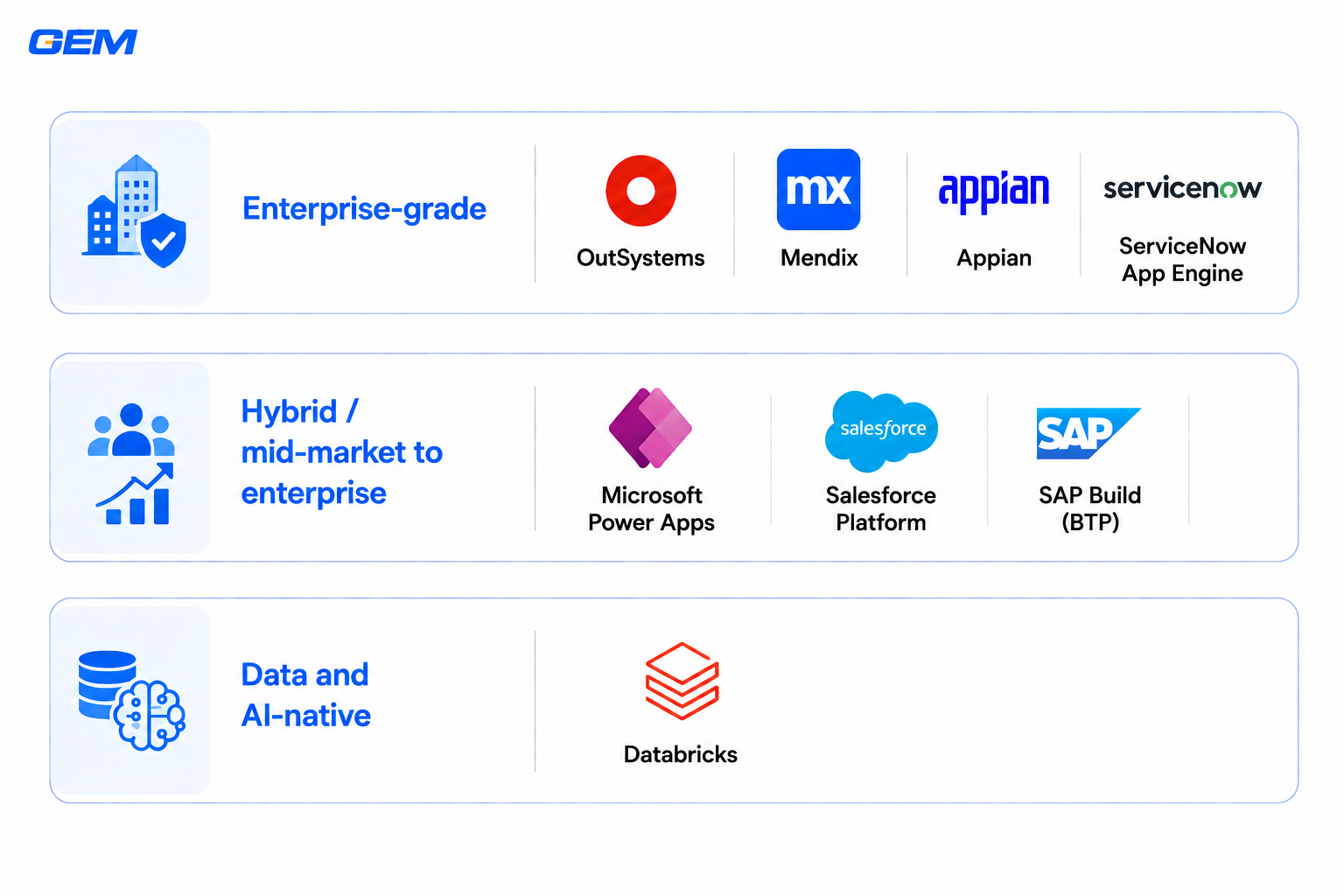
The market has stratified into three tiers:
- Enterprise-grade: OutSystems, Mendix, Appian, ServiceNow
- Hybrid / mid-market to enterprise: Microsoft Power Apps, Salesforce, SAP
- Data and AI-native: Databricks
1. ServiceNow
| Category | Process-centric low-code platform |
| Best for | ITSM-adjacent application development; workflow automation, or regulated industries requiring auditability |
ServiceNow began as an ITSM platform and has evolved into one of the most powerful low-code, no-code environments for organisations building custom applications inside an ITSM context. ServiceNow App Engine includes a broad ecosystem of pre-built integrations, workflow automation capabilities through Flow Designer, process orchestration tools, and AI-powered development features that help accelerate enterprise application delivery.
Its governance and compliance posture is exceptional – purpose-built for financial services, healthcare, and government where auditability is non-negotiable.
Delivery reality: Most valuable to organisations already running the ServiceNow platform. Pricing is enterprise-contract-grade and typically opaque until scoped. Certified ServiceNow developers are among the scarcest and most expensive platform specialists in APAC – demand consistently outpaces supply.
APAC signal: Deep enterprise penetration across large Japanese corporations (financial institutions) and Singapore’s government-linked companies. One of the most frequently encountered platforms in enterprise digital transformation programs across the region.
Discover: ServiceNow Integration – Challenges and Best Practices
2. SAP
| Category | ERP-native low-code, no-code suite (SAP BTP) |
| Best for | SAP S/4HANA and ERP-centric enterprises, workflow automation on SAP BTP, or organisations pursuing the SAP Autonomous Enterprise strategy |
SAP Build is SAP’s unified low-code no-code suite built on the SAP Business Technology Platform (BTP). It brings together three core capabilities under one roof: SAP Build Apps (formerly AppGyver) for drag-and-drop application development across web and mobile, SAP Build Process Automation for workflow orchestration and robotic process automation; and SAP Build Work Zone for creating role-based digital workspaces. In 2026, SAP introduced Joule Studio – an AI-native development environment within SAP Build that allows teams to create AI agents grounded in SAP business context and governed for enterprise scale.
SAP Build provides native OData and REST API integration with SAP systems out of the box. At SAP Sapphire 2026, SAP unveiled the Autonomous Enterprise vision – positioning SAP Build and Joule Studio as the development layer for AI agents that execute core business operations across finance, procurement, HR, and supply chain.
Delivery reality: SAP Build is powerful within the SAP ecosystem but requires certified SAP BTP and SAP Build developers for enterprise-grade deployments – particularly for complex process automation and AI agent configuration in Joule Studio. Organisations running SAP S/4HANA who attempt SAP Build programs without certified delivery expertise consistently report governance gaps, shadow IT proliferation, and costly remediation. Pricing is available through SAP BTP subscription tiers; enterprise programs typically require formal scoping with SAP or an SAP partner.
APAC signal: SAP has deep enterprise penetration across APAC, with recent Q4 2025 wins including Kirin Holdings and Mitsui Sumitomo Insurance in Japan, and KT DS in South Korea. Any organisation in APAC running SAP infrastructure and pursuing digital transformation is a natural SAP Build candidate.
3. Salesforce
| Category | CRM-native low-code platform |
| Best for | Salesforce-standardised organisations, customer-facing process automation, or sales and service workflows |
Salesforce provides low-code capabilities through Lightning App Builder (UI development), Flow (workflow automation), and Einstein AI (intelligent automation and prediction). For enterprises where Salesforce is the system of record for customer data, the platform removes integration friction and accelerates customer-facing application delivery.
Delivery reality: Most valuable inside the Salesforce ecosystem. Certified Salesforce developers are in consistently short supply across APAC markets – demand significantly outpaces available certified talent in Japan and Singapore in particular.
APAC signal: Widespread adoption across banking, insurance, and technology sectors in Singapore and Japan. Salesforce Platform delivery capacity is a persistent bottleneck for digital transformation programs across the region.
Download to read more: Salesforce State of Sales Report 2026 (PDF)
4. OutSystems
| Category | Enterprise low-code application platform |
| Best for | Legacy modernisation at scale, customer-facing apps requiring enterprise SLAs or agentic AI delivery |
OutSystems is the most developer-centric of the enterprise low-code, no-code platforms, providing a full visual IDE (Service Studio), component marketplace (Forge), and deployment flexibility across on-premises, private cloud, and OutSystems Cloud (AWS / Azure / GCP).
In 2026, OutSystems has positioned its low-code, no-code platform a round agentic app development: Mentor for AI-assisted generation, Agent Workbench for managing AI agent lifecycles, and integrated DevSecOps observability. For organisations building traditional applications and AI agents within a single governance framework, OutSystems presents the strongest agentic story in the enterprise segment.
Delivery reality: Steep learning curve; requires certified developers with proprietary runtime knowledge. Implementation timelines exceed vendor estimates when delivery teams are underprepared – making experienced delivery partners essential, not optional.
APAC signal: Active certified partner ecosystems in Japan, Singapore, and Korea. Primary adopters: regulated financial services and government sectors.
5. Mendix
| Category | Enterprise low-code application platform (Siemens) |
| Best for | Fusion teams, manufacturing & industrial digital transformation or SAP / AWS / Snowflake ecosystem |
Mendix, owned by Siemens, is built around fusion development – enabling business analysts, citizen developers, and professional developers to collaborate through two IDEs: Mendix Studio (web-based, business-user-friendly) and Mendix Studio Pro (desktop IDE for developers).
Its AI layer, Maia, supports natural language app generation, guided development, and learning-based recommendations. Strategic partnerships with AWS, Snowflake, and SAP make Mendix the default low-code, no-code platform for organisations deeply embedded in those ecosystems.
Delivery reality: More accessible to non-developers than OutSystems but still requires trained implementers for enterprise-grade deployments. Multi-app enterprise licensing starts at $2,495/month plus $15 per user. Migration off Mendix requires rebuilding, not porting – partner selection matters from day one.
APAC signal: Strong traction in manufacturing and industrial sectors in Japan and Korea, aligned with Siemens’ regional footprint. Growing adoption in Singapore’s smart manufacturing programmes.
6. Microsoft Power Apps
| Category | Mid-market to enterprise low-code platform |
| Best for | Microsoft 365 / Azure-centric organisations, citizen development at scale, or internal tool automation |
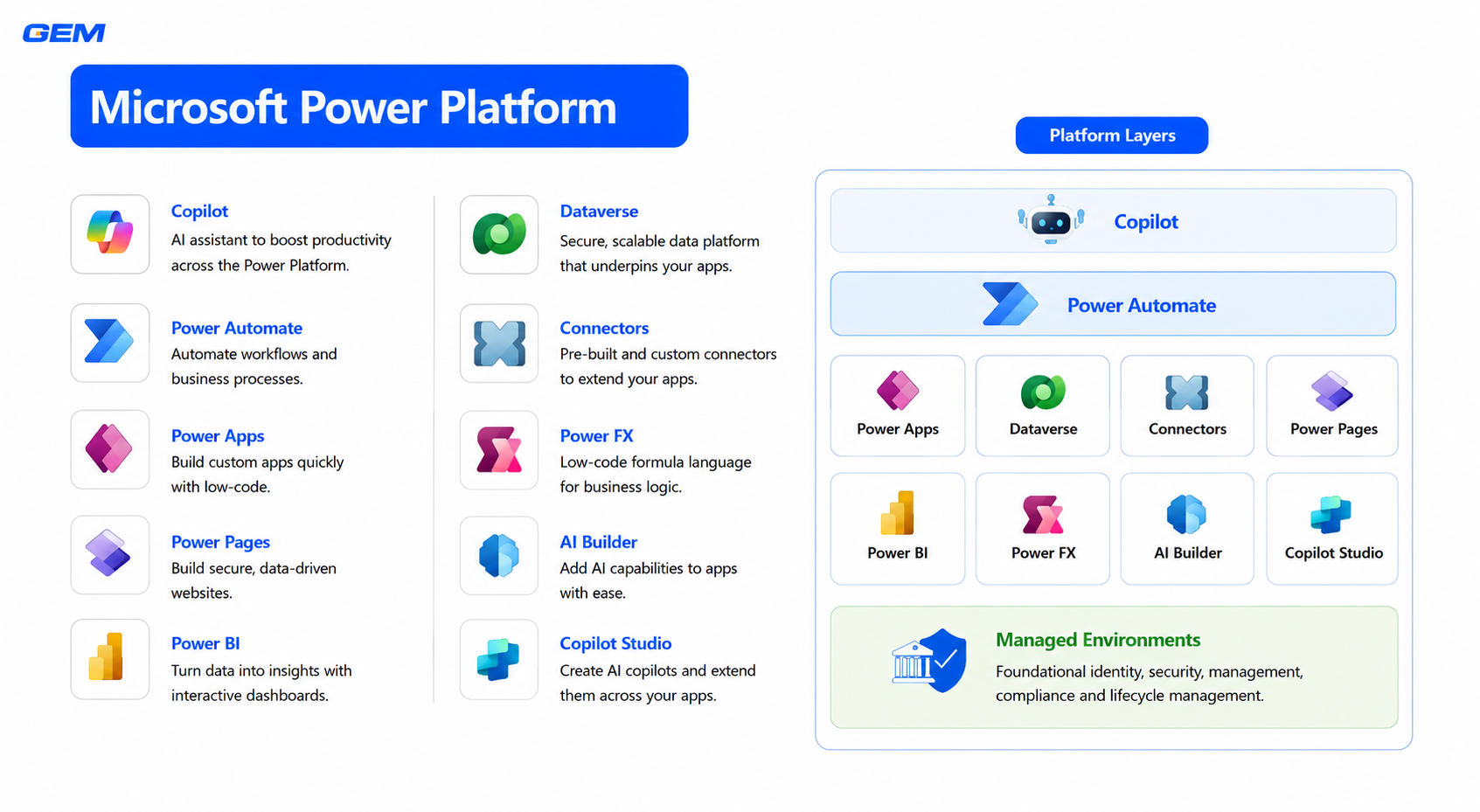
Microsoft Power Apps is the most widely deployed low-code, no-code platform in enterprises globally – primarily because it comes bundled with Microsoft 365 licensing. Paired with Power Automate, Power BI, and Copilot Studio, it forms the Microsoft Power Platform: a comprehensive automation and AI agent development stack.
The 2026 version is materially different from earlier iterations. Copilot integration enables natural language app and workflow generation. For organisations in the Microsoft ecosystem, the Power Platform represents the fastest path to citizen development at scale.
Delivery reality: More accessible but less powerful than OutSystems or Mendix for complex, high-transaction applications. Governance over citizen development programmes requires careful Center of Excellence setup, which requires specialist expertise most internal IT teams do not carry.
APAC signal: Widest penetration of any low-code, no-code platform across all enterprise sizes in Singapore, Korea, and Japan – driven by Microsoft’s installed base. Power Platform expertise is the highest-volume platform skill request from APAC delivery programs.
7. Databricks
| Category | Data & AI Platform with low-code delivery capabilities |
| Best for | AI-ready data platform delivery, low-code pipeline orchestration, or enterprise AI implementation programs |
Databricks occupies a distinct position in this list. It is not a traditional application development platform – it is a unified data intelligence platform that has significantly expanded its low-code and no-code capabilities through Databricks Lakeflow (agentic data pipeline orchestration), Unity Catalog (data governance), and integration with model serving layers.
In 2026, the boundary between “data engineering” and “AI application development” has dissolved. Enterprise AI applications require a data foundation capable of feature engineering, real-time ingestion, and model serving – which Databricks delivers with increasingly low-code interfaces. Databricks frequently sits behind the OutSystems or Mendix application layer, providing the data foundation that makes intelligent applications possible.
Delivery reality: Requires specialist data engineers and ML engineers for implementation. Low-code capabilities reduce friction for data analysts but do not eliminate the need for platform-certified expertise. Cost model (DBU-based consumption) requires careful architecture governance to control at enterprise scale.
APAC signal: Accelerating enterprise adoption across Singapore’s financial sector and large Korean conglomerates pursuing AI transformation. Increasingly appearing as a required component in enterprise RFPs alongside application platforms.
Source: Databricks
8. Appian
| Category | Enterprise low-code + Process automation platform |
| Best for | Complex case management, financial services and insurance process orchestration, or long-running regulatory workflows |
Appian combines low-code application development with business process management (BPM) and robotic process automation (RPA) in a single platform. Its strength is complex process orchestration – case management workflows spanning weeks or months, involving multiple systems, requiring complete regulatory auditability.
In 2026, Appian has embedded AI throughout its automation layer: AI Skills for document processing, intelligent extraction, and AI Copilot for natural language process design.
Delivery reality: Purpose-built for use cases that other platforms handle poorly – complex multi-party case management, regulatory reporting workflows, and AI-augmented document processing. Competency in Appian is a competitive differentiator for delivery firms targeting BFSI and government clients.
APAC signal: Growing enterprise footprint across Japan and Korea in insurance and banking sectors where complex case management is a core operational requirement.
How to Choose The Right Platform: Decision Framework
The right low-code, no-code platform decision depends on your client’s existing ecosystem, team composition, compliance requirements, and whether the primary deliverable is an application, a process, or a data layer. Most enterprise programs in 2026 require a composable stack – not a single platform.
Based on hands-on implementation experience across enterprise programs in Japan, Korea, Southeast Asia, and Australia, GEM’s low-code experts have compiled the following comparison to help technology leaders evaluate the strengths, limitations, and best-fit scenarios for each platform:
| Scenario / Need | Recommended Platform |
| Legacy ITSM modernisation | ServiceNow |
| Manufacturing / Siemens ecosystem | Mendix |
| Complex case management (BFSI) | Appian |
| Microsoft-centric citizen developers | Power Apps / Copilot Studio |
| High-performance agentic apps | OutSystems |
| AI transformation, data-heavy | Databricks + Mendix / OutSystems |
| CRM-centric delivery | Salesforce |
| SAP S/4HANA ecosystem extension | SAP Build (BTP) |
The Real Challenge Begins After Platform Selection
Choosing the right low-code, no-code platforms is an important decision, but platform selection is only the first step in a successful enterprise program. In practice, many organisations discover that the greater challenge lies in execution, governance, and long-term adoption.
While modern low-code no-code platforms provide powerful capabilities out of the box, enterprises still need the right combination of people, processes, and delivery expertise to translate those capabilities into business outcomes.
Common challenges organisations encounter after adopting a low-code no-code platform include:
- Building a delivery team with the right mix of platform expertise, business knowledge, and governance experience
- Aligning platform adoption with existing architecture, security, and compliance requirements
- Establishing governance frameworks that support both agility and long-term scalability
- Creating effective knowledge transfer processes to ensure internal teams can sustain and expand the platform over time
- Balancing speed-to-value with maintainability as application portfolios grow
| ⚠ Delivery Readiness Check
Project timelines for low-code, no-code implementation programs are often influenced as much by organisational readiness as by platform capabilities. Enterprises should assess whether the required skills, governance processes, and operating models are already in place before committing to delivery plans. |
GEM Corporation: Certified Delivery Expertise Across Leading Low-code, No-code Platforms
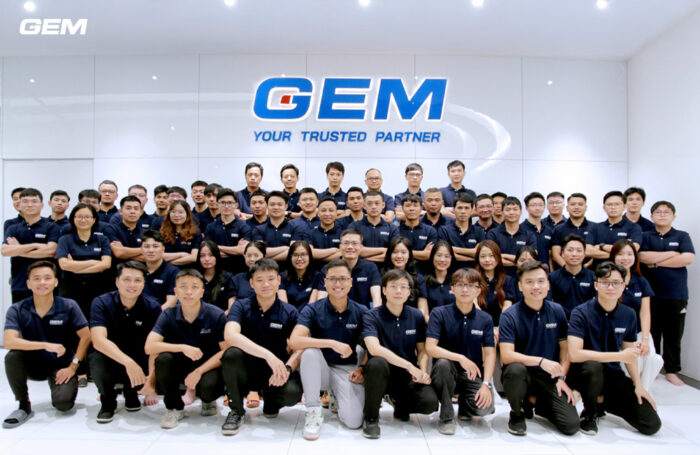
GEM Corporation is a global IT services and consulting firm, trusted by clients from Japan, ANZ, Asia, the EU, the US, and other key markets since 2014. With over 450 IT experts and a track record of delivering 300+ successful projects, GEM brings a comprehensive, domain-led approach to digital transformation. Our teams combine deep technical expertise with sector-specific insights to align technology initiatives with measurable business outcomes.
As a certified ServiceNow and Databricks delivery partner, GEM offers end-to-end capabilities across the platform, from advisory and implementation to ongoing managed services.
We provide embedded engineering capacity across leading low-code, no-code platforms, including OutSystems, Mendix, ServiceNow, Microsoft Power Platform, Databricks, Appian, and Salesforce, operating within your sprint cadence, your repositories, and your governance standards.
Why Enterprises and Partners in APAC Work With GEM
As one of Vietnam’s leading mid-sized technology services companies, GEM combines enterprise delivery capability with the agility, responsiveness, and commercial flexibility that many large global system integrators struggle to provide. For organizations seeking a trusted technology partner in APAC, this balance often translates into faster decisions, closer collaboration, and stronger business outcomes.

- APAC-aligned delivery model: Operating from Vietnam (GMT+7), GEM provides full or near-full working-hour overlap with major APAC markets including Japan, Korea, Singapore, and Australia. This enables real-time collaboration, faster issue resolution, and more efficient delivery cycles across distributed teams.
- Potential access to C-level strategic guidance: As a leading mid-sized technology partner, GEM offers clients direct engagement with senior architects, delivery leaders, and executive decision-makers. Beyond project execution, clients benefit from practical consultation on platform strategy, delivery models, governance, and technology roadmaps throughout the engagement lifecycle.
- Enterprise expertise across low-code, data, and AI: GEM delivers certified expertise across leading enterprise platforms including OutSystems, Mendix, ServiceNow, Microsoft Power Platform, Appian, Salesforce, and Databricks. We help organizations accelerate application development, workflow automation, platform modernization, data transformation, and AI adoption through practical implementation experience.
- Agile delivery with enterprise governance: Our delivery teams integrate directly into client operating models, sprint cycles, repositories, governance frameworks, and DevOps processes. This combination of agility and governance helps enterprises move faster while maintaining the quality, security, and compliance standards required for business-critical systems.
- Cost-efficient, quality-assured delivery: Vietnam continues to be one of the most attractive destinations for enterprise technology delivery in APAC. By leveraging a highly skilled engineering workforce and a streamlined operating model, GEM helps organizations optimize delivery costs while maintaining enterprise-grade quality and delivery standards.
- Knowledge transfer by design: Every engagement includes structured documentation, architecture guidance, enablement programs, and handover processes. Our goal is not only to deliver low-code, no-code platforms solutions, but also to equip internal teams with the knowledge required to operate, scale, and evolve those solutions independently.
- Proven experience across APAC markets: GEM has extensive experience supporting enterprises across Japan, Korea, Southeast Asia, Australia, and other global markets. Our teams understand the regional expectations around quality, security, compliance, and stakeholder management, enabling smoother execution of business-critical technology initiatives.
If you are evaluating low-code, no-code platform delivery options for an upcoming program, whether you are an enterprise buyer, a prime contractor, or a transformation consultancy, we offer a no-commitment technical scoping call with our delivery leads.