
AI-Assisted Testing Services
GEM’s AI-assisted testing experts apply AI to make testing faster and smarter – generating test cases, healing broken tests automatically, and prioritizing what to test next – validated by QA engineers at every step.
Benefit from GEM’s proactive and overarching security testing for robust, resilient software
Writing and maintaining test cases by hand does not scale with how fast applications change. AI-assisted testing generates candidate test cases, adapts to UI changes automatically, and tells your team what to test first – with QA engineers validating every step.

Test cases are written manually, one by one, based on tester experience Automated tests break with every UI change and require manual fixes All tests run every time, regardless of what actually changed Test coverage gaps are discovered by accident, not systematically Defect patterns are analyzed manually after the fact, if at all


AI generates candidate test cases from requirements and application behavior, reviewed by QA engineers Self-healing test scripts adapt to UI changes automatically, reducing maintenance AI prioritizes which tests to run based on code changes and risk, speeding up feedback AI analyzes coverage gaps and suggests where testing is thin AI detects defect patterns and predicts where new issues are likely to appear
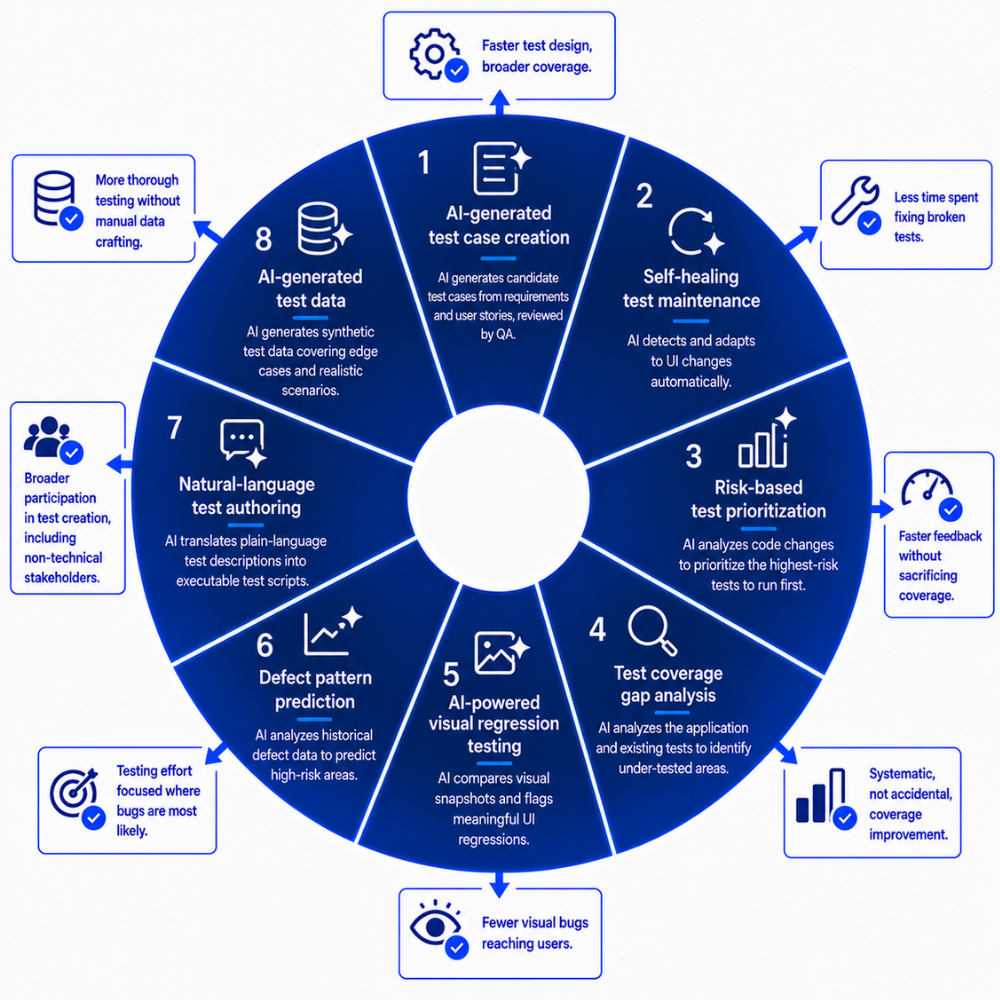
GEM applies AI to specific, high-value testing tasks – not as a black box that replaces QA judgment, but as an assistant that QA engineers review and validate at every step.
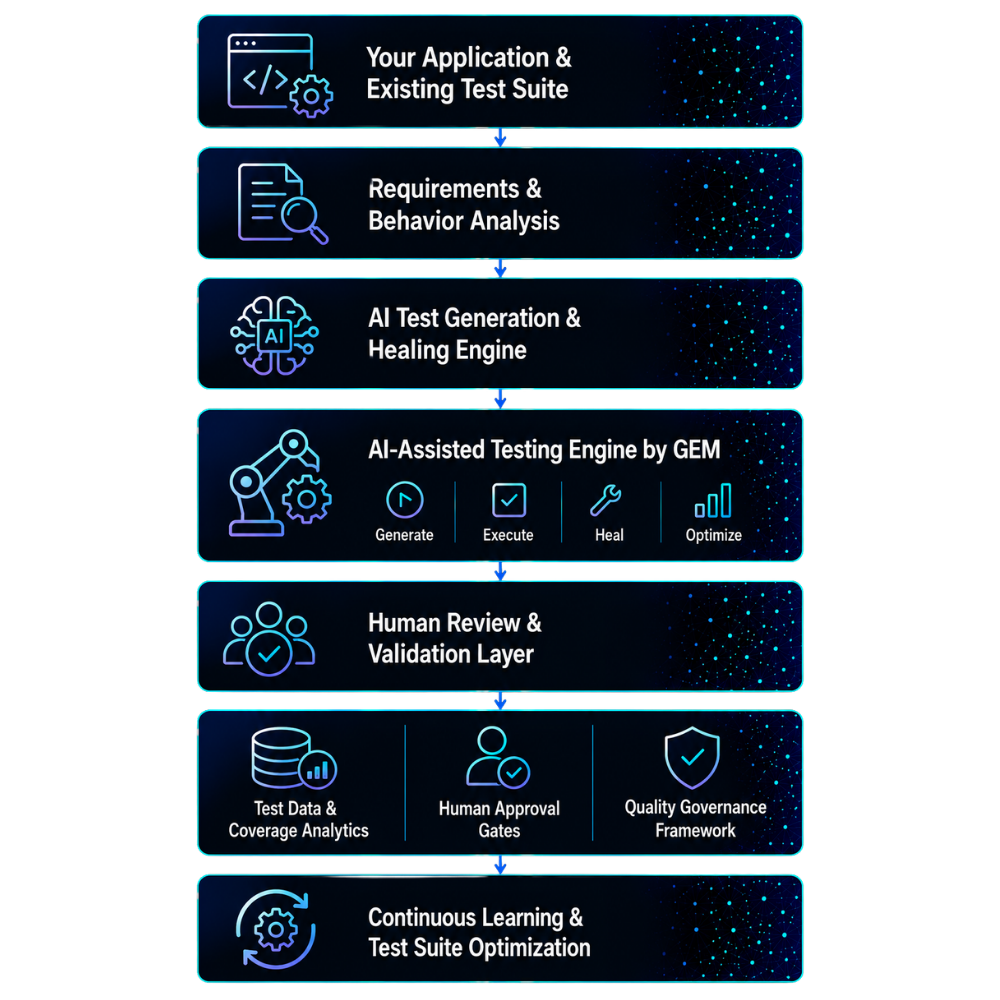
Evaluate current testing practices and pilot AI-assisted test generation or healing on one high-value area.
Integrate AI-assisted capabilities into your existing test suite and workflows, with QA teams trained on the review process.
Monitor AI accuracy and impact, then extend AI-assisted testing across more of the test suite.

AI-generated test cases, reviewed by QA, cut the time needed to design comprehensive coverage.

Self-healing tests reduce the time spent fixing scripts broken by routine UI changes.

Running the highest-risk tests first shortens the time between a code change and knowing if it broke something.

AI-identified coverage gaps get closed deliberately, not by accident.

Defect pattern prediction focuses testing effort where issues are most likely to appear.

Every AI-generated test case or decision is logged and reviewed, so QA can explain what changed and why.
AI-assisted testing applies AI to specific testing tasks – generating test cases, healing broken automated tests, prioritizing what to test, and predicting where defects are likely to appear – while QA engineers review and validate the results.
Test Automation builds and maintains the framework and CI/CD integration that runs tests reliably at scale. AI-Assisted Testing applies AI within that framework – to generate test cases, heal broken scripts, and prioritize execution. The two work together: AI-assisted capabilities can run inside a Test Automation framework.
Functional & E2E Testing defines and validates test scenarios against real business requirements and user journeys, led by testing experts. AI-Assisted Testing uses AI to accelerate parts of that process – such as generating candidate test cases or predicting defect-prone areas – with QA engineers still validating the requirements and results.
AI-generated test cases and scripts are grounded in your actual requirements and application behavior, and reviewed by QA engineers before being trusted, following practices aligned to guidance such as the OWASP Top 10 for LLM Applications where generative AI is involved.
Self-healing tests use AI to detect when a UI element has changed and automatically adjust the test script to match, rather than failing outright. Reliability depends on the type of change; significant changes still surface for QA review rather than being silently auto-corrected.
Yes. AI-generated or AI-modified tests are reviewed by QA engineers before being trusted as part of the regular test suite, especially for high-risk or business-critical scenarios.
Yes. AI-assisted capabilities are designed to plug into your existing automation framework and CI/CD pipeline rather than requiring a separate, parallel system.
Data handling depends on the model provider and deployment option chosen. GEM configures AI-assisted testing to align with your data governance and residency requirements, and can discuss specific model provider data policies during scoping.
Tell us what’s holding your business back
Get a free transformation assessment: the right technology opportunities, expected business impact, and a practical roadmap. We reply within 1 business day.