




Most enterprises don’t have a shortage of ideas for internal tools – they have a backlog. Finance wants a faster approval workflow. Operations wants a real-time inventory dashboard. HR wants to retire a leave-request spreadsheet that breaks every quarter-end. Individually, none of these projects looks strategic. Collectively, they are why IT backlogs stretch 12-18 months and why business units quietly build their own tools in Excel, SharePoint, and shadow SaaS.
Gartner’s research on enterprise application platforms has tracked this shift for years: internal, custom-built software is no longer a “nice to have” – it is where a growing share of new enterprise applications originate, and low-code is the delivery mechanism driving that growth. Mendix, a Siemens business, has been named a Leader in Gartner’s Magic Quadrant for Enterprise Low-Code Application Platforms for nine consecutive years, most recently ranked furthest on the Completeness of Vision axis in the 2025 report.
This guide is written for the people who have to make that call: CIOs, enterprise architects, and digital transformation leads deciding whether Mendix is the platform that gets internal apps out of the backlog and into production – without trading away governance, security, or integration with the SAP, Salesforce, and Azure environments they already run. We’ll cover the architecture, the build process, real APAC-relevant scenarios, honest platform comparisons, and the numbers that should go into your business case.
Why Internal Applications Become Enterprise Bottlenecks
Internal apps rarely fail because the idea was bad. They fail because the delivery model was built for a different era of software.
- The backlog problem. Most enterprise IT organizations run a portfolio triage where customer-facing revenue systems get priority, and internal tools – HR portals, procurement trackers, quality-inspection apps – get queued behind them indefinitely. A request for a leave-approval workflow competes for the same sprint capacity as a core banking upgrade, and it loses every time.
- The shadow IT response. When the backlog gets too long, business units stop waiting. They build in Excel, Power Automate, Google Sheets, or unsanctioned SaaS tools. This isn’t rebellion – it’s a rational response to unmet need. But it creates real risk: no audit trail, no access controls, no integration with core systems, and data that lives outside IT’s visibility entirely. Analysts have flagged unmanaged internal tooling as a recurring driver of compliance and data-governance incidents in industries like banking and insurance.
- The cost of “just build it in code.” Custom development remains the default answer for many enterprise architects, but a full-stack internal app – frontend, backend, database schema, auth, integrations, hosting, testing – routinely takes a small team 4-9 months for something a business user experiences as “a form with a workflow behind it.” That mismatch between perceived simplicity and actual delivery cost is the core tension this guide addresses.
- Business impact. Every month an approval workflow stays manual, or an inventory count stays in a spreadsheet, is a month of avoidable error, delay, and hidden labor cost. Internal apps are not IT overhead – they are the connective tissue between ERP/CRM systems of record and the people who actually do the work. Treating them as low priority is treating operational efficiency as optional.
Key takeaway: The bottleneck isn’t demand for internal apps – it’s a delivery model mismatched to the size and speed of the requests.
Traditional Development vs. Low-Code
| Dimension | Traditional Custom Development | Low-Code (Mendix) |
| Time to first working version | 8-16 weeks | 2-4 weeks |
| Team composition | Backend, frontend, DevOps, QA specialists | Cross-functional squad incl. business analyst as co-builder |
| Change request turnaround | Days to weeks (code, review, deploy pipeline) | Hours to days (visual model change, one-click deploy) |
| Governance & reuse | Manual, inconsistent across teams | Enforced via platform-level app governance, shared modules |
| Integration effort | Custom connectors, hand-written | Pre-built connectors + open REST/OData/Java/JS extensibility |
| Total cost of ownership | High: maintenance debt accumulates | Lower: model-driven apps are self-documenting and easier to hand over |
Low-code is not “no governance” or “toy apps.” Mendix’s model-driven approach means the application logic, data model, and workflow are visual artifacts that both developers and business analysts can read – which is precisely what makes governance easier to enforce, not harder, because there’s a single source of truth instead of tribal knowledge locked in a codebase.
The honest trade-off: low-code is not the right tool for highly specialized, performance-critical, or deeply novel technical problems (a real-time trading engine, a custom rendering pipeline). It is the right tool for the 80% of enterprise internal apps that are fundamentally forms, workflows, dashboards, and data orchestration wrapped around existing systems of record – which describes most HR, procurement, operations, and compliance tooling.
Implementation consideration: The teams that get the most value from this shift don’t treat low-code as “cheaper coding.” They treat it as a different operating model – smaller squads, tighter business involvement, and a portfolio approach to internal apps rather than a project-by-project one.
Why Mendix Accelerates Time-to-Value
Three structural characteristics separate Mendix from “just a faster IDE”:
- Model-driven development end-to-end. Data models, page logic (microflows/nanoflows), and UI are all first-class visual artifacts, not generated scaffolding you then hand-edit. This matters at scale: when 40 internal apps exist across a portfolio, a model-driven approach means any developer can open any app and understand it in minutes, not days.
- Full application lifecycle in one platform. Mendix covers ideation (Mendix Assist, app templates), development (Studio and Studio Pro), testing, and cloud-agnostic deployment (Mendix Cloud, private cloud, or on customers’ own Kubernetes/Azure/AWS infrastructure) inside one governed environment – rather than stitching together separate tools for each stage.
- Enterprise-grade extensibility. Mendix apps are not sealed low-code boxes. Studio Pro allows Java and JavaScript actions, custom widgets, and full API-level extensibility, so when a requirement genuinely needs custom logic, teams write it – inside the same governed app, instead of abandoning the platform.
Business value: the practical outcome is that a working, testable version of an internal app is often in front of business stakeholders within the first two to three weeks, not after a full requirements-to-delivery cycle. That compressed feedback loop is where most of the time-to-value gain actually comes from – not typing speed, but eliminating the rework that happens when business users only see the “finished” product months later.
Risk to manage: speed can tempt teams to skip architecture discipline. Mendix’s governance tooling (App Store curation, module reuse, environment promotion controls) exists specifically to prevent “fast but unmanageable” sprawl – but only if an enterprise actually configures and enforces it from day one.
Enterprise Architecture of Mendix
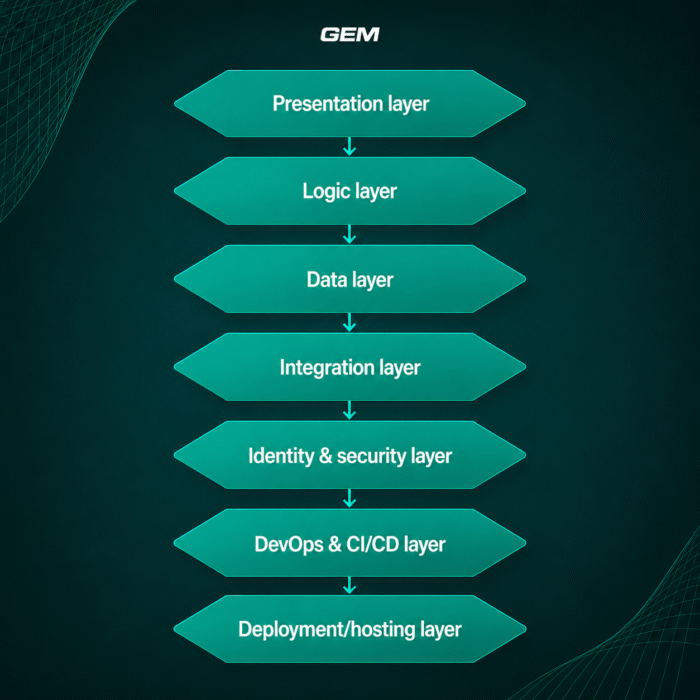
A production-grade Mendix deployment is not a single app sitting in isolation – it’s a layered architecture:
- Presentation layer: responsive web and native mobile UI, built from Atlas UI design system components, themeable to enterprise brand standards.
- Logic layer: microflows (server-side business logic) and nanoflows (client-side/offline logic) that encode workflow, validation, and orchestration.
- Data layer: Mendix’s built-in domain model plus connectors to external databases; supports both Mendix-managed persistence and integration with existing enterprise data stores.
- Integration layer: REST, SOAP, OData, GraphQL, and message-based connectors (including Kafka), plus a curated Marketplace of pre-built connectors for SAP, Salesforce, Microsoft 365, and Azure services.
- Identity & security layer: SSO/SAML, OAuth2, role-based access control down to the microflow level, and encryption in transit and at rest.
- DevOps & CI/CD layer: Mendix’s native pipeline plus support for external CI/CD (Azure DevOps, GitHub Actions, Jenkins) for enterprises that need low-code inside an existing DevOps standard.
- Deployment/hosting layer: Mendix Cloud (managed), or private/hybrid deployment to AWS, Azure, or on-premises Kubernetes, which matters for regulated industries with data-residency requirements.
Technical consideration for enterprise architects: the integration layer is usually the deciding factor in a Mendix evaluation, not the low-code editor itself. An enterprise running SAP ECC or S/4HANA, for example, needs to validate connector maturity and real-time vs. batch integration patterns before committing a portfolio strategy – this is where a proof-of-concept against your actual SAP or Salesforce instance is worth more than any vendor demo.
Compliance note: Mendix supports enterprise governance requirements including ISO 27001-aligned security controls at the platform level, but the application-level compliance posture (data classification, retention, access policy) is still the implementing team’s responsibility to design correctly – the platform enables governance, it doesn’t automate away the need for it.
Common Internal Apps Built with Mendix
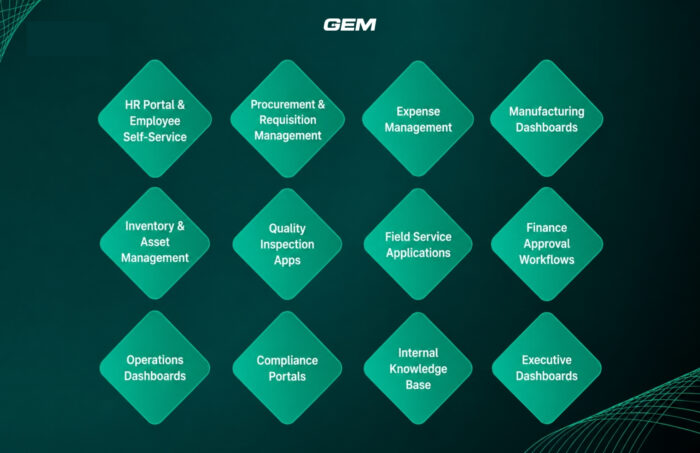
These are the categories that consistently deliver fast, measurable ROI because they replace manual or spreadsheet-based processes with structured, auditable workflows:
- HR Portal & Employee Self-Service: leave requests, document access, onboarding checklists, org-chart lookups
- Procurement & Requisition Management: purchase requests, approval chains, vendor onboarding
- Expense Management: receipt capture, policy validation, multi-level approval routing
- Manufacturing Dashboards: shop-floor KPIs, OEE tracking, downtime logging
- Inventory & Asset Management: stock levels, transfer requests, maintenance scheduling
- Quality Inspection Apps: mobile inspection checklists with photo capture, non-conformance tracking
- Field Service Applications: technician scheduling, work-order management, offline-capable mobile forms
- Finance Approval Workflows: budget requests, invoice matching, spend-threshold routing
- Operations Dashboards: cross-functional KPI visibility for plant or regional managers
- Compliance Portals: policy attestation, audit-trail documentation, incident logging
- Internal Knowledge Base: searchable SOPs, policy documents, role-based content access
- Executive Dashboards: consolidated, real-time views pulled from ERP/CRM for leadership reporting
Enterprise example (representative pattern): A manufacturing enterprise consolidating quality-inspection data across multiple plants typically starts with a single-plant Mendix pilot – replacing paper or PDF checklists with a mobile app that logs inspections, flags non-conformances, and routes them to quality engineers automatically. The pattern that consistently works: launch narrow, prove the workflow with one plant or one business unit, then template and roll out – rather than attempting an all-plants “big bang” from day one.
Step-by-Step Guide: How to Build Internal Apps Using Mendix
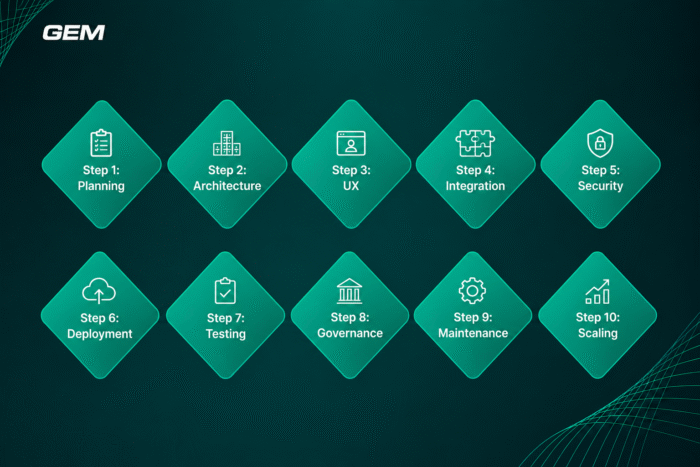
- Step 1: Define the workflow in business terms before opening Studio Pro: who requests, who approves, what data is captured, what system of record it touches. Skipping this step is the single most common cause of rework.
- Step 2: Decide data ownership (does Mendix own this data, or does it orchestrate data that lives in SAP/Salesforce?), integration pattern (real-time API call vs. scheduled sync), and hosting model (Mendix Cloud vs. private cloud) before building the first page.
- Step 3: Use Atlas UI components rather than custom-styling everything from scratch. Internal apps don’t need bespoke design systems – they need consistency and speed, and a shared component library across your app portfolio pays off the moment you have more than three apps in production.
- Step 4: Build and test the connector to source systems early, not last. Integration risk is almost always higher than UI risk; validate it in week one of the sprint, not week six.
- Step 5: Configure role-based access control at the module and microflow level, not just page-level visibility. Map roles to your existing IAM/SSO groups so app access inherits enterprise identity governance rather than creating a parallel permission system.
- Step 6: Promote through dev → test → acceptance → production environments using Mendix’s native pipeline or your existing CI/CD tooling. Automate this from the first app, even a small one – retrofitting a deployment pipeline after 15 apps exist is far more expensive than building it in from app one.
- Step 7: Combine Mendix’s automated testing capabilities with structured UAT involving the actual business users who requested the app – not just IT QA. Internal apps live or die on adoption, and adoption starts with the pilot users feeling heard during testing.
- Step 8: Register the app in a central app catalog with an assigned owner, data classification, and review cadence. Without this, a portfolio of 30+ internal apps becomes as unmanageable as the shadow IT it replaced.
- Step 9: Assign clear ownership (business + technical) for each app post-launch. Low-code reduces build effort, not the need for someone to own the app’s lifecycle.
- Step 10: Once a pattern proves out (e.g., an approval-workflow template), reuse it as a Mendix module across other business units rather than rebuilding from scratch each time – this is where the real portfolio-level ROI compounds.
AI + Mendix: Agentic and Copilot-Assisted Development
Mendix has been building AI-assisted capabilities into the platform for several years, and the direction of travel matters for any enterprise planning a multi-year internal-app portfolio:
- AI-assisted development: Mendix Assist and related copilot capabilities help generate initial data models, suggest microflow logic, and accelerate boilerplate – shifting developer time toward business logic and integration rather than repetitive configuration.
- GenAI integration inside apps: Beyond assisting the building of apps, Mendix supports connecting generative AI (via its Marketplace connectors and open API extensibility) into the apps themselves – for example, an internal knowledge-base app that uses an LLM for natural-language search over policy documents, or a procurement app that drafts vendor communication.
- Agentic workflows: The emerging pattern across the low-code market – not unique to Mendix, but one it is actively building toward – is agentic AI: workflows where an AI agent doesn’t just assist a human step but autonomously executes multi-step processes (triaging a support ticket, reconciling an invoice discrepancy, routing an exception) with human approval gates at defined checkpoints. For internal apps, this is the natural next layer on top of the workflow automation these platforms already provide.
- Implementation consideration: Agentic and GenAI features inside internal apps raise the same governance questions as any AI deployment – data access scope, hallucination risk in decision-support contexts, and audit trails for AI-influenced actions. The right pattern for most enterprise internal apps today is AI-assisted (human approves, AI recommends) rather than fully autonomous, especially in regulated functions like finance approvals or compliance workflows.
- Future roadmap consideration: Enterprises building a Mendix portfolio now should architect data models and integration layers with future AI/agentic capability in mind – clean, well-governed data is the actual prerequisite for useful AI in internal apps, more than any specific AI feature the platform ships next.
Read more about: Mendix’s Agentic AI Development
APAC Perspective
Internal application modernization looks different across APAC markets, shaped by labor dynamics and sector-specific digital transformation priorities:
South Korea faces a well-documented engineering talent shortage in enterprise IT, particularly for legacy modernization work in banking and manufacturing conglomerates. Low-code platforms are increasingly positioned as a way to extend limited senior-developer capacity across a larger portfolio of internal tooling, rather than a replacement for skilled engineers.
Japan continues to grapple with “2025 Digital Cliff”-style legacy modernization pressure – a well-known industry concern about aging core systems and a shrinking IT workforce. Internal apps that sit on top of legacy ERP/mainframe systems, rather than replacing them outright, are a common and pragmatic entry point for low-code adoption in Japanese enterprises.
Singapore and Australia show the most mature enterprise low-code adoption in the region, often driven by government digital-transformation initiatives (Singapore’s Smart Nation programs, Australia’s public-sector digital service standards) that have normalized low-code/no-code procurement at the enterprise level.
Vietnam, Malaysia, Thailand, and Indonesia are earlier in enterprise low-code maturity but show fast-growing demand – particularly in banking modernization, manufacturing digitization (supporting export-oriented manufacturing bases), and government digital-service initiatives. In these markets, internal apps often serve a dual purpose: operational efficiency and a proving ground for broader digital transformation capability before enterprises commit to larger customer-facing platform investments.
Regional implementation consideration: data-residency and regulatory requirements vary meaningfully across these markets (particularly banking and government sectors), which makes Mendix’s flexible hosting model – Mendix Cloud, private cloud, or on-prem – a practical advantage for APAC enterprises balancing central IT standards against local regulatory requirements.
Mendix vs. Alternatives
| Platform | Best fit | Governance | Extensibility | Trade-off vs. Mendix |
| Mendix | Enterprise-wide internal app portfolios, complex integration needs | Strong: model-driven, App Store governance, granular RBAC | High: Java/JS actions, full API access | — |
| Microsoft Power Apps | Microsoft 365-centric orgs, citizen-developer-led apps | Good within Microsoft ecosystem; weaker outside it | Moderate: strong Power Platform/Azure ties | Best when org is deeply standardized on Microsoft 365/Dynamics/Azure |
| OutSystems | Similarly enterprise-grade, high-performance app portfolios | Strong: comparable enterprise governance model | High: comparable extensibility | Close competitor; comes down to integration ecosystem and dev experience fit |
| Traditional coding | Highly specialized, performance-critical, or novel systems | Fully custom: governance is whatever the org builds | Unlimited | Highest control, slowest/most expensive for standard internal-app patterns |
| AppSheet (Google) | Lightweight departmental apps, Google Workspace-centric teams | Lighter-weight, less suited to complex workflow | Lower: simpler automation model | Good for small/simple apps; not built for complex enterprise workflow |
| ServiceNow App Engine | Orgs already standardized on ServiceNow for ITSM/workflow | Strong within ServiceNow’s data model | Moderate : extending ServiceNow itself | Strongest when the app logically belongs inside ServiceNow |
Decision framework for enterprise architects: the right question isn’t “which platform is best” in the abstract – it’s “which platform best matches our existing enterprise stack, our integration complexity, and whether we need one governed platform for the full portfolio, or a narrower tool for a specific system’s ecosystem.” A short, structured proof-of-concept against your actual integration requirements (SAP, Salesforce, core banking, etc.) is worth more than any vendor comparison matrix, including this one.
ROI Analysis
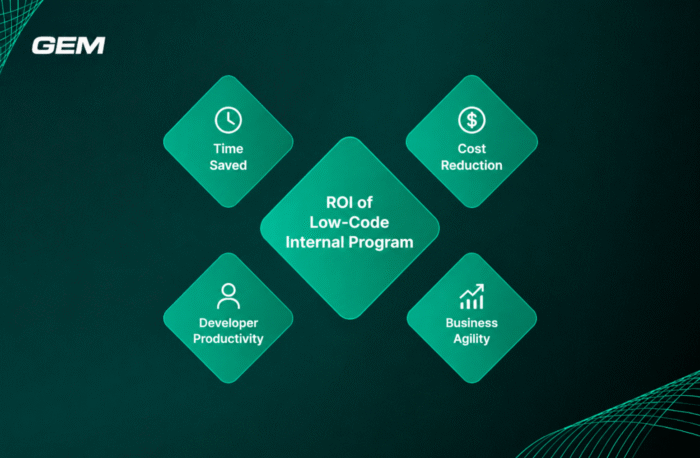
Return on a low-code internal-app program comes from four compounding sources:
- Time saved. The clearest, fastest-to-measure gain: internal app delivery timelines commonly compress from months to weeks for standard workflow/dashboard patterns, once a team has built two or three apps and established reusable components.
- Cost reduction. Fewer specialized full-stack developer-hours per app, and lower long-term maintenance cost due to the self-documenting nature of model-driven applications – a meaningful factor when developer turnover is high, which is a real constraint in several APAC markets right now.
- Developer productivity. A smaller, cross-functional squad (often including a business analyst as co-builder) can maintain a larger app portfolio than an equivalent traditional-development team, because the visual model lowers the ramp-up cost for anyone picking up an existing app.
- Business agility. This is the hardest to quantify and the most strategically important: the ability to respond to a new regulatory requirement, a new business process, or a merger-driven system change in weeks instead of quarters. Enterprises that build a mature internal-app portfolio effectively buy themselves organizational optionality – the ability to adapt operational tooling at the speed the business actually changes.
For a typical first internal-app program (305 apps replacing manual or spreadsheet processes), enterprises commonly see payback within the first 6-12 months, driven primarily by labor-hour savings and error reduction in the replaced manual process – with the platform’s value compounding further as reusable modules reduce the cost of each subsequent app. ROI is highest when apps replace a genuinely painful manual process (multi-step approvals, cross-system data reconciliation) and lowest when a “low-code app” is really just digitizing a process that didn’t need digitizing in the first place. The business case should start with process pain, not platform capability.
Discover a similar topic: How Enterprise AI Workflow Automation Delivers ROI: 4 Low-Code Case Studies
GEM Corporation’s Mendix Implementation Services
GEM Corporation is an enterprise technology partner with 400+ IT professionals and consultants, a 2024 Clutch 100 award winner, and a track record of digitally empowering 300+ industry leaders – including Fortune Global 500 companies – across banking, insurance, manufacturing, retail, logistics, and healthcare. GEM’s delivery process is ISO-certified and CMMi-appraised, and the company is an official ServiceNow partner alongside deep, hands-on delivery experience across the broader enterprise low-code ecosystem – including Mendix, Microsoft Power Apps, Appian, and OutSystems.
Within Low-Code & No-Code Development practice, GEM’s Mendix implementation services cover the full lifecycle this guide has walked through: architecture and integration assessment against your existing SAP, Salesforce, or core-system landscape; pilot-to-portfolio delivery starting from a single high-value internal app; governance and app-catalog setup; and application managed services once apps are in production. GEM’s broader internal-application track record includes projects such as a back-office management system supporting 14,000+ users and an HR automation solution that cut back-office effort by 80% for an APAC energy and utilities enterprise – the same category of workflow and operations apps this guide covers.
Conclusion & Implementation Roadmap
Internal applications sit in an odd blind spot for most enterprises: individually low-priority, collectively responsible for a meaningful share of operational drag, error, and shadow-IT risk. Low-code doesn’t eliminate the discipline good software delivery requires – architecture decisions, security, governance, and change management all still matter. What it changes is the cost and speed of acting on that discipline, compressing delivery from quarters to weeks and making a genuine internal-app portfolio strategy achievable rather than aspirational.
Mendix’s nine consecutive years as a Gartner Magic Quadrant Leader, its model-driven architecture, and its enterprise-grade extensibility make it a credible platform for exactly this kind of portfolio play – particularly for enterprises with complex, multi-system integration needs across SAP, Salesforce, Azure, and legacy environments.