




According to ServiceNow’s Enterprise AI Maturity Index 2026, AI spending is up 110%, yet only 16% of organisations have successfully integrated AI into enterprise workflows. The difference lies not in budget or technology, but in execution. This article explores why most ServiceNow AI implementation initiatives fail, where organisations get stuck, and the three disciplines shared by enterprises that turn a ServiceNow AI implementation into measurable business value.

The $500 Million Wake-Up Call
Let’s start with the most striking data point of 2026.
ServiceNow, the company behind one of the world’s leading enterprise workflow platforms, saved $500 million in a single year by running their own platform on itself. Today, AI supports 91% of its self-service requests, helping return more than 2.3 million hours to employees.
That’s not a product pitch. That’s a working proof of concept at enterprise scale.
Yet many organisations investing in the same technologies are seeing very different results. They have deployed Now Assist. They have launched AI pilots. Some have even introduced AI agents into key workflows.
But despite the investment, measurable business outcomes often remain elusive.
So what are the organisations achieving real AI value doing differently? And why do so many others struggle to move beyond the pilot stage?
That’s what this article explores, drawing on industry research, enterprise examples, and the lessons emerging from the most successful ServiceNow AI implementations today.
The Hard Numbers: Where the 84% Are Right Now
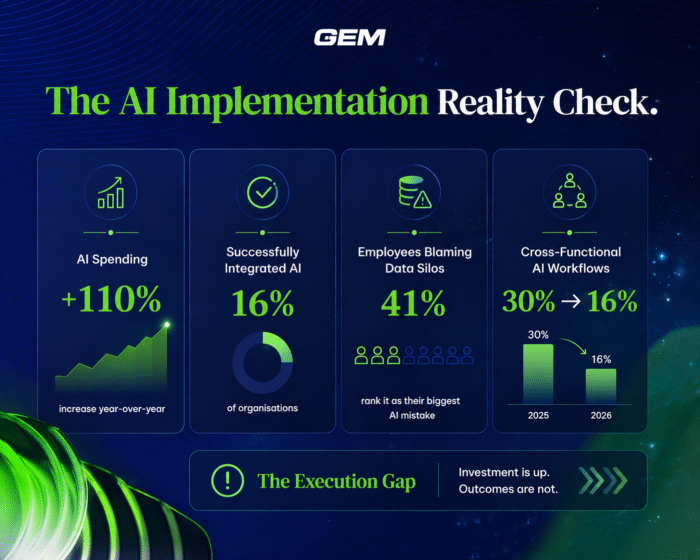
ServiceNow’s Enterprise AI Maturity Index 2026 is the most comprehensive study on this topic available today. Surveying thousands of enterprises globally, it surfaces a contradiction that explains the entire problem below:
- AI spending is up 110% year-over-year, the commitment is real
- Only 16% of organisations have widely replaced fragmented legacy systems with an integrated platform
- 41% of employees rank data silos as their organisation’s single biggest AI mistake
- In 2025, 30% of organisations had streamlined cross-functional AI workflows. By 2026, that number dropped to 16%, because a new wave of agent sprawl is sitting on top of still-fragmented platforms.
|
This matters enormously for any organisation running ServiceNow. The platform’s AI capabilities, Now Assist, AI Agent Studio, the newly launched ServiceNow Otto™, and the Autonomous Workforce suite, are genuinely powerful. But they require a different kind of organisational foundation than traditional ITSM automation.
The 84% who are struggling are not failing because the technology doesn’t work. They’re failing because they’re deploying AI on top of infrastructure that was never designed for it.
The 3 Mistakes That Keep the 84% Stuck in ServiceNow AI Implementation
Mistake #1: Starting with AI Instead of Data Hygiene
This is the most common, and most expensive mistake in ServiceNow AI implementations. The question is: Why does AI fail even after deployment?
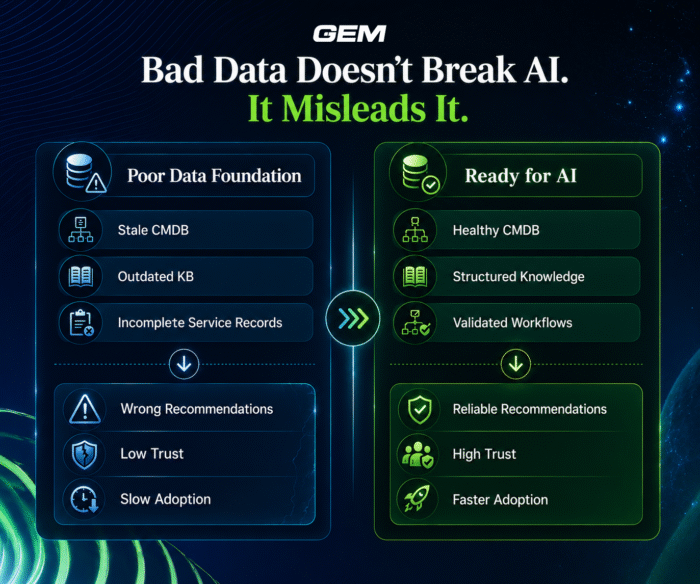
Organisations get excited by the capabilities (understandably, the demos are compelling). They license Now Assist, turn on summarisation features, maybe deploy a virtual agent. Then they wonder why their AI keeps surfacing wrong answers, confidently. The reason is almost always the same: CMDB (Configuration Management Database) quality.
AI in ServiceNow doesn’t operate in a vacuum. It reasons across the data that lives in your platform, configuration items, knowledge articles, incident histories, SLA records, and service catalogue entries. If that data is stale, inconsistent, or incomplete (and in most enterprise environments, it is), the AI will faithfully automate bad processes faster.
|
Most organisations start with AI. The most successful ones start with readiness. That’s why they follow a deliberate sequence before scaling AI across the enterprise:
- CMDB audit & remediation: correct relationships, stale data, and coverage gaps.
- Knowledge base restructuring: organise content for machine consumption.
- Now Assist pilot: validate AI output on a single workflow.
- Full AI agent deployment: only after steps 1 to 3 are solid.
Many AI initiatives spend months troubleshooting inaccurate outputs, inconsistent recommendations, and low user trust, only to discover that the root cause isn’t the AI itself, but the quality of the underlying data. Organisations that invest in data readiness early are able to move from pilot to production faster and build a stronger foundation for long-term ServiceNow AI implementation success.
Mistake #2: Deploying Point Solutions Instead of an Orchestration Layer
As AI adoption grows, many organisations face an uncomfortable reality: Are they streamlining workflows, or simply replacing one set of silos with another?
A modern ServiceNow AI implementation should be designed around orchestration rather than isolated AI deployments. The second failure mode is architectural. It’s what drives the “agent sprawl” problem referenced in the Maturity Index.
An organisation stands up a Now Assist summarisation feature for ITSM. Then a separate AI chatbot for HR. Then a virtual agent for the service catalogue. Then a third-party AI tool for security triage. Each looks successful in isolation. Together, they create a fragmented, ungoverned AI landscape where:
- Actions taken by one agent are invisible to others
- No single view of AI performance or compliance exists
- Human oversight becomes nearly impossible to maintain at scale
- The value proposition of the ServiceNow platform (unified data, single system of record) is completely undermined
The organisations that are winning (the 16%) treat AI deployment as an architectural decision, not a feature rollout. They anchor everything to two ServiceNow capabilities that most organisations underutilise: AI Control Tower and the AI Agent Orchestrator.
- ServiceNow AI Control Tower: A centralised governance and observability hub that lets you track, manage, and optimise every AI agent running across your environment, whether built on ServiceNow, Microsoft Copilot, Anthropic’s Claude, or a custom model. The AI Control Tower closed deals at nearly triple the volume in the last quarter of 2025 and exceeded quarterly targets by 4x: a clear signal that the most sophisticated enterprise buyers have recognised its importance.
- AI Agent Orchestrator: The coordination layer that lets multiple AI specialists pass tasks between each other, maintaining context across handoffs. Without this, each agent operates in a silo, no better than the workflow silos enterprises have been trying to escape for a decade.
The goal is not to build smarter individual agents, but to create an orchestrated AI ecosystem where governance, visibility, and coordination are built in from the start.
Mistake #3: Measuring AI by Ticket Count Instead of Time Returned
Most organisations can tell you how many tickets AI has handled. Far fewer can tell you how much business value it has created.
Measuring business impact correctly is a critical component of every successful ServiceNow AI implementation strategy. This mistake is less about implementation and more about organisational alignment, but it may be the most dangerous of the three, because it causes enterprises to think they’re succeeding when they’re not.
Most IT leaders track AI effectiveness using ITSM metrics: MTTR, ticket volume, first-contact resolution rate. These are valuable, but they’re lagging indicators. ServiceNow itself uses a different primary metric for its own AI deployments: hours returned to employees.
Their internal benchmark: 2.3 million employee hours returned to productive work in 2025 alone. That translates directly to labour cost avoidance, workforce reallocation, and strategic capacity – the language of a CFO, not just an IT director.
The three-layer measurement framework used by the 16%:
| Level | What To Measure | Example Outcome |
|---|---|---|
| Operational Efficiency | Request deflection, resolution speed, automation rate | City of Raleigh achieved a 98% request deflection rate |
| Workforce Productivity | Employee hours returned to higher-value work | ServiceNow returned 2.3 million employee hours in 2025 |
| Business Impact | Cost savings, revenue enablement, strategic capacity | ServiceNow generated $500 million in savings in 2025 |
When AI is measured across all three layers, the conversation shifts from operational activity to business value. Organisations gain a clearer understanding of what’s working, what’s underperforming, and where the next wave of ROI can be unlocked.
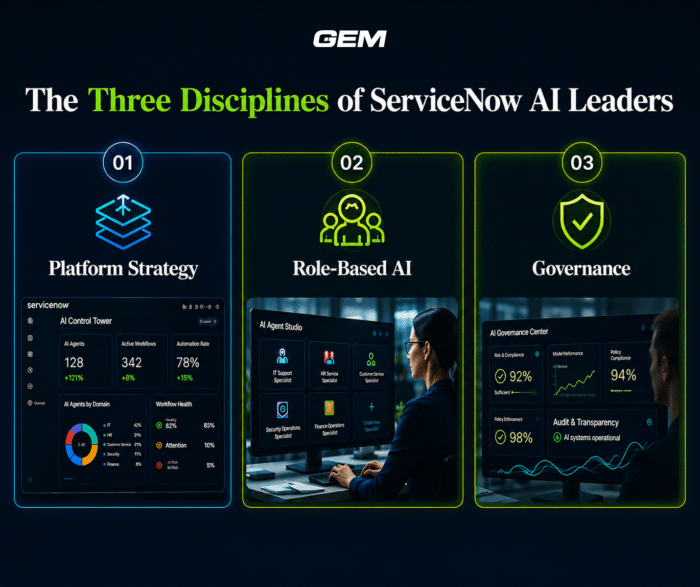
What the 16% Know: Three Disciplines of ServiceNow AI Implementation Leaders
Discipline 1: They Treat the Platform as the AI Strategy, Not the Tool
Organisations leading in ServiceNow AI implementation increasingly position ServiceNow as their enterprise AI control plane rather than simply another operational platform. There’s a fundamental difference in how AI leaders frame the role of ServiceNow. The 84% see it as an IT management tool that now has AI features. The 16% see it as what ServiceNow actually is in 2026: an enterprise operating system for AI.
This distinction drives every downstream decision.
At Knowledge 2026, ServiceNow’s annual conference held in May 2026, the company announced ServiceNow Action Fabric, a foundational platform capability that opens ServiceNow to any AI agent in the enterprise, regardless of where it was built.
|
According to IDC, the number of active AI agents globally is projected to grow from roughly 28.6 million today to over 2.2 billion by 2030. As AI adoption accelerates, success will depend less on the number of agents an organisation deploys and more on its ability to orchestrate them effectively. This is why leading organisations are positioning ServiceNow as a governance and coordination layer for enterprise AI, ensuring growth doesn’t come at the cost of control.
The organisations leading in ServiceNow AI implementation share three common disciplines.
- Treat ServiceNow as the enterprise AI control plane.
- Anchor deployment to data readiness & workflow hygiene.
- Measure ROI by hours returned and business impact, not features.
Discipline 2: They Deploy Role-Scoped AI Specialists, Not General-Purpose Chatbots
One of the most important announcements at Knowledge 2026 was the full expansion of ServiceNow’s Autonomous Workforce, a suite of AI “specialists” purpose-built for specific enterprise roles. These are not chatbots. They are AI agents scoped to a defined job function, with role-appropriate authority, access, and escalation logic built in.
The current lineup covers: IT Service Management, IT Operations, Site Reliability, Customer Relationship Management, Human Resources, Finance, Legal, Procurement, Security, and Risk.
The key is not deploying more AI agents, but deploying the right ones in the right roles:
- Identify role-specific AI agents (IT, HR, Finance, Security).
- Assign role-appropriate authority and escalation logic.
- Monitor performance & adoption continuously.
The results from early deployments are not incremental improvements. They are step-change outcomes:
| Organisation | Deployment | Result |
| ServiceNow (internal) | IT Service Desk AI Specialist | 99% faster case resolution |
| CVS Health | AI for customer service workflows | 50% fewer live agent chats |
| Docusign | IT ticket automation | Targeting 90% autonomous resolution |
| City of Raleigh | Employee request handling | 98% deflection rate: 1 full month of staff time saved |
| CrowdStrike | Workflow automation | 30% reduction in time to identify and prioritize high-risk vulnerabilities and misconfigurations |
Discipline 3: They Invest in Governance Before They Scale
The third discipline is the least glamorous, and the most overlooked.
Every major AI deployment failure in 2025 had a governance problem at its root, an agent making decisions outside its intended scope, a model surfacing sensitive data it shouldn’t have accessed, a workflow bypassing human approval in a compliance-critical process.
Governance may not be the most exciting part of an AI strategy, but it is often the difference between a successful deployment and an expensive lesson. The 16% of organisations succeeding with AI in ServiceNow have made governance a first-class design requirement rather than an afterthought.
In practice, this means putting the right guardrails in place before AI scales across the organisation:
- Register every AI agent in AI Control Tower
- Define access policies for each workflow
- Implement human-in-the-loop checkpoints for sensitive tasks
- Review AI performance quarterly against business outcomes
The governance premium pays off in a specific way: trust. ServiceNow’s own research shows that employee trust in AI is the single biggest predictor of adoption. Organisations with governance frameworks in place saw adoption rates compound. Those without them spent months battling shadow IT, sceptical end users, and compliance pushback.
|
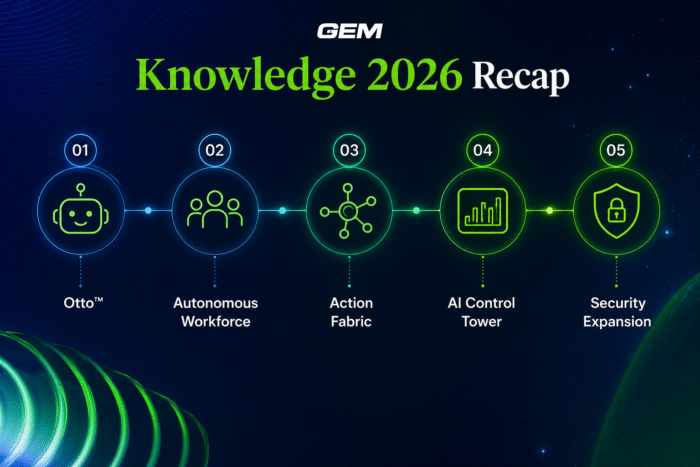
The New ServiceNow AI Landscape: What Changed at Knowledge 2026
For organisations planning their ServiceNow AI roadmap, these are the five announcements from Knowledge 2026 that change the calculus:
1. ServiceNow Otto™: Unified AI experience across workflows and personas
One of the most significant developments for organisations planning a ServiceNow AI implementation is the introduction of ServiceNow Otto™. The platform now brings together Now Assist, Moveworks (acquired in Dec 2025), and AI Experience under a single AI brand. The result is a more consistent AI experience across the enterprise, enabling employees to interact with AI seamlessly across IT, HR, finance, customer service, and operational workflows.
2. Autonomous Workforce Expansion: Role-scoped AI specialists for all functions
The Autonomous Workforce expansion represents another major milestone in the evolution of ServiceNow AI implementation. What began with the L1 IT Service Desk AI Specialist has expanded into a portfolio of role-specific AI specialists designed for virtually every enterprise function. With the L1 IT Specialist already generally available and additional specialists launching throughout 2026, organisations can now deploy AI capabilities tailored to specific business processes, responsibilities, and outcomes rather than relying on generic AI assistants.
3. ServiceNow Action Fabric + MCP Server: Integrate any external AI agent through governed workflows
ServiceNow Action Fabric is the headline architectural innovation of 2026. Any external AI agent: Claude, Copilot, Gemini, or a custom model, can now route governed enterprise actions through ServiceNow via a Model Context Protocol (MCP) Server. This is included in all Now Assist and AI Native SKUs, and positions ServiceNow as the connective tissue for the multi-agent enterprise. Every action is governed, auditable, and grounded in business context. These capabilities fundamentally redefine what a large-scale ServiceNow AI implementation can achieve across enterprise workflows.
4. AI Control Tower Enhancements: ROI tracking, compliance, observability
New ROI tracking, observability, and compliance capabilities give organisations greater visibility into the performance and value of their AI investments. For enterprises pursuing a large-scale ServiceNow AI implementation, these enhancements provide a centralised way to measure outcomes, govern AI assets, and demonstrate business value across the organisation, not just for ServiceNow-native models.
5. Security Stack Expansion: Real-time asset discovery & AI-driven security workflows
Acquisitions of Armis (closed April 2026) and Veza (closed March 2026) add real-time asset discovery, cyber exposure management, and identity security, all natively integrated with AI-driven workflows. As organisations scale their ServiceNow AI implementation, these capabilities help ensure that AI-driven workflows operate within a secure, governed, and compliant enterprise environment.
From AI Adoption to Measurable Business Value
Ready to make your ServiceNow AI implementation deliver measurable results?
A successful ServiceNow AI implementation requires clean data, workflow orchestration, governance, and outcome-based measurement. The gap between potential and actual results is wide, but the right approach delivers ROI fast.
If you’re evaluating your ServiceNow AI roadmap, GEM’s experts help you identify the gaps, opportunities, and priorities needed to scale AI with confidence.
Avoid the mistakes that cause many ServiceNow programmes to stall after go-live: 3 Reasons Why ServiceNow Implementation Lose Momentum After Go-Live and Strategies for Success for Australian Enterprises