




Case study
6-Month Smart Manufacturing Transformation: Powering a Sustainable, AI-Ready Factory
- Team size: 7
- Development time: 6 months
Explore more case study
Background
Manufacturers are moving from isolated automation toward connected, intelligent, and increasingly autonomous operations, with AI reshaping how factories plan, produce, and improve. Investment is accelerating: 80% of manufacturing executives plan to allocate at least 20% of improvement budgets to smart manufacturing, including automation, analytics, sensors, and cloud technologies. Yet scaling remains a challenge, Deloitte found that 84% of manufacturers generate measurable value from AI, but only 20% of use cases are scaled.
Against this backdrop, a global automotive manufacturer launched a smart manufacturing initiative combining a scalable MLOps environment for AI-driven material labeling and model lifecycle management with an AI agent framework for real-time factory coordination.
GEM joined as an engineering partner, building the technical foundation for scalable Smart Manufacturing, industrial AI, and intelligent factory operations.
Challenges
Before implementation
- Fragmented data: Manufacturing data remained distributed across on-premises systems.
- Manual AI lifecycle: Model training, deployment, monitoring, and retraining were difficult to scale.
- Legacy architecture: The monolithic system limited flexibility and maintainability.
- Complex coordination: Production, quality, logistics, and safety required faster coordination.
During implementation
- Architecture migration: Decomposing the monolith into scalable microservices.
- MLOps automation: Structuring the end-to-end AI lifecycle.
- System integration: Connecting cloud infrastructure with OT systems, IoT devices, and real-time data.
- Operational continuity: Introducing CI/CD and observability without disrupting manufacturing operations.



Solution
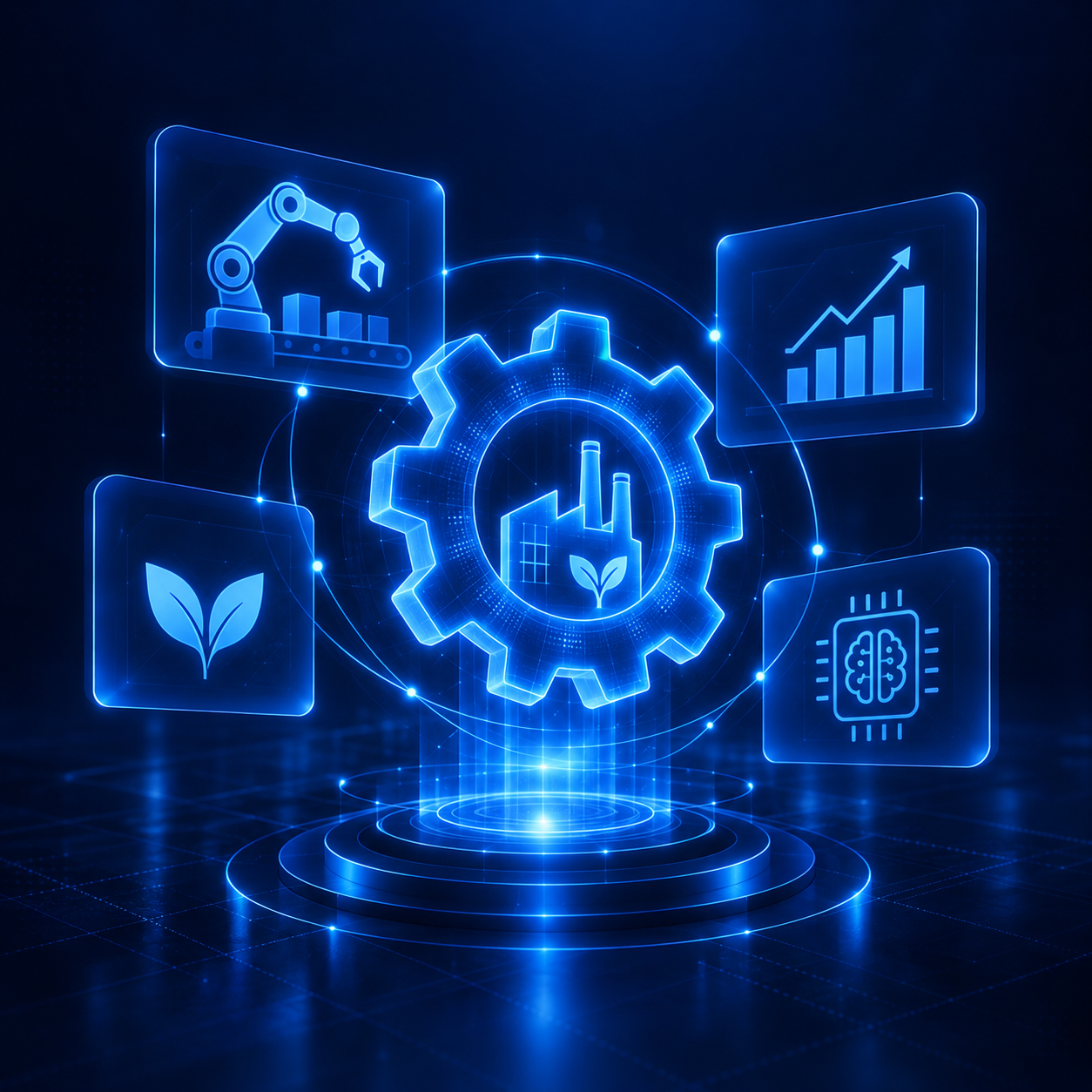
GEM proposed a modern manufacturing intelligence foundation built around four core capabilities: microservices modernization, MLOps automation, an AI-ready manufacturing foundation, and CI/CD with observability.
1. Microservices Architecture Migration
GEM analyzed the existing monolithic application landscape and designed a target microservices architecture aligned with future scalability requirements.
The work covered:
- Service decomposition
- API restructuring
- Database analysis
- Module redesign
- Integration planning
The resulting architecture provides a more modular foundation for maintainability, deployment, and future extensibility.
2. MLOps Automation
GEM established a structured MLOps environment covering the AI lifecycle from:
Data Preparation → Training → Validation → Deployment → Monitoring → Retraining
This approach helped turn AI from an individual project activity into a more structured operational capability.
The MLOps foundation was designed to support AI-driven material labeling and model lifecycle management within the broader Smart Manufacturing transformation.
3. AI-Ready Manufacturing Foundation
GEM established the technical foundation required to support future AI-driven manufacturing operations.
The platform was designed to enable future capabilities such as:
- Event monitoring
- Workflow orchestration
- Recommendation support
- Intelligent decision assistance
These capabilities form part of the longer-term transformation roadmap rather than being presented as completed production outcomes within this engagement.
4. CI/CD and Observability Enablement
GEM implemented CI/CD pipelines and observability capabilities to improve software delivery and operational visibility.
The solution incorporated:
- Deployment automation
- Centralized logging
- Monitoring
- Performance tracking
These capabilities strengthened system reliability, operational transparency, and governance across the manufacturing technology environment.
Tech stack
- Amazon EKS
- Amazon EC2
- Amazon S3
- Amazon ECR
- AWS Lambda
- AWS Step Functions
- Amazon DynamoDB
- API Gateway
- AWS CloudWatch
- AWS Systems Manager
- Kubeflow
- MLflow
- Spark
- Java
- JSP
- Vue.js
- PostgreSQL
Output
The engagement delivered more than an application modernization project. GEM established a scalable digital foundation designed to support the client’s longer-term Smart Manufacturing roadmap.
- Modernized microservices architecture to replace the existing monolithic application structure.
- Structured MLOps environment for AI lifecycle management.
- Cloud-native foundation for future intelligent manufacturing initiatives.
- Automated CI/CD pipelines for software delivery.
- Centralized logging and monitoring capabilities.
- Observability foundation for improved operational visibility.
- Integration foundation connecting OT systems, IoT devices, and real-time data streams.
- Technical foundation designed to support future AI-driven factory capabilities.
Impacts
Operational efficiency
- 30% reduction in unplanned line stops through predictive maintenance capabilities.
- 12% improvement in first-pass yield through vision-based inspection at the production line.
- Reduced the planning refresh cycle from weekly to 2 hours, enabling more responsive production planning.
- Improved coordination across planning, quality, and maintenance through AI-enabled operational workflows.
Business transformation
- Established an AI-enabled foundation connecting production planning, computer vision, predictive maintenance, and MES/ERP integration.
- Enabled AI agents to respond to live orders and material conditions, identify production defects, and raise maintenance work orders.
- Created a more connected operating model in which quality data flows into the lakehouse for daily review.
- Established a foundation for more intelligent and increasingly autonomous, manufacturing operations.
Closing remarks
Sustainable, intelligent and smart manufacturing requires more than automation. Organizations need the architecture, data foundation, AI lifecycle management, and operational governance required to scale intelligent technologies responsibly.
Through this 6-month engagement, GEM helped establish a modern technology foundation combining microservices modernization, MLOps automation, cloud infrastructure, and observability. The result is a scalable platform designed to support the client’s continued Smart Manufacturing journey and future intelligent factory initiatives.
Explore a relevant agentic AI analytics system here: From Weeks to Under 15 Seconds: An Enterprise Agentic AI Analytics System for a Leading APAC FMCG Corporation