




Organisations are moving beyond isolated AI pilots toward workflow automation: AI-powered workflows that automate repetitive tasks, streamline operations, and support human decision-making at scale. According to a recent McKinsey report (April/2026), leading companies are already seeing nearly $3 in returns for every $1 invested in AI, with the strongest outcomes coming from focused, workflow-driven deployments rather than broad experimentation.
At the same time, low code platforms are accelerating enterprise AI workflow automation by helping enterprises prototype, integrate, and scale AI workflows faster while maintaining governance and operational control. Morgan Stanley’s analysis (May/2026) found that the number of S&P 500 companies reporting measurable AI impact nearly doubled year-over-year, reflecting a broader shift from AI experimentation to operational execution.
The 4 examples below show how enterprises across Australia, Europe, South Korea, and Japan are using enterprise AI workflow automation on low code platforms to reduce manual work, improve efficiency, and deliver measurable business outcomes.
Why Enterprise AI Workflow Automation Matters
According to Deloitte’s 2026 State of Generative AI in the Enterprise report, enterprises are increasingly deploying AI across customer service, software engineering, cybersecurity, supply chain management, and enterprise operations. At the same time, governance, trust, and measurable ROI remain critical factors in scaling enterprise AI successfully.
Meanwhile, Gartner predicts that by the end of 2026, 40% of enterprise applications will include task-specific AI agents. This signals a major transition from experimental AI deployments toward operational AI systems embedded directly into enterprise workflows.
For enterprise buyers, successful AI adoption depends on three things:
- clear operational value
- safe deployment and governance
- demonstrable ROI
That is why workflow optimisation has become one of the most practical entry points for CIOs, CTOs, COOs, and transformation leaders. It combines the speed of AI with the control of human oversight, making it easier to move from pilot to production.
To help you better understand how enterprises are applying enterprise AI workflow automation on low code platforms, we provide analysis for the 4 examples below, using the STAR framework: Situation, Task, Action, and Result.
Success Story 1: AI-Powered Invoice Automation in Australia
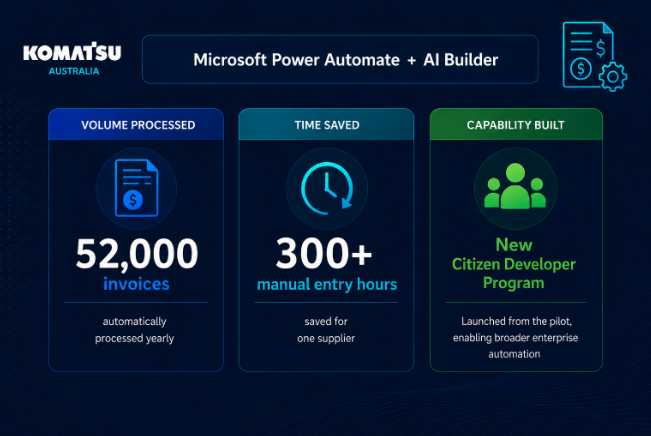
Situation: Komatsu Australia, the Australian subsidiary of a global equipment manufacturer, was manually processing nearly 52,000 invoices a year. The parts department needed a more scalable way to handle invoice-heavy operations without increasing administrative workload.
Task: The goal was to automate invoice processing with a low-code approach that could reduce manual effort, improve efficiency, and support faster business operations across finance and procurement workflows.
Action: Komatsu Australia implemented Microsoft Power Automate together with AI Builder to create an end-to-end invoice processing workflow. Microsoft says the automation was developed in just three weeks, with cloud and desktop flows used to extract invoice data, update systems, and log exceptions.
Result: The project enabled Komatsu Australia to process nearly 52,000 invoices annually while saving more than 300 manual entry hours for one supplier. Built in just three weeks, the solution also became the foundation for a broader citizen developer and automation program.
GEM’s takeaway: The fastest enterprise AI workflow automation wins often come from narrow, repetitive processes where ROI is easy to measure and operational risk is easy to contain. For COOs and finance leaders, the lesson is to start with high-volume, rules-based workflows that are painful enough to justify automation quickly.
Discover what drove the results on Microsoft here
Success Story 2: Legal Research Automation in Europe
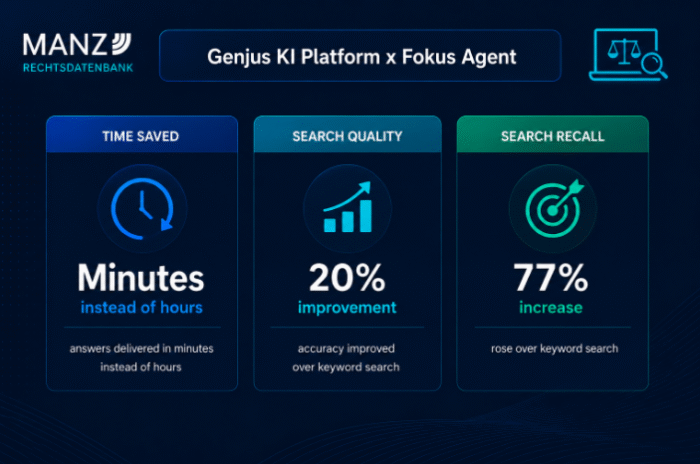
Situation: MANZ Rechtsdatenbank, an Austrian legal database, hosted more than 3.5 million documents, but basic search still required lawyers to manually review hundreds of texts. Legal teams were spending hours gathering relevant information for the case before the analysis began.
Task: The goal was to build an AI-powered legal copilot that could plan and execute multi-source legal research, while automating iterative queries and synthesis.
Action: MANZ partnered with DeepSet to extend its Genjus KI platform with Fokus, an autonomous agent feature. Fokus splits complex queries, routes them to internal and web sources, and synthesises answers with citations. The agent was built on the Haystack framework and fine-tuned for the legal domain.
Result: This is one of the strongest enterprise AI workflow automation examples in intelligent search, helping MANZ deliver trusted answers in minutes instead of hours while improving search accuracy by 20% and recall by 77%. The solution also drove strong commercial results, with hundreds of seats sold and annual revenue goals exceeded within 6 weeks.
GEM’s takeaway: In knowledge-heavy industries, AI cannot just be fast. It also has to be reliable, referenceable, and defensible. Enterprise AI workflow automation works best when it improves both speed and trust at the same time.
See how the teams adopted AI at scale on DeepSet here
Success Story 3: Healthcare Workflow Automation in South Korea
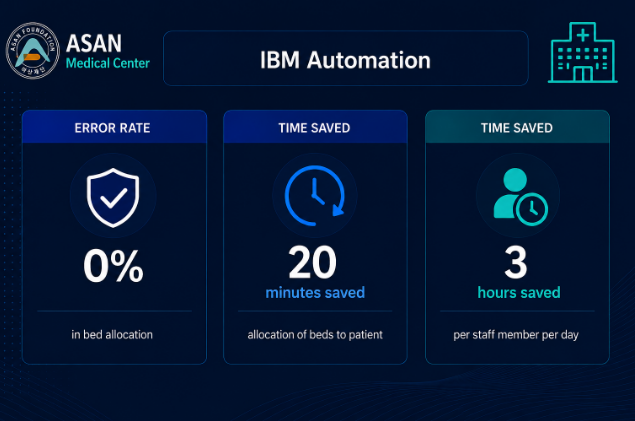
Situation: In South Korea’s highly competitive healthcare sector, Asan Medical Center wanted to improve patient service while freeing staff from repetitive administrative work. Bed allocation was a particularly complex process because many criteria had to be handled manually, and training new staff took months.
Task: The goal was to automate bed allocation and related repetitive workflows while maintaining accuracy, service quality, and operational control. The hospital needed a solution that could reduce manual workload without compromising reliability in a high-stakes healthcare environment.
Action: IBM applied automation to the bed allocation process and extended it to related tasks such as inpatient registration, reservation changes, and cancellations. The system was designed for a real hospital setting where speed, precision, and process consistency all matter.
Result: The published results are compelling: a 0% error rate in bed allocation, 20 minutes faster allocation of beds to patients, and 3 hours saved per staff member per day. This is one of the clearest enterprise AI workflow automation stories because it shows that automation can improve both service quality and workforce efficiency in a regulated environment.
GEM’s takeaway: In regulated environments, enterprise AI workflow automation is not only about saving time. It is also about reducing operational variance, improving service quality, and protecting process reliability.
See how the transformation happened on IBM here
Success Story 4: Low Code AI Transformation in Japan
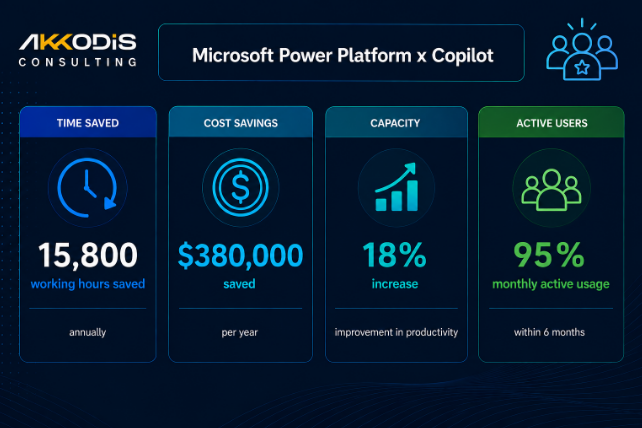
Situation: Japan’s workforce challenge is shaped by a shrinking labor pool and an aging population. AKKODiS Consulting, an engineering and consulting firm in Japan, needed to adapt both its internal operations and the way it supports clients. Microsoft’s customer story says the company moved away from a top-down transformation model and instead empowered frontline employees to drive change with low-code and AI tools.
Task: The objective was to democratise automation and AI across the organisation so the people closest to the work could build solutions themselves. That meant using Microsoft Power Platform and Microsoft 365 Copilot to improve daily operations, increase productivity, and create a repeatable culture of innovation.
Action: AKKODiS rolled out Microsoft Power Platform and Copilot Studio across its workforce. The tools were used not only for internal process improvement but also to strengthen a citizen-developer culture and explore agent-based AI for low-risk decisions. Microsoft notes that the company views this as a responsible AI ecosystem where human judgment and technology work together.
Result: AKKODiS saved approximately 15,800 working hours annually, equivalent to around $380,000 per year, through AI-driven process improvements and low-code automation. The company also reported an 18% productivity increase and 95% monthly active usage within 6 months.
GEM’s takeaway: AI-powered business process transformation is also an operating-model shift. When frontline employees can build and improve workflows themselves, organisations gain speed, ownership, and a culture of continuous improvement.
Explore the full case study on Microsoft here
What Successful Enterprise AI Workflow Automation Projects Have in Common
Across these examples, one pattern is clear: the strongest enterprise AI workflow automation initiatives built around measurable workflows, operational governance, and fast paths to business value. From GEM’s experience supporting enterprise AI transformation initiatives, 4 strategic patterns stand out:
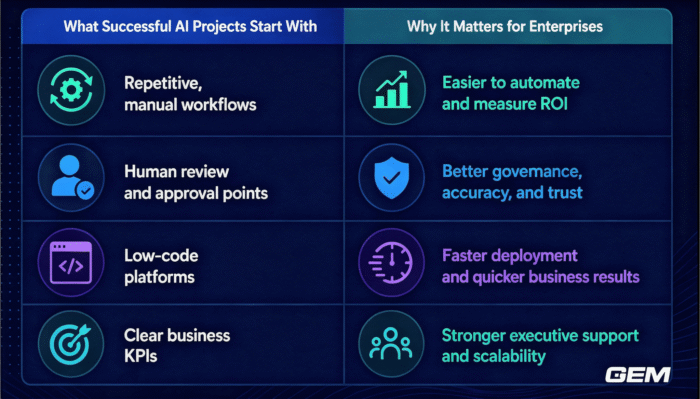
1. Start with repetitive workflows that have measurable friction
The best enterprise Ai workflow automation projects usually begin with workflows that are repetitive, time-consuming, rules-based and easy to measure. According to Deloitte’s 2026 enterprise AI research, organisations are increasingly deploying AI across customer service, software engineering, cybersecurity, supply chain operations, and enterprise workflows where throughput, productivity, and error-rate improvements can be clearly measured. The winning entry point is usually a bounded workflow where AI can remove friction and prove ROI quickly.
2. Treat governance as part of workflow design
As enterprise AI adoption accelerates, governance becomes part of the architecture itself. Human escalation paths, auditability, security controls, and approval checkpoints are becoming critical components of enterprise AI workflow automation, especially in regulated industries. A recent research paper on agentic systems also highlights a growing gap between AI deployment speed and governance maturity, reinforcing the need for human-in-the-loop operational design. Scalable enterprise AI depends as much on governance as on model capability.
3. Use low code platforms to achieve faster business impact
Low-code platforms shorten the path from pilot to operational deployment. In the examples above:
- Komatsu built an invoice automation workflow in 3 weeks
- MANZ achieved commercial traction within 6 weeks
- AKKODiS saved 15,800 working hours annually through broader automation adoption
For enterprise teams, speed matters because it reduces experimentation costs while creating faster executive buy-in.
4. Measure enterprise AI by operational outcomes
The strongest AI workflow orchestration programs are measured by operational impact:
- time saved
- throughput improvement
- error reduction
- productivity gains
- revenue acceleration
McKinsey estimates generative AI could add $2.6 trillion to $4.4 trillion in annual value, which is useful not because it sounds large, but because it reframes AI as a productivity and operating-model issue rather than a demo-level feature. For enterprise leaders, that means the right question is not whether the AI is impressive, but whether it changes the economics of work.
Final Thoughts
Low-code AI automation is becoming one of the most practical ways for enterprises to turn AI into measurable business value. For enterprises that want to go beyond experimentation, workflow automation is where AI starts to create real operational impact. At GEM Corporation, we help enterprises turn AI experimentation into scalable business outcomes. Our team specialises in enterprise AI transformation, agentic AI implementation, and low-code automation strategies tailored to complex operational environments. From customer operations and knowledge management to workflow automation and AI governance, we work with organisations to design enterprise AI solutions that are measurable, scalable, and aligned with real business priorities.
Learn more about other enterprise AI insights: How to Avoid 3 Expensive AI Pilot Mistakes