





AI Accelerators 2026: The 24 Vendors That Matter in the Enterprise AI Stack
The enterprise AI landscape in 2026 has entered a new phase: implementation gravity. Organizations are under pressure to move beyond proofs of concept and deliver production-grade AI that is secure, measurable, and integrated into real business workflows. Deloitte’s 2026 research shows the gap clearly: many enterprises are still stuck in pilot mode, while only a smaller share have scaled a meaningful portion of their AI initiatives into production.
At the same time, the market itself is changing. Google Cloud describes 2026 as the rise of the Agentic Enterprise, Microsoft is emphasizing agentic AI and marketplace-based deployment, and AWS is investing heavily in the infrastructure needed to accelerate AI from pilot to production. The message is consistent across the ecosystem: the winning advantage is no longer model access alone, but the ability to engineer, govern, and operationalize AI at scale. The real advantage now lies in the engineering depth required to convert models into reliable, autonomous, production-grade agents powered by AI accelerators 2026.
That shift has created a distinct category: AI accelerators 2026. These are the vendors and partners that compress the path from strategic intent to live capability. They help enterprises move faster from experimentation to execution, and from AI ambition to real operational impact.
Industry trackers in early 2026 continue to show that many enterprise AI initiatives still fail before reaching production. The root cause is rarely model quality. More often, it is the lack of production-grade engineering, workflow design, governance, and integration discipline. In this environment, success depends on agentic engineering delivered through AI accelerators 2026 ecosystem by partners who can prove measurable outcomes.
This guide highlights the 24 AI accelerators 2026 vendors buyers should understand, organized by the role they play in the enterprise stack.
What are AI Accelerators in 2026?
AI accelerators are any tools or partners that help a company adopt AI faster and with less risk. As organizations move from experimentation to production, AI accelerators 2026 increasingly determine how quickly business value can be realized. It includes developer productivity tools, cloud and data infrastructure, SaaS platforms with native agents, and implementation partners that can take AI from prototype to production.
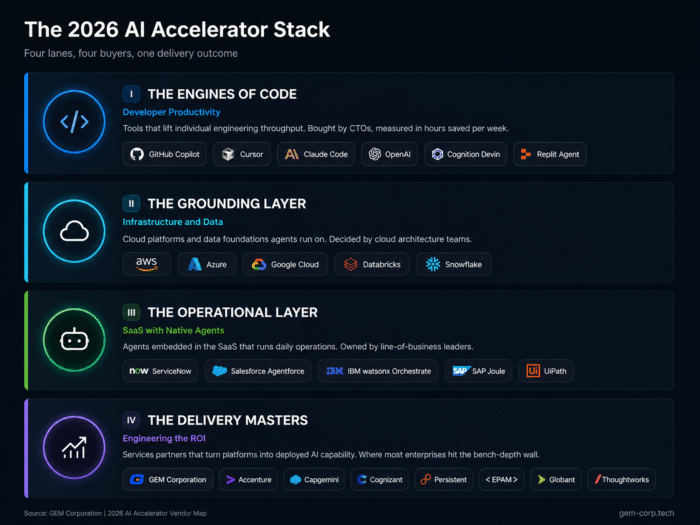
The most useful way to think about the market is as a stack:
- Developer productivity
- Infrastructure and data
- Operational SaaS with native agents
- Delivery partners and systems integrators
This stack-based view reflects how enterprise AI is actually being bought and deployed in 2026: not as a single product, but as an ecosystem of tools and services powered by AI accelerators 2026 that must work together. Understanding the AI accelerators 2026 market through a stack model helps enterprise buyers evaluate where each vendor fits and where investment priorities should be placed.
The 4 Layers of the AI Accelerators Stack 2026
I. The Engines of Code: Developer Productivity
These tools accelerate engineering teams directly. They compress development timelines, reduce context switching, and help teams move from idea to implementation faster as part of the broader AI accelerators 2026 landscape.
1. GitHub Copilot
GitHub Copilot remains a central force in the modern developer workflow. It has evolved from a code completion assistant into a broader platform supporting the full software development lifecycle. In 2026, it offers deeper repository awareness and can help refactor modules from natural language prompts. For teams already working inside the GitHub ecosystem, it remains one of the most practical choices.
2. Cursor
Cursor has become a preferred AI-native IDE for professional engineers. Its deep repository indexing helps it answer questions about architecture, dependencies, and code relationships that traditional IDEs often miss. It reduces the context-switching burden that slows senior developers and supports a smoother path from thought to implementation. For backend-heavy teams, it is often the first tool evaluated. Explore Cursor.
3. Anthropic Claude Code
Claude Code brings Claude’s reasoning capabilities directly into the developer terminal. It supports conversational commands for complex git workflows, codebase analysis, and multi-file fixes. Engineering teams use it to automate migration work, documentation tasks, and repetitive code operations. It reflects a broader shift toward orchestration-based engineering, where developers act more like conductors than manual typists. Learn more about Anthropic Claude Code.
4. OpenAI Enterprise
OpenAI continues to define the standard for general-purpose reasoning agents inside the corporate world. Their enterprise tier provides the security and dedicated capacity required for large-scale data analysis, and it remains the default choice for organizations that need a versatile assistant capable of bridging the gap between raw code and executive-level business insights. The integration of advanced reasoning models allows it to solve multi-step logic problems that historically required human experts. Explore enterprise solutions at OpenAI.
5. Cognition (Devin)
Cognition has positioned Devin as the most autonomous coding agent commercially available. It is optimized for tasks with clear success criteria, including bug backlogs, technical documentation, and migration work. Pricing dropped from $500 per month to $20 plus $2.25 per Agent Compute Unit, materially expanding the addressable market. After the 2025 acquisition of Windsurf, Cognition now offers both autonomous and IDE-led patterns under one portfolio. See Cognition.
6. Replit Agent
Replit Agent grew revenue ten times in the nine months following its launch and raised a $400 million Series D at a $9 billion valuation. Agent 4 introduced parallel task forking that auto-resolves merge conflicts roughly 90 percent of the time. Replit’s strength is browser-based development with full environment provisioning, which lowers the friction for prototyping teams and new engineers. Visit Replit.
Collectively, these vendors represent the fastest-growing segment of the AI accelerators 2026 ecosystem because they directly improve engineering productivity and reduce development cycle times.
II. The Grounding Layer: Infrastructure and Data
AI agents require a strong data and infrastructure foundation. Without that layer, even the best model will fail in production. These vendors provide the bedrock for scalable enterprise AI built on AI accelerators 2026 infrastructure.
7. Amazon Web Services (AWS)
AWS focuses on the modernization aspect of the AI journey through its Q Developer agent. The tool is tuned to refactor legacy Java and .NET estates into modern, cloud-native architectures, allowing enterprises to clear technical debt before deploying new AI capabilities. AWS provides the scale required for high-frequency model training and real-time inference, and remains the primary choice for organizations with large on-premise footprints moving toward a hybrid cloud model. See AWS.
8. Microsoft Azure
Azure offers the path of least resistance for the global corporate workforce. It connects AI modernization directly to the Microsoft 365 ecosystem, which allows for direct deployment of agents across Teams and Outlook. The OpenAI partnership ensures Azure users have first-day access to the latest models, and the platform’s low-code agentic workflow tooling makes it accessible for non-technical business units. Azure remains the dominant choice for environments standardized on the Microsoft stack. See Azure AI.
9. Google Cloud
Google Cloud has repositioned Vertex AI as the Gemini Enterprise Agent Platform. It focuses on connecting deep data stored in BigQuery with real-time agentic execution, and Google’s strength sits in handling multi-modal inputs, which makes it the preferred platform for data-intensive industries. Google Cloud committed $750 million in April 2026 to fund partner-led agentic AI development, the largest single commitment of its kind. Find out more at Google Cloud.
10. Databricks
Databricks defines the Lakehouse Architecture of 2026. It provides the unified data foundation that agents need to operate accurately on enterprise data. By integrating the Mosaic AI stack, Databricks allows companies to build custom models grounded in proprietary data, ensuring that agents understand the specific semantics of the business, from supply chain logic to financial reporting. It is essential for any data-first organization. Visit Databricks.
11. Snowflake
Snowflake repositioned in April 2026 as the control plane for the agentic enterprise. Cortex Code now supports connectivity with other AI agents via the Model Context Protocol and the Agent Communication Protocol, with a Claude Code plugin available out of the box. Snowflake Intelligence acts as a personal work agent for business users, learning individual workflows over time. For organizations whose enterprise data already lives in Snowflake, this control plane increasingly matters more than the model choice itself. See Snowflake.
As enterprise AI adoption matures, infrastructure-focused AI accelerators 2026 providers are becoming increasingly critical for governance, scalability, and data-grounded agent performance
III. The Operational Layer: SaaS with Native Agents
These platforms embed AI directly into the software that runs the daily operations of a business, increasingly powered by AI accelerators 2026 platforms.
12. ServiceNow
ServiceNow is the recognized leader in agentic collaboration. Its Now Assist agents operate across IT, HR, customer service, and finance to automate complex ticket resolutions. The platform uses a human-in-the-loop model to ensure AI-driven decisions are vetted by a subject matter expert, which reduces the risk of automated errors in critical business processes. It has become the central nervous system for modern enterprise workflow automation. Explore NowAssist at ServiceNow.
Also explore: How ServiceNow can build resilient IT operations?
13. Salesforce Agentforce
Salesforce has moved beyond CRM tools to offer a fully autonomous agent workforce. Agentforce agents use proprietary customer data to handle service requests and marketing campaigns with high accuracy, operating within the guardrails of the Salesforce Trust Layer for data privacy and regulatory compliance. This allows companies to scale customer-facing operations without a linear increase in headcount. Learn more at Salesforce.
14. IBM Watsonx Orchestrate
IBM Watsonx Orchestrate ships with 100+ domain-specific agents, 400+ prebuilt tools, and an Agent Catalog. The platform’s strength sits in regulated industries: financial services, healthcare, and public sector buyers consistently shortlist Watsonx for the auditability, lineage, and policy controls baked into its agent runtime. See IBM.
15. SAP Joule
SAP Joule reached general availability for its agent builder studio in Q1 2026, providing collaborative AI agents across the SAP business application suite. For enterprises whose process backbone runs on SAP, Joule is the natural agent layer because it inherits SAP’s data model, identity, and process semantics. Explore SAP Joule.
16. UiPath
UiPath has repositioned around agentic automation, combining its RPA footprint with LLM-driven decision making. As a Premier ServiceNow partner with the first IntegrationHub Spoke and a certified Test Manager Connector, UiPath is the most common choice when organizations want to combine deterministic automation with AI agents on the same platform. See UiPath.
This category demonstrates how AI accelerators 2026 are evolving beyond model development and into day-to-day operational execution across business functions.
IV. The Delivery Masters: Engineering the ROI
Platforms and tools provide the foundation. Delivery partners turn that foundation into production results. In 2026, the most valuable AI accelerators 2026 vendors are not only software products but also implementation partners capable of owning outcomes end to end.
17. GEM Corporation
GEM Corporation operates at the frontier of high-velocity AI delivery and represents a new generation of implementation-focused AI accelerators 2026 partners that help enterprises move from strategy to production faster. Headquartered in Vietnam, with delivery offices in Japan, Korea, and Australia, GEM runs an AI-first model with 400+ consultants spanning AI engineering, data engineering, data science, automation testing, business analysis, QA, and DevOps. Every consultant works with Claude Code, GitHub Copilot, MS Copilot, and OpenAI tooling integrated into daily delivery, and senior engineers validate every output before it ships.
That delivery model translates into four outcomes that matter to enterprise buyers in 2026. First, faster time-to-deployment, because AI-accelerated build cycles paired with senior validation keep the rework rate low. Second, end-to-end accountability, because GEM owns the full lifecycle from AI readiness assessment through agentic architecture design, agent development, AIOps, and MLOps without vendor handoffs. Third, compliance-ready execution, because CMMI Level 3, ISO 27001, ISO 9001, and ISTQB Gold Partner certifications mean the firm’s process meets audit and security expectations of regulated industries without retrofitting. Fourth, predictable scale across APAC, because GEM dispatches certified engineers across Korea, Japan, ANZ, and Singapore in a hybrid onsite-offshore squad model, with consultants speaking fluent English, Japanese, and Korean.
GEM holds official consulting partnerships with both Databricks and ServiceNow. On Databricks, GEM dispatches Databricks Professional engineers for Data Engineering, Data Visualization, ML Engineering, and AI agent development on Lakehouse Architecture. On ServiceNow, 30+ certified consultants build, configure, and govern agentic workflows inside Now Assist. Industry delivery experience covers FSI, Healthcare, Fintech, HR Tech and HCM, Retail and Omnichannel, General Mobile Applications, and Manufacturing. GEM does not sell promises; the firm delivers the engineering depth that turns AI investment into measurable return. Visit GEM Corporation.
18. Accenture
Accenture stands as the largest global entity for AI implementation. The firm uses its scale to deploy enterprise playbooks across every major industry sector, and its flagship partnership with OpenAI brings experimental technology into the world’s largest corporations under tight security controls. Accenture is the primary choice for global conglomerates needing massive implementation bandwidth across multi-continent rollouts and heavy change management. Its reach is unmatched in global consulting. See Accenture.
19. Capgemini
Capgemini emphasizes the intelligent industry concept and the transformation of business processes. After the $3.3 billion acquisition of WNS in 2025, the firm built a practice dedicated to high-impact agentic operations. Capgemini helps companies move from fragmented data sets to a unified AI strategy, with a focus on the long-term sustainability of AI systems within complex global supply chains. The firm suits organizations looking for a steady, consult-first partner for multi-year transformations. Visit Capgemini.
20. Cognizant
Cognizant has been recognized as a frontier firm for deploying agentic AI at scale. The firm specializes in modernizing the core systems of large financial and healthcare organizations, with an emphasis on creating self-healing IT environments through AI automation. Cognizant provides the deep bench strength needed for continuous delivery in highly regulated markets, bridging the gap between legacy stability and AI innovation. See Cognizant.
21. Persistent Systems
Persistent Systems has emerged as a visible leader in productizing AI delivery. The firm focuses on building reusable software accelerators on top of major platform licenses, allowing clients to bypass the initial phases of agent development and move directly to customization. Persistent maintains strong technical ties to the hyperscaler ecosystem, and the model appeals to firms that want to combine engineering depth with a library of pre-built AI assets. Find out more at Persistent Systems.
22. EPAM Systems
EPAM Systems brings a rigorous engineering culture to the AI accelerator market. The firm is recognized for handling complex, custom software development in financial services and life sciences, and its teams focus on the hard engineering problems of AI integration: data privacy, complex API orchestration, and high-quality custom code. EPAM often serves as the primary technical partner for firms with highly specific architectural requirements. Visit EPAM Systems.
23. Globant
Globant has built one of the more visible AI service practices among the global digital engineering firms, with a public emphasis on agentic delivery and a portfolio of reusable accelerators. Its scale across the Americas and Europe makes it a frequent shortlist entry for enterprise agentic projects. See Globant.
24. Thoughtworks
Thoughtworks brings the engineering rigor for which it is known into agentic territory: continuous delivery, evolutionary architecture, and the testing discipline that agent harnesses now require. For clients with internal engineering cultures already aligned with modern delivery practices, Thoughtworks is often a natural fit. Visit Thoughtworks.

How to Read the AI Accelerators Vendors 2026 Map
The 24 vendors above do not all compete directly. They operate across different layers of the enterprise stack, and each layer represents a separate decision.
The Developer Productivity tier is the easiest to trial and the fastest to reverse. Tools like GitHub Copilot, Cursor, Claude Code, OpenAI Enterprise, Devin, and Replit Agent can be tested team by team and evaluated within a quarter. For most enterprises, this layer should already be in production or at least in active pilot mode within their AI accelerators 2026 strategy.
The Infrastructure and Data tier is usually shaped by existing cloud commitments. AWS, Azure, and Google Cloud often reflect prior enterprise architecture decisions, while Databricks and Snowflake define the data foundation for AI-grounded agents.
The SaaS Operational tier is where AI typically creates the clearest business value, but also where implementation is hardest. ServiceNow Now Assist, Salesforce Agentforce, IBM Watsonx Orchestrate, SAP Joule, and UiPath all require workflow design, identity governance, audit logging, and human-in-the-loop oversight. The challenge is the integration and operational design required to fully leverage AI accelerators 2026.
The Delivery Masters tier is the strategic decision. Picking the right engineering partner is increasingly as important as picking the right platform. Platforms can be procured quickly. The ability to turn them into working, compliant, production systems is what separates leaders from laggards.
For enterprises that want AI accelerators 2026 to deliver real business value, the winning formula is clear: pair the right platform with the right implementation partner, and make sure the partner owns delivery end to end.
If your AI roadmap for the next 12 months depends on accelerators actually reaching production, the partner question deserves the same scrutiny as the platform question. Talk to GEM Corporation about a delivery squad sized to your 2026 plan.
Let’s find out about: How AI And Cloud Integration is Reshaping Business Operations