




Contents
- What is ServiceNow GRC? And Why It Matters
- Core Capabilities of the ServiceNow GRC Platform
- Types of Risks Addressed in ServiceNow GRC
- How an Integrated Risk Management Approach Works
- Benefits of ServiceNow GRC Implementation
- ServiceNow GRC in Action: Real-World Use Cases
- Building a Resilient GRC Strategy: Best Practices for Implementation
- Measuring GRC Program Performance
- GEM’s ServiceNow Capabilities
- Conclusion
Managing risk and meeting compliance demands is no longer just a box-ticking exercise. It’s now tied directly to business performance, stakeholder confidence, and operational continuity. ServiceNow GRC helps organizations bring structure to risk oversight and make compliance more manageable across teams. In this article, we’ll look at what the platform offers, the types of risks it addresses, how it fits into broader risk strategies, and how businesses are using it to strengthen internal controls. Let’s break down how ServiceNow GRC supports smarter decision-making and more accountable operations.
What is ServiceNow GRC? And Why It Matters
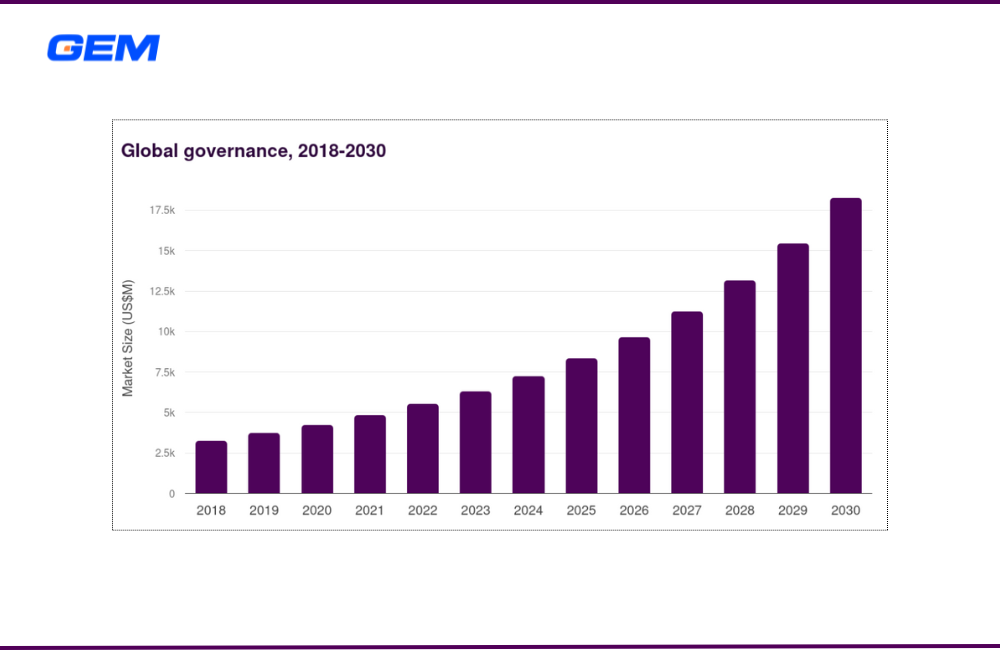
With the GRC cybersecurity market projected to grow at a 17% CAGR through 2030, demand for scalable, platform-based solutions continues to rise. ServiceNow is named a leader in the GRC space by Forrester, receiving the highest possible scores in 12 criteria, including innovation and workflow automation. This reflects its growing relevance for enterprises looking to move from fragmented compliance programs to connected, actionable risk strategies.
ServiceNow GRC (Governance, Risk, and Compliance) is a cloud-native platform designed to bring risk, compliance, and audit processes into a single system of record. It helps organizations align risk efforts across IT, security, and business functions by automating control workflows, centralizing risk data, and enabling real-time tracking of compliance status. Key capabilities include automated control testing, risk intelligence, integrated business continuity tools, and a centralized approach to third-party oversight.
Core Capabilities of the ServiceNow GRC Platform
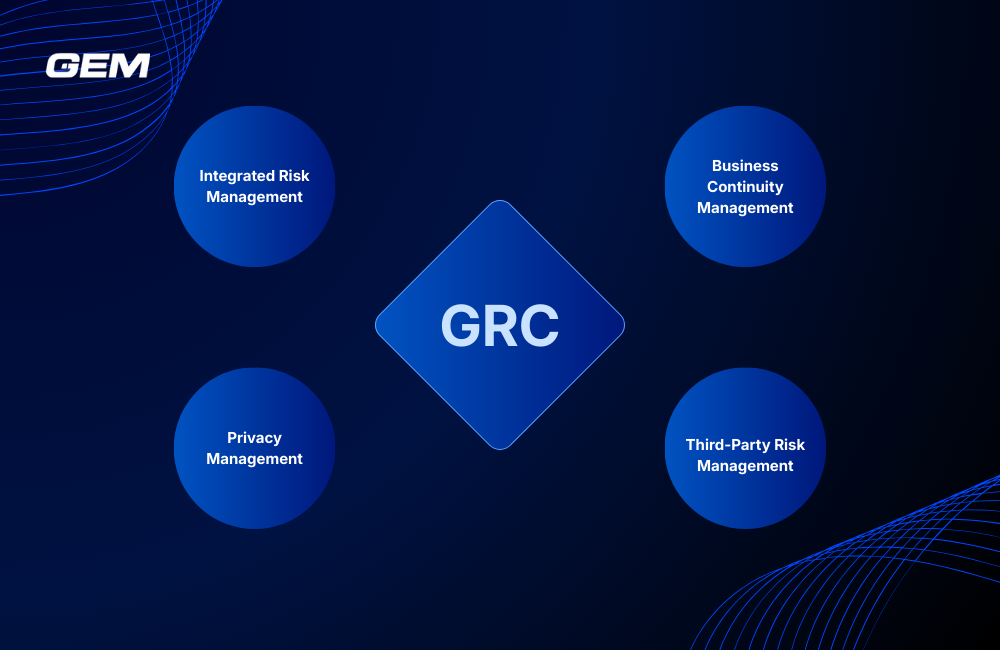
ServiceNow GRC is structured around modular capabilities that help organizations operationalize governance, risk, and compliance activities across the enterprise. Each module is designed to serve a discrete function, while working in concert to create a unified risk posture.
Integrated Risk Management
This module provides a consistent framework for capturing, evaluating, and monitoring risks across business units. Risk data is connected to relevant business processes and assets, allowing teams to assess exposure in real time. Organizations can define risk thresholds, score risks based on impact and likelihood, and create automated workflows to assign follow-up actions. Integration with ServiceNow’s CMDB and incident data supports continuous risk monitoring and scenario planning.
Business Continuity Management
ServiceNow’s continuity management tools allow organizations to identify critical dependencies, assess potential impacts of disruptions, and build recovery strategies aligned with business priorities. The module supports crisis response coordination, real-time status tracking, and testing of recovery plans. Visual dependency maps and impact simulations help decision-makers prioritize response efforts during high-impact events.
Privacy Management
This application helps manage regulatory requirements tied to personal data, including GDPR, CCPA, and other regional laws. Teams can automate privacy impact assessments (PIAs), maintain records of processing activities, and monitor the status of regulatory obligations. Built-in workflows guide stakeholders through data classification, consent tracking, and breach response procedures. Privacy risks are linked to business services and assets, giving visibility across the data lifecycle.
Third-Party Risk Management
This module centralizes the management of vendor and supplier risk by consolidating due diligence, onboarding, and continuous monitoring into a single system. Organizations can automate third-party risk assessments, assign risk ratings, and track remediation actions. Integration with contract data and performance metrics helps assess vendor health and reduce exposure from third-party failures or non-compliance.
Types of Risks Addressed in ServiceNow GRC
ServiceNow GRC is built to address a broad spectrum of risk categories. Each type is mapped to platform functions that support detection, assessment, and mitigation.
- Strategic Risk
This includes risks tied to long-term business decisions, such as entering new markets or launching new products. ServiceNow helps track strategic initiatives, assess alignment with risk appetite, and monitor key risk indicators that may impact business direction.
- Operational Risk
Failures in day-to-day operations, whether from process breakdowns, human error, or external events, can disrupt service delivery. The platform enables centralized tracking of such risks, linking them to business services and providing visibility into their potential impact on performance.
- Technology Risk
Technology risks stem from failures in systems, software, or infrastructure. ServiceNow connects these risks to IT assets, change requests, and incident data, helping teams identify vulnerabilities and maintain service continuity through proactive controls.
- Data Risk
The loss, corruption, or unauthorized access of data can result in compliance violations and reputational damage. ServiceNow supports classification of sensitive data, tracks where it resides, and provides workflows to manage data protection and breach response.
- Cyber Risk
Cybersecurity threats, such as malware, phishing, and unauthorized system access, are tracked through integrations with security operations tools. ServiceNow GRC allows organizations to link cyber risks to business assets and monitor control effectiveness in real time.
- Privacy Risk
Privacy concerns arise when personal or regulated data is exposed or mishandled. ServiceNow’s privacy module helps identify where sensitive data lives, who has access, and what safeguards are in place to prevent misuse or non-compliance.
- Reputational Risk
Reputation can suffer from service failures, regulatory breaches, or ethical lapses. ServiceNow allows organizations to link reputation-impacting risks with relevant business services and monitor early warning indicators that signal rising exposure.
- Third-Party Risk
Vendors and suppliers can introduce security, operational, or compliance risks. ServiceNow centralizes third-party information, automates risk scoring, and tracks performance metrics to maintain oversight of external relationships.
- Compliance / Regulatory Risk
Regulatory compliance remains a major concern across industries. With ServiceNow, organizations can centralize policies, map them to applicable controls, and audit compliance efforts in real time. Automated evidence collection and reporting simplify audit preparation and reduce administrative overhead.
How an Integrated Risk Management Approach Works
An integrated risk management (IRM) model enables organizations to shift from fragmented risk handling to a unified, intelligence-driven strategy. ServiceNow GRC supports this transition by combining risk, compliance, and governance data into a single platform, making it easier to monitor exposure, align risk responses with business goals, and drive accountability across functions.
Rather than treating risk as a standalone activity owned by a single department, IRM embeds it into enterprise-wide processes. Risk data is continuously collected from operational systems, third-party relationships, and compliance workflows. This allows teams to assess risk in context, prioritize based on business impact, and act using shared data and automated workflows.
For integrated risk management to be effective, a GRC program must meet several key criteria:
- Be sponsored by senior executives and cross-functional leaders (CISO, CIO, CFO, General Counsel) who can drive strategy and alignment.
- Foster a culture where risk awareness is embedded into everyday decision-making.
- Operate on a cloud-based platform that supports scalability, cross-functional collaboration, and continuous improvement.
- Integrate with other enterprise systems, such as ITSM, HR, procurement, or finance to extract relevant data and trigger actions automatically.
- Leverage common data models and taxonomies to reduce duplication and enable cross-leveraging of insights.
- Address business risks at both the enterprise and third-party levels, using a shared framework for scoring and response.
- Use process-based workflows to guide investigations, assessments, and remediation activities.
- Embed risk insights into operational tools, such as dashboards for service delivery teams or alerts for compliance owners.
- Make information accessible to frontline employees, not just risk professionals, to encourage broader participation.
- Use automated risk indicators and control monitoring to detect issues early and reduce manual effort.
- Translate risk into business terms using real-time visualizations tailored for executives and board-level reporting.
- Maintain this model across departments, vendors, and geographies, providing a consistent, enterprise-wide view of risk posture.
Read more: Discover how Data Platform Transformation enables unified, enterprise-level risk intelligence.
Benefits of ServiceNow GRC Implementation
Organizations implementing ServiceNow GRC typically realize both operational and strategic benefits. By unifying risk and compliance activities on a single platform, teams can work more efficiently, adapt faster to change, and build trust with internal and external stakeholders.
Key outcomes include:
- Lower operational costs by automating control testing, evidence collection, and reporting activities that would otherwise require manual effort.
- Fewer penalties and audit findings through improved compliance tracking and real-time control monitoring.
- Improved vendor oversight by automating third-party risk assessments and consolidating supplier data.
- Faster adaptation to change, whether driven by new regulations, digital transformation, or evolving business models.
- Operational efficiency, as redundant tasks are eliminated and teams can focus on higher-value activities.
- Scalable risk management automation, supporting growth without adding administrative complexity.
- Better data access, giving stakeholders a single source of truth for risk and compliance management metrics across the enterprise.
- Process consistency, with standardized workflows that reduce variation and improve audit readiness.
- Improved productivity by automating repetitive actions and reducing the need for manual follow-up.
- Stronger communication with business leaders and boards, supported by clear dashboards and business-aligned reporting.
- Faster, more confident decision-making, with access to real-time risk data and scenario modeling.
- Reputation advantage, as customers and partners recognize the organization’s structured approach to risk and data protection.
Stop trying to find the dots. Let us help you connect them!
With GEM as your ServiceNow Partner, accelerate delivery, reduce complexity, and gain a competitive edge in today’s fast-changing market.
ServiceNow GRC in Action: Real-World Use Cases
ServiceNow GRC supports a wide range of operational scenarios by integrating data, automating processes, and aligning risk activities with business priorities. Below are key use cases that demonstrate how organizations apply the platform to address real challenges.
Streamline Internal Audit Workflows
Audit teams often face delays caused by fragmented data and manual tracking. With ServiceNow GRC, audit planning, scheduling, and execution are handled within a centralized system. Teams can access documentation, evidence, and control status in real time, which reduces administrative burden and improves audit cycle times. The platform also supports issue tracking and remediation workflows, helping stakeholders close gaps efficiently and with full traceability.
Identify Potential Risks
Risk identification is no longer limited to periodic assessments. ServiceNow GRC centralizes risk information and automates evaluations based on predefined criteria. Risk owners can apply consistent scoring models, monitor key indicators, and prioritize risks based on business impact. The result is a dynamic risk profile that reflects the organization’s current posture across operational, strategic, and third-party domains.
Integrate with Other ServiceNow Products
ServiceNow GRC connects seamlessly with ITSM, HR Service Delivery, and other modules, allowing organizations to use existing workflows and data sources. For example, incidents in ITSM can automatically trigger control testing or risk reassessments in GRC. This integration helps eliminate silos, increase transparency, and improve responsiveness. ServiceNow Managed Services support ongoing updates and performance monitoring, helping teams maintain alignment across modules.
Business Continuity and Disaster Recovery
Business continuity planning requires coordination across departments and systems. ServiceNow’s tools help organizations identify critical processes, assess disruption impacts, and define recovery strategies. Crisis response features support plan execution, while simulation tools test readiness under different scenarios. Documentation and status updates are tracked centrally, allowing leadership to make informed decisions during unplanned events.
Compliance with Regulation
Regulatory obligations continue to evolve, placing pressure on compliance teams to stay current and audit-ready. ServiceNow GRC module maintains a centralized library of applicable regulations, policies, and standards. The platform supports control mapping, evidence collection, and automated testing, giving teams real-time visibility into compliance status. Dashboards and reporting tools help surface issues early and track resolution timelines, improving both internal oversight and external audit outcomes.
Building a Resilient GRC Strategy: Best Practices for Implementation
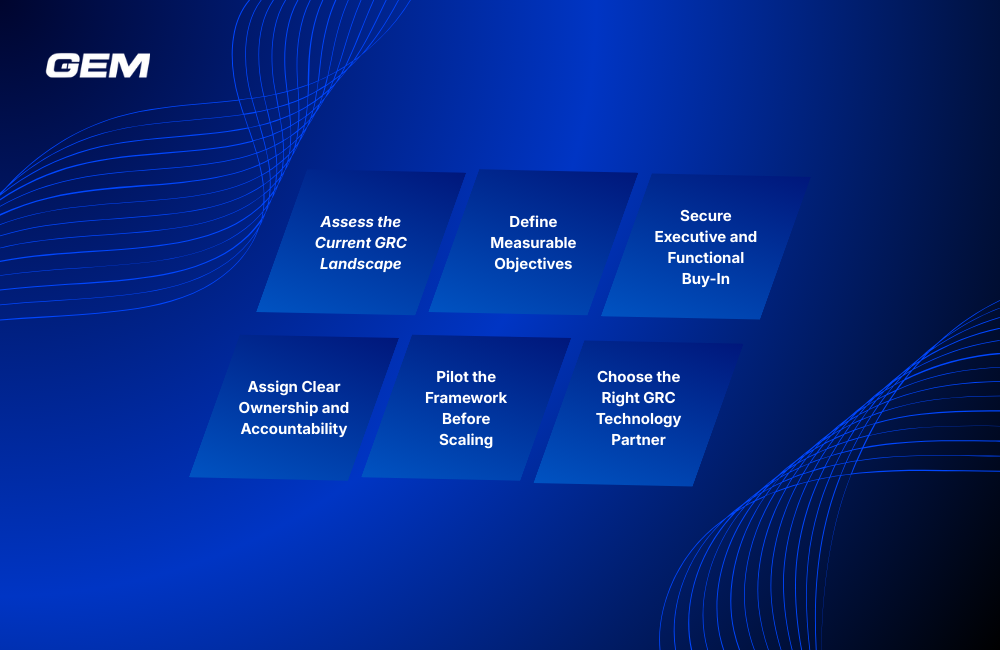
Launching a GRC program that supports long-term business goals requires more than just deploying technology. It involves aligning stakeholders, setting measurable targets, and maintaining flexibility to adjust as risks evolve.
- Assess the Current GRC Landscape
Begin with a baseline assessment of the organization’s existing risk and compliance environment. Understand where gaps exist, whether in process maturity, data availability, or stakeholder engagement. This provides the foundation for setting scope and priorities.
- Define Measurable Objectives
A successful GRC strategy starts with clear, outcome-driven goals. These can include reducing audit findings, improving time to risk resolution, or increasing policy adherence. Objectives should align with business priorities and include metrics for tracking progress.
- Secure Executive and Functional Buy-In
Leadership support is necessary not only for funding but also for setting expectations across the organization. Involving executives from security, legal, finance, and operations helps align GRC initiatives with broader enterprise goals and improves adoption across teams.
- Assign Clear Ownership and Accountability
Define who is responsible for managing risks, updating controls, and responding to compliance issues. Assigning ownership ensures tasks are completed on time and that there is a clear escalation path for unresolved items.
- Pilot the Framework Before Scaling
Testing in a smaller function, such as IT or procurement, can highlight potential issues and validate assumptions. Use feedback from the pilot to refine workflows, adjust roles, and streamline integrations before expanding to other units.
- Choose the Right GRC Technology Partner
Selecting a platform that supports automation, reporting, and cross-functional collaboration is essential. ServiceNow GRC brings these capabilities into a single platform, giving organizations the tools to manage risk dynamically and in coordination with other business systems. A strong ServiceNow implementation partner can support configuration, user training, and long-term scalability.
Read more: Explore our ServiceNow services!
Measuring GRC Program Performance
Quantifying the success of a GRC program involves assessing how effectively risk and compliance efforts support business goals. ServiceNow GRC enables organizations to establish measurable indicators that reflect both operational efficiency and strategic alignment.
Key performance areas include:
Risk Mitigation Metrics
Track the rate of risk identification, treatment, and closure. Monitor residual risk levels over time and evaluate the effectiveness of mitigation plans through control testing outcomes and incident recurrence rates.
Audit and Compliance Efficiency
Measure audit cycle times, the number of open versus closed audit findings, and control failure rates. Use automation data to assess time saved on evidence collection, reporting, and remediation workflows.
Platform Usage and Automation
Evaluate adoption across business units by tracking the volume of risk assessments completed, automated workflows triggered, and user engagement across dashboards and reports.
Third-Party Risk Oversight
Monitor the percentage of third parties assessed, time to complete due diligence, and frequency of reassessments. Metrics here can reveal the maturity of vendor governance and highlight areas for improvement.
Business Impact Indicators
Include metrics such as downtime avoided due to proactive risk response, costs avoided through early compliance issue detection, and stakeholder satisfaction with risk reporting.
GEM’s ServiceNow Capabilities
GEM Corporation delivers full-spectrum ServiceNow services that help enterprises operationalize governance, risk, and compliance while aligning with broader IT and business transformation goals. As a certified ServiceNow partner with over ten years of experience, GEM supports clients across ITSM, ITOM, ITAM, HRSD, CSM, and GRC modules.
Our teams bring a combination of platform mastery and industry-specific insight, enabling them to design and deploy solutions that reflect each client’s unique operational landscape. From integrating ServiceNow with legacy systems to automating manual risk assessment workflows, GEM structures every engagement to deliver measurable outcomes.
With over 400 professionals and a portfolio of 300+ projects delivered globally, GEM helps clients transform ServiceNow into a strategic asset, driving transparency, accountability, and operational consistency across the enterprise.
Conclusion
ServiceNow GRC helps organizations shift from fragmented efforts to a unified framework that aligns risk, compliance, and governance with overall business performance. From automating audits to managing third-party risks and supporting regulatory adherence, the platform supports real-time visibility and decision-making at scale. Combined with a structured implementation approach and measurable outcomes, it becomes a central pillar of enterprise resilience. To explore how ServiceNow GRC can support your organization’s objectives, contact GEM.
ServiceNow GRC provides a connected platform for managing enterprise risks, automating compliance workflows, and aligning governance activities with business priorities. It integrates with other systems to support real-time monitoring, assessment, and reporting.
It centralizes audit planning, execution, and documentation, giving teams real-time access to audit data. This reduces manual effort, shortens audit cycles, and improves issue tracking and resolution.
What types of risks can be addressed using ServiceNow GRC?
The platform supports management of strategic, operational, technology, cyber, data, privacy, reputational, third-party, and regulatory risks, connecting each to business processes and controls.
What are the benefits of integrating ServiceNow GRC with other ServiceNow modules?
Integration with ITSM, HRSD, and other modules breaks down silos, increases collaboration, and automates workflows. This creates a more responsive and transparent risk management environment across the enterprise.
How does GEM support the implementation of ServiceNow GRC?
GEM provides end-to-end ServiceNow services, from planning and configuration to post-launch optimization. With experience across industries and modules, GEM helps organizations operationalize risk strategies on the ServiceNow platform.