




Contents
- What is ServiceNow ITSM?
- Why ServiceNow ITSM Fails to Deliver Its Full Value
- What Good Looks Like: The Business Case for ServiceNow ITSM
- 6 Common Pitfalls in ServiceNow ITSM Setup (+ Tips to Avoid)
- 1. Neglecting Change Management Undermines Adoption
- 2. Lack of Governance Creates Demand Chaos and Debt
- 3. Early Customisations Introduce Long-Term Complexity
- 4. Skill Gaps in Admin Teams Slow Platform Maturity
- 5. Insufficient UAT Leads to Defects and Delays
- 6. Missing Strategic Alignment Limits ITSM Value
- GEM Corporation – Your ServiceNow Implementation Partner
- Conclusion
ServiceNow ITSM implementation pitfalls aren’t always technical, and that’s what makes them harder to spot. Many projects struggle not because of the platform, but due to missteps in setup, planning, and decision-making. From governance gaps to rushed customisations, these issues often surface after go-live, when course correction is more complex and costly. In this article, we’ll walk through 6 common mistakes that limit the value of ServiceNow ITSM and offer practical ways to avoid them, based on real implementation patterns and stakeholder feedback. Let’s look at where teams typically go wrong and what it takes to get it right from the start.
What is ServiceNow ITSM?
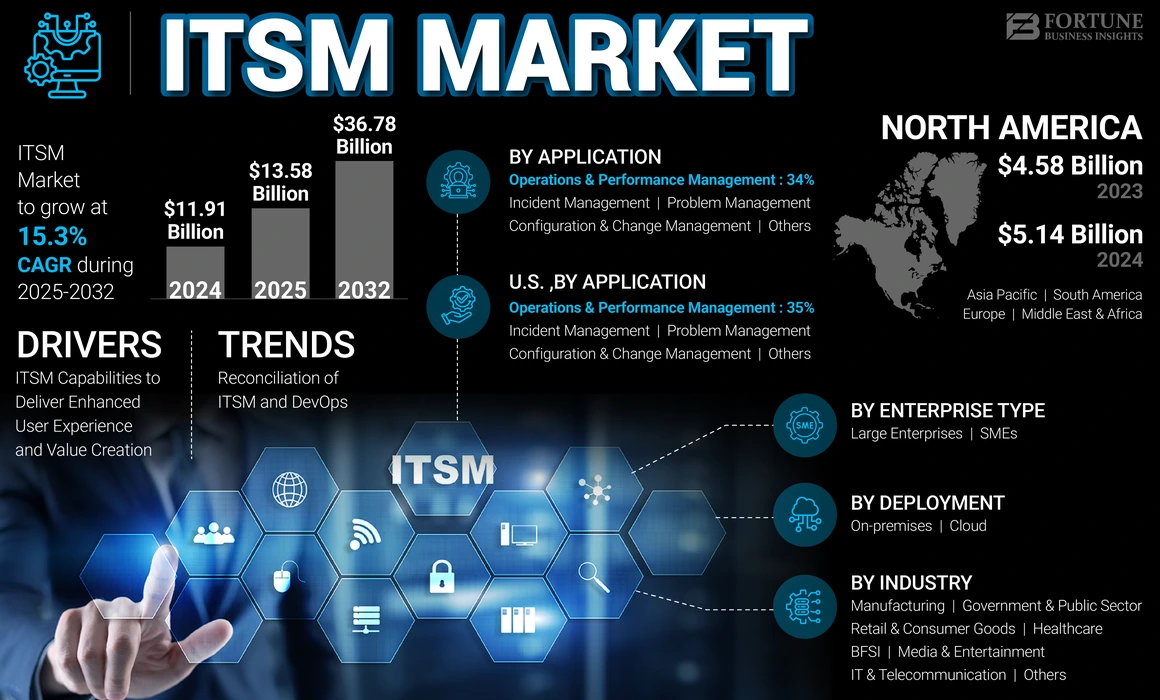
Source: Fortune Business Insights
The global ITSM market size was valued at USD 11.91 billion in 2024. It is projected to reach USD 36.78 billion by 2032, growing at a CAGR of 15.3% (Fortune Business Insights, 2024). This growth reflects the rising need for scalable, modern platforms that help organizations manage IT services more effectively.
ServiceNow ITSM (IT Service Management) is a cloud-based platform that standardizes and automates IT service processes, including incidents, problems, changes, and service requests, based on ITIL practices. It brings structure to how IT teams operate by centralizing workflows, data, and tools. The platform improves visibility and coordination across teams, helping them address service disruptions, manage change, and respond to user needs more efficiently.
Core Functions of ServiceNow ITSM:
- Incident Management: Capture, prioritize, and resolve service interruptions such as system outages.
- Problem Management: Identify and resolve the underlying causes of repeat issues.
- Change Management: Manage updates to systems and infrastructure with controlled risk.
- Service Request Management: Process and fulfill employee or customer requests at scale.
- Knowledge Management: Maintain a searchable knowledge base to improve self-service and reduce support volume.
- Configuration Management (CMDB): Maintain a live view of IT assets and their relationships.
- Automation and AI: Reduce manual tasks and apply AI to improve ticket handling and response accuracy.
ServiceNow ITSM is widely adopted across industries to align IT services with business needs, manage support operations more consistently, and improve service outcomes.
Why ServiceNow ITSM Fails to Deliver Its Full Value
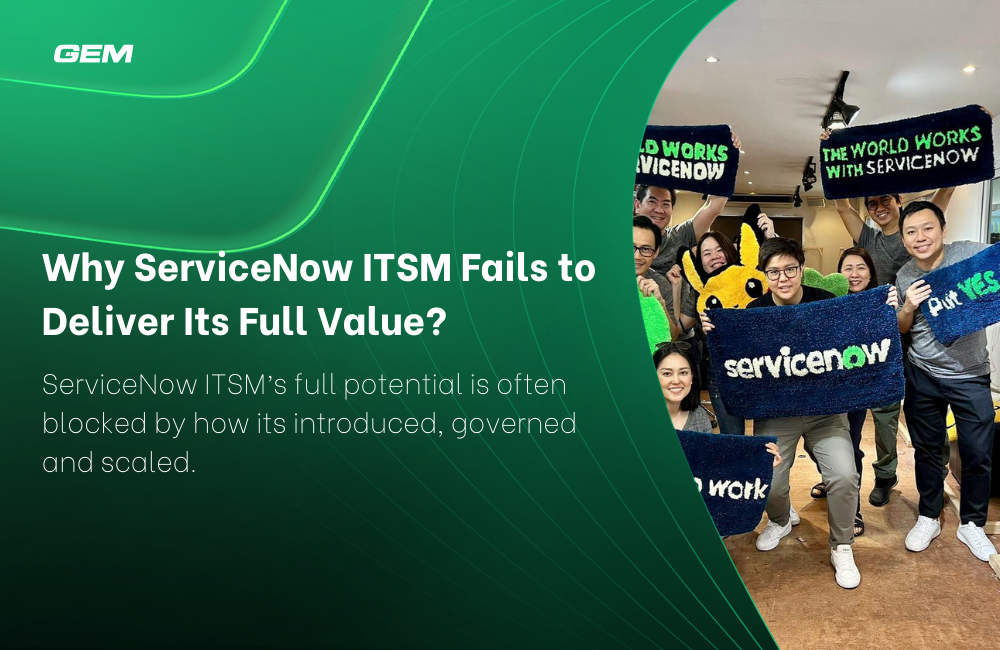
ServiceNow ITSM is designed to streamline operations and improve how IT services are delivered. When implemented with the right structure, it creates measurable improvements across service quality, efficiency, and cost.
Successful implementations bring:
- Operational alignment through consolidated service workflows
- Faster resolution times by replacing manual processes with automation
- Higher user satisfaction through improved response and transparency
- Clearer ROI through structured governance and better data visibility
Still, many organizations fall short of these outcomes. The platform’s potential is often limited not by technical constraints, but by how it’s introduced, governed, and scaled. Misalignment between platform capabilities and internal processes can delay benefits, create complexity, or lead to missed opportunities. The next section outlines the common setup mistakes that contribute to these gaps and how they can be avoided.
Transform Your Business with the Power of Technology
Adopt AI, cloud solutions, and advanced analytics to reimagine your operations and stay ahead of the competition. Let’s future-proof your business together.
What Good Looks Like: The Business Case for ServiceNow ITSM
When ServiceNow ITSM is implemented with strong alignment between business priorities, governance, and user needs, the results are measurable and sustainable. At its best, the platform becomes a central operating layer that connects IT to the rest of the enterprise, improving service quality, accelerating response, and reducing friction across teams.
Here’s what successful ServiceNow ITSM adoption delivers:
- Operational consistency: Standardised workflows replace fragmented processes, reducing variation across teams and regions.
- Faster resolution times: Automation and structured routing cut delays in handling incidents, changes, and requests.
- Improved user satisfaction: Employees experience greater transparency and responsiveness, leading to better engagement and fewer escalations.
- Actionable data: Built-in reporting surfaces trends across services, helping IT leaders monitor demand, performance, and capacity.
- Better return on investment: With strong governance, reusability, and process coverage, organisations increase usage while containing cost.
These outcomes don’t result from the platform alone. They depend on the quality of implementation decisions, internal readiness, and ongoing platform stewardship. Avoiding setup pitfalls is just as important as unlocking new features.
6 Common Pitfalls in ServiceNow ITSM Setup (+ Tips to Avoid)
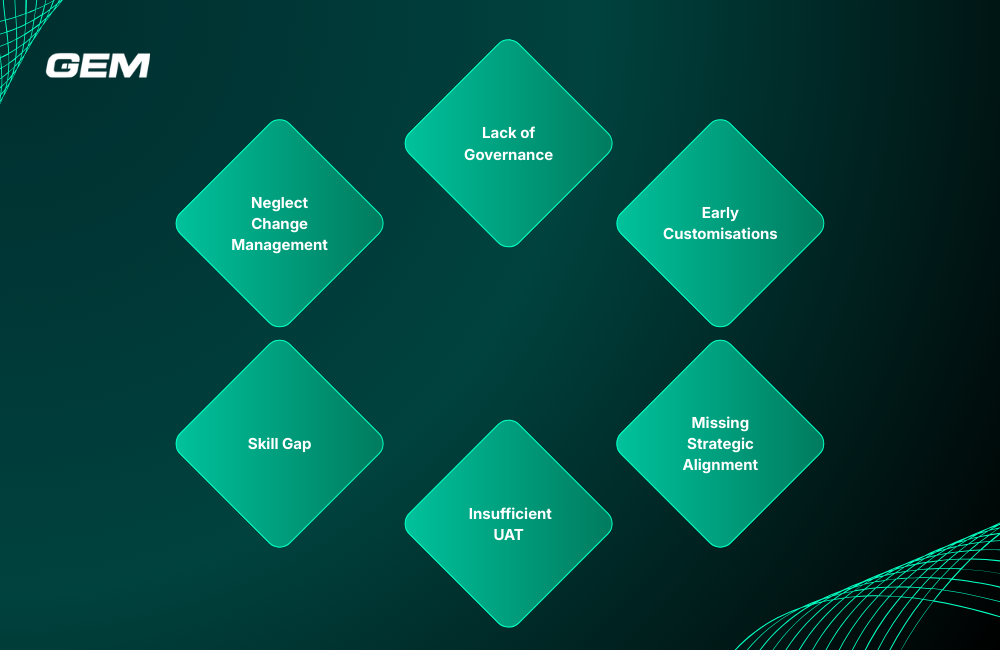
While many articles summarise ITSM setup risks in five points, our experience shows that limiting the list often overlooks a recurring issue: early customisation decisions. Based on real-world implementation patterns, this article highlights six common pitfalls that consistently impact ServiceNow ITSM outcomes, each with practical steps to avoid them.
1. Neglecting Change Management Undermines Adoption
Change resistance is often overlooked in platform rollouts. Employees rely on familiar workflows, and even well-designed systems face pushback when internal communication and training are delayed or poorly executed.
Observed pattern: When users are engaged early, through naming initiatives, early access programs, or simple gamification, adoption improves. Without this, frustration sets in quickly, and the platform is seen as a barrier rather than an enabler.
How to avoid it:
- Scope OCM explicitly at the start of the project and assign ownership.
- Allocate budget for internal engagement activities, not just technical delivery.
- Use interactive formats, such as naming contests, role-based demos, or pilot groups, to build internal momentum.
- Prioritise training for administrators and business users, not just developers.
If ignored:
- Users bypass the platform, reverting to email or shadow systems.
- IT support demand increases as users struggle to adjust.
- Business outcomes are delayed due to poor platform perception.
2. Lack of Governance Creates Demand Chaos and Debt
ServiceNow’s flexibility is a strength, but without disciplined intake and oversight, it becomes a liability. Post-launch, demand for enhancements often surges. Without clear governance, teams prioritise based on urgency, not impact.
Observed pattern: In the absence of structured review, quick fixes accumulate. Over time, technical debt slows delivery, increases costs, and introduces risk.
How to avoid it:
- Define governance roles across three levels: strategic (sponsorship), demand (intake and prioritisation), and technical (design standards).
- Set up a backlog review rhythm where cross-functional leaders assess enhancements against business goals.
- Involve enterprise architects to validate alignment with broader technology strategy.
If ignored:
- Duplicate functionality, inconsistent user experiences, and unstable integrations.
- Burnout in IT teams from unfiltered demand.
- Reduced stakeholder trust due to inconsistent delivery.
Bring your ideas to life faster than ever before
Our agile solutions streamline workflows and cut time-to-market, helping you launch innovations quickly and confidently.
3. Early Customisations Introduce Long-Term Complexity
Many organisations feel pressure to replicate legacy processes immediately. This often leads to unnecessary customisations that complicate upgrades, increase support effort, and dilute platform value.
Observed pattern: Teams bypass out-of-the-box capabilities without fully exploring what’s already available, leading to duplicated work and fragile code.
How to avoid it:
- Build a “configure first, customise later” mindset into delivery governance.
- Use ServiceNow’s standard workflows unless a business-critical gap is identified.
- Establish a review process for any proposed customisation, with clear criteria for approval.
If ignored:
- Higher support costs, upgrade delays, and reduced agility.
- Hidden dependencies that block future enhancements.
- Difficulty onboarding new admins due to complexity.
4. Skill Gaps in Admin Teams Slow Platform Maturity
Skilled platform administrators are essential to long-term success. Without them, even small changes become bottlenecks, and poorly designed workflows erode platform performance.
Observed pattern: Where internal skills are limited, teams either over-rely on external partners or make changes that create downstream issues (e.g., ungoverned flows, broken integrations).
How to avoid it:
- Prioritise structured training using ServiceNow’s on-demand modules.
- Engage ServiceNow’s IMPACT team early to assess capability gaps and build learning plans.
- Pair internal teams with external partners for knowledge transfer and mentoring.
If ignored:
- Excessive reliance on contractors for basic tasks.
- Accidental misconfigurations that degrade performance.
- Slower delivery cycles due to limited internal capacity.
5. Insufficient UAT Leads to Defects and Delays
UAT is often reduced to a checklist item, with untrained users expected to validate workflows they’ve never seen. This creates a false sense of readiness and leads to avoidable defects post-launch.
Observed pattern: Guided UAT, where IT walks users through key workflows in real-time, leads to better feedback, faster resolution, and stronger business buy-in.
How to avoid it:
- Combine UAT with contextual training to give users confidence in what they’re testing.
- Schedule collaborative sessions after sprint showcases to validate functionality in small increments.
- Capture feedback live and log it directly into the backlog for tracking.
If ignored:
- Testing delays, missed bugs, and end-user confusion.
- Post-launch support spikes as gaps emerge.
- Poor user sentiment and adoption risk.
Read more: ServiceNow ITOM vs. ITSM: Key differences & similarities
6. Missing Strategic Alignment Limits ITSM Value
Treating ServiceNow as a set of disconnected tools rather than a platform leads to fragmented outcomes. Without a roadmap, enhancements are reactive and misaligned with business priorities.
Observed pattern: Teams with a clear, evolving roadmap make better investment decisions, protect platform integrity, and scale with purpose.
How to avoid it:
- Create a roadmap tied to strategic business goals and revisit it quarterly.
- Use the roadmap to prioritise development, guide governance, and track performance.
- Define success criteria tied to usability, adoption, and business outcomes.
If ignored:
- Underused modules, rising costs, and fragmented user experiences.
- Poor alignment between IT and business stakeholders.
- Missed opportunities to scale platform value across functions.
Why Wait? Start Your Digital Transformation Today
Don’t let outdated systems hold you back. With our expertise, you can streamline your operations, embrace innovation, and see measurable results faster than ever
GEM Corporation – Your ServiceNow Implementation Partner

GEM Corporation is an official ServiceNow Consulting Partner with a proven track record in delivering scalable, outcome-focused ITSM implementations across diverse industries. Since 2014, we’ve supported enterprises in Japan, APAC, and Europe with high-performance technology solutions built for long-term value.
Our ServiceNow practice is shaped by a clear delivery philosophy: speed, quality, and reliability. With over 400 IT professionals and certified ServiceNow specialists, we help clients move from legacy IT workflows to structured, ITIL-aligned service operations. Whether the goal is to centralise service management, streamline change control, or improve incident response, we bring the technical depth and delivery discipline to support it end-to-end.
GEM’s ServiceNow capabilities span end-to-end ITSM delivery, including implementation, platform optimisation, and roadmap-driven governance. We support integration with enterprise systems, develop custom applications on the Now Platform, and provide ongoing platform management. Our team also works across extended modules such as ITOM, ITAM, HRSD, CSM, and SecOps, helping clients scale ServiceNow as a unified platform for digital operations.
As an ISO/IEC 27001:2022, ISO 9001:2015, and CMMI Level 3 certified organisation, and an ISTQB Gold Partner, we approach ServiceNow projects with enterprise-grade process control and a commitment to measurable outcomes.
Our clients value us not just for the technical build, but for the way we drive clarity, adoption, and long-term platform sustainability.
Conclusion
Many ServiceNow setup implementation pitfalls stem not from the platform itself, but from avoidable missteps around governance, change management, skills, and planning. Organisations that approach implementation with a clear roadmap, strong internal capabilities, and disciplined execution are more likely to realise the platform’s full potential. From early-stage configuration to long-term scaling, success depends on business alignment, user engagement, and operational clarity.
To discuss how GEM can support your ServiceNow implementation or review your current setup, contact us directly.
How can organisations avoid over-customising ServiceNow early on?
Start with standard capabilities and evaluate customisation requests through a governance process. Align changes with business outcomes and assess long-term impact before implementation.
What role does OCM play in ServiceNow success?
Organisational Change Management helps users adopt the platform effectively. Without it, adoption slows, sentiment declines, and the benefits of the platform are delayed.
What’s the value of having a ServiceNow roadmap?
A roadmap connects platform development to business strategy. It guides prioritisation, supports governance, and ensures the platform evolves with organisational needs.
How can GEM support our ServiceNow implementation?
GEM offers end-to-end ServiceNow services, from ITSM setup and optimisation to platform governance, integration, and ongoing support. With certified consultants and enterprise delivery standards, GEM helps clients avoid common pitfalls and build lasting value.